What the 2021-22 Budget Means for Young Aussies
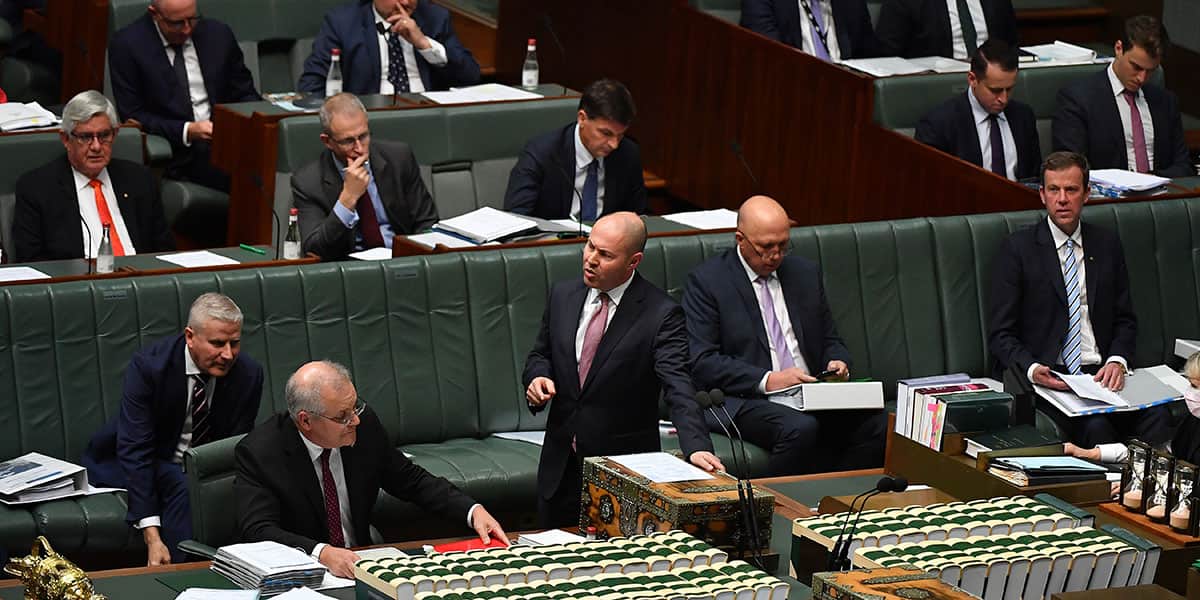
Hint: low to middle income earners are a winner this year.
Last night, the federal government announced their plans for the 2021-22 budget, and boy are there some important points that young people should note.
While the political party in government hasn’t changed since last year, there are some major differences in this year’s spending.
So, we’re here to break down how much money young Aussies will and won’t be getting back, and where some of those dollars will go to help you over the next 12 months.
Young workers and students
Starting off with young people’s issues: the government is funnelling an extra $500 million into the JobTrainer program, which plans to create around 163,000 jobs and reduce the rate of unemployment, which is currently at a scary 11.8 per cent.
The extra money put into JobTrainer will mean that more young people can upskill for free—or at much lower fees—so that they are more employable in a COVID world.
On top of JobTrainer, the government’s apprenticeship wage subsidy scheme is getting a tasty boost of $2.7 billion to help create 170,000 new positions.
But all that moolah is gonna go straight to employers which means there’s no guarantee that apprentices will be kept on after their training finishes or when the subsidy ends.
There is also a bright side for students that aren’t keen on TAFE, uni or apprenticeships too. The government is putting $21 million towards 5,000 extra short courses, so you can skill up nice and quick.
Finally, JobMaker is still sticking around, so businesses will have an incentive to hire young workers, however, it’s looking like it will only support about 10,000 jobs instead of the 450,000 that was promised in 2020.

Young taxpayers
Next on the list is taxpayers, specifically low and middle income earners (yeah this is most young people ngl).
Last night the government announced that they would be extending the “Low and Middle Income Tax Offset” for another year.
This means that the tax rebate (which you can learn more about here) is going to be worth slightly more than usual. Essentially, low and middle income workers will get more money back at tax time.
So, if you earn $37,000 or less, your offset will be $225.
If you take home between $37,0001 and $48,000 a year, your offset will be $225 plus 7.5 cents for every dollar above $37,000. But it does cap at $1,080.
Wage earners between $48,001 and $90,000 will get an offset of $1,080.
And those earning between $90,001 and $126,000 will get an offset of $1,080 minus three cents for every dollar above $90,000.

International students
Unfortunately, it’s looking like we won’t get to see any of our international buddies back in Aussie schools or unis any time soon (2022 maybe?) thanks to the border closures.
However, the government is giving international students that are already here a decent hand.
Remember how international students could only work a limit of 40-hours per fortnight? Well, it’s going in the bin.
This means that international students who have been stuck in Australia can now work full-time hours and have the opportunity to earn enough to support themselves. This is a huge relief.
Plus, the NSW and VIC governments are considering bringing in some international students via special programs that will avoid hotel quarantine. These could start sometime later on this year, so keep an eye out.

Universities
Unfortunately, universities will be losing out a bunch in this year’s budget.
Not only are they feeling the pain from losing international students, but there is still no clarity about when the borders will reopen and whether or not the coronavirus vaccine rollout will help bring more international students back to Aussie shores.
To make matters even worse, the budget actually contains no specific funding for universities, so educational institutions are losing out big time in 2021.
Mental health
Last year, we watched a big load of budget money go towards mental health due to the effects of lockdown and coronavirus, and this year, that funding is set to continue.
An extra $2.3 billion this year is being put towards the National Mental Health and Suicide Prevention Plan (big yes).
It is set to be divided into five key areas starting with $250 million being invested into early intervention including platforms for online counselling, referrals and clinical support.
$1.4 million will go to treatment and treatment centres for adults, young people and kids.
Indigenous Aussies and vulnerable Australians will also get an extra $107 million, which is awesome news.
Plus, $202 million will go into the mental health workforce. This will mean more scholarships and clinical placements for nurses, psychologists and allied health practitioners.
So, if you’ve been putting off talking to a professional about your mental health, now’s a great time to start.
Women
This year, women are getting a really decent slice of the budget, which is very different to what was promised last year.
Women’s health is getting a major boost of $354 million which will be spread across heaps of areas.
This will include improving cervical and breast cancer screening, extending free mammogram services, adding $47 million towards postpartum depression services, $95.9 million on embryo screening for IVF and $13.7 million to reduce pre-term birth rates.
There will also be $27 million put towards mental health to reduce eating disorders as well as $21.6 million on education and endometriosis.
This was a big one at the top of the government’s list due to the criticism they received earlier in the year about the treatment of women in the workplace, specifically parliament and schools. $998 million is going towards reducing domestic and family violence, as well as support for survivors over the next four years. $320 million will also go to consent and respectful relationship education over the next four years (woo!).
Plus, the government is setting up new trial programs to help women flee violent relationships by giving them up to $5,000 in assistance.
In education, there is still a major push for investments into women in STEM with $42.4 million going to scholarships for high level STEM qualifications over the next four years.
Gaming
In an unlikely turn of events, the gaming industry in Australia is getting a nice boost.
The government announced that they will be introducing a 30 per cent refundable Digital Games Tax Offset in an attempt to attract some of the global game market—and its money—into Australia.
Only eligible businesses that spend at least $500,000 on gaming expenditure are able to get it though.
The exact details on the whole thing are still being ironed out at the moment, but the government’s plan is to spend $1.2 billion on measures to improve Australia’s digital tech and economy.

The environment
Finally, we come to the issue on most Gen Z's minds: the environment.
This area is a bit of a winner and loser this year, with no money being put towards any renewables but $100 million going towards ocean protection.
There are still no commitments to net zero emissions by 2050, which is super disappointing but there is some money going towards pilot programs that encourage people to take up environmental protection on private land.
The government is also looking to spend $10 million to protect 10 Aussie species, including the beloved platypus.

Aaaand that’s a wrap. There are a bunch of other things that the government has put their money towards this year but it’s stuff that isn’t really interesting to young people and students.
But if you want to learn more about the budget you can find out all the extra details here.
Header Image: Sam Mooy via Getty Images
Topics
Ref: bda1f3cf-3d4a-447e-bc9d-ad260065a57a





Comments & Feedback
Share your opinion
Emoji cheatsheet Formatting Comment guidelines