What the 2020-21 Budget Means for Young Aussies (AKA How Much You Will and Won't Get Back)
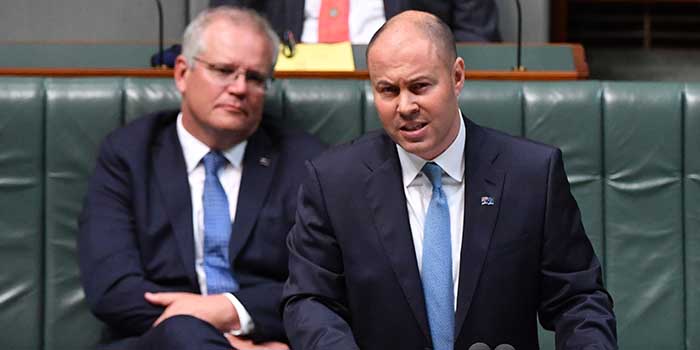
Money is flying everywhere. Will it land in your pocket?
The federal budget can be kind of tricky to navigate, but with Australia in its biggest recession in a long while, the recently-delivered budget for 2020 – 21 is a really important one to know the ins and outs of.
So, to make your life a little bit easier, we’ve broken down what changes are being implemented, who they benefit, who they disadvantage and how it might affect you.
Education
With a lot of news being spread about the cost of degrees and changes to HECS this year, higher education is a hot button topic that we’ve all been anxiously waiting to hear about in the new budget.
The federal government expects the demand for places at university to rise over the next 12 months, so they plan to provide an extra $299 million for 12,000 undergraduate spots.
There will also be support for an extra 50,000 short online courses in teaching, science, health, agriculture, and information technology.
Those who are looking to start a traineeship or apprenticeship are in luck because the federal government will also provide $1.2 billion for businesses to employ 100,000 more apprentices and trainees.

Jobs
Jobs and welfare payments are getting some surprising and not so surprising changes this coming year.
As expected, JobKeeper payments are still set to end 28 March 2021 and there will be no changes to the current JobSeeker rate at just $40 a day.
The government is however introducing the JobMaker scheme which the government expects will support 450,000 jobs.
This is different to JobKeeper and JobSeeker though, as money won’t be put directly into employee’s pockets. Instead, employers who hire eligible employees aged 16 to 35 will be paid $200 a week for those aged under 30 and $100 a week for those between 30 to 35, for up to 12 months for each new job. These payments to employers will encourage businesses to hire more young people as a priority, which is great if you're looking for work, but don't expect additional payments in your account like you got with the coronavirus supplement.
New employees are required to work a minimum of 20 hours per week and must have been receiving at least one form of welfare payments in the last three months. These include JobSeeker, Youth Allowance and the Parenting Payment.
There will also be more support for women in jobs as the majority of people who lost their work during the pandemic were women. The government plans to provide $231 million over four years to fund a second Women’s Economic Security Package.
This funding will assist grants in women’s leadership and development programmes, fund a Women in STEM program to support 500 women to complete advanced diplomas, and a Respect@Work Council will be established to address and combat workplace sexual harassment.

Taxes
If you’re likely to pay any income tax over the next 12 months, you’ll be glad to know that 11 million Aussies will be getting a tax cut. Even better, the cut will be backdated so once legislation has passed, taxpayers will receive a little extra money direct to their bank accounts.
Low to middle income earners will see more of their income on their payslips as the 19 per cent tax rate threshold will rise from $37,000 to $45,000 and the 32.5 per cent tax rate threshold will go up from $90,000 to $120,000. This means that those who earn between $45,000 and $90,000 each financial year will get an extra $1080 back at tax time.
The economy
The state of our economy affects everyone within the country, especially those who are looking for work or are at a high risk of losing their jobs due to events like the pandemic.
Over the last six months, the economy has taken a pretty big hit. As a result of coronavirus and our society pretty much having to shut down for a number of weeks (and even a number of months in some states) we have seen the worst recession in the country since the end of World War II.
The deficit was predicted to hit $213.7 billion this year and drop to $66.9 billion by the 2023 – 24 financial year, but now it is expected to reach a whopping $703 billion this year and peak in 2024 at $966 billion.
Although the debt may not be felt by everyone just yet, eventually the government will seek to bring down debt and return the economy to a surplus by collecting more money through taxes, so even though we're getting tax cuts now, over the coming decade we may get stung with more taxes and less generous spending, so brace yourselves.
Health
The healthcare sector is getting some pretty good boosts this coming financial year as we see more focus on mental health, pregnancy, vaccines and cancer research.
Firstly, mental health services are getting a huge overhaul, with an extra $148 million put towards mental health in regards to the coronavirus impact. This means that the number of Medicare-funded psychological services will jump from 10 to 20.
There will also be more funding provided to headspace, Lifeline, Beyond Blue and Kids Helpline totalling an extra $5.7 billion in mental health support.
For expectant parents, the government has relaxed the rules for government paid parental leave because of the impact that the pandemic had on jobs.
Normally, parents must have worked a minimum of 10 of the previous 13 months before giving birth or adopting a child, or they will become ineligible for the payment. Now it will change so that new parents from 22 March 2020 and 31 March 2021 will still receive the payment if they have worked 10 out of the last 20 months.
Cancer research and funding will also get a lift as an extra $9 million is put towards child and young adult cancer research. The drug Lynparza used in the treatment of ovarian cancer will also be added to the Pharmaceutical Benefits Scheme (PBS) so that it is more affordable for patients.

The National Disability Insurance Scheme (NDIS) is also set for a boost of $3.9 billion to support more people living with disability.
Finally, there will of course be money put towards vaccines in the coming months. Specifically the federal government will put $1.7 billion towards research at the University of Oxford and the University of Queensland for COVID-19 vaccines.
There has also been another $10 million put aside for the CSIRO to fast-track the COVID-19 vaccine in Australia as soon as it becomes available.
Environment
An important topic on all of our minds the last few years has been the environment and the climate crisis. The new budget has demonstrated some wins and some losses for the planet for the coming year, so let’s take a look.
The Commonwealth National Parks will get a huge investment of $233 million to upgrade facilities in Kakadu, Uluru, Booderee National Park and Christmas Island.
The environment will see $1.8 billion provided to restore mangroves, sea grasses and tidal marshes to protect and re-establish Australian oceans.
Recycling will also get a lift as $250 million will be put towards infrastructure to stop over 600,000 tonnes of waste going to landfill.
On the downside, the budget hasn’t included any clarity about when Australia plans to achieve zero carbon emissions but there will be $1.9 billion to fund lower emissions and renewable technologies. Although, for some renewables like wind and solar, the government has cut off their federal financial support because they are now considered "mature technologies".

Housing
While we keep being told that houses will forever be out of our reach because of our avocado addiction, first homebuyers are in for a little extra help thanks to the governments expansion of the government's First Home Loan Deposit Scheme.
10,000 first home buyers will get access to the scheme which will allow them to borrow money for a mortgage, and avoid lenders mortgage insurance, with just a 5 per cent deposit.
There will also be an extra $1 billion put into low cost finance for the construction of affordable housing and another $150 million will be made available to the Indigenous Home Ownership Program for the construction of new homes in regional locations.

Travel and immigration
Much like the environment, travel and immigration have some wins and many losses this year, because a lot of tourism has been forced to be put on hold thanks to the pandemic. This budget has a specific focus towards domestic and regional travel.
The government will give $250 million towards regional tourism and $6 million over the next two years to support local tourism operators, tourism to the Great Barrier Reef Marine Park and $2.2 million to aid the Reef HQ Aquarium in Townsville.
For now, it also looks like international borders won’t be re-opening until the end of next year, and some state borders, like Western Australia's, are set to stay shut until 2021.
Unfortunately, the number of refugees being accepted into Australia under our humanitarian program will drop by 5000. The government plans to save $958 million over the next four years by capping the rate that Australia accepts at just 13,750 per year.
While there is a lot to unpack here, there is still a lot of information on the funding for areas such as infrastructure and defence, which you can check out on the government’s budget website.
Header Image: Sam Mooy via Getty Images
Topics
Ref: e5aaa8cc-1ff8-46af-8448-ac4d0059285b



Comments & Feedback
Share your opinion
Emoji cheatsheet Formatting Comment guidelines