Rogue Facebook Employees Fighting To Get Rid Of Fake News, Following Trump Victory
The ramifications of Donald Trump being elected President of the United States are indeed far reaching. So much so, it may result in a change to your Facebook feed.
Facebook has come under fire in the wake of the election for their role in promoting fake news stories that may have misled voters.
And no, we’re not talking about satirical stories from The Onion or ClickHole.
Rather, fake stories like this eyebrow-raiser:
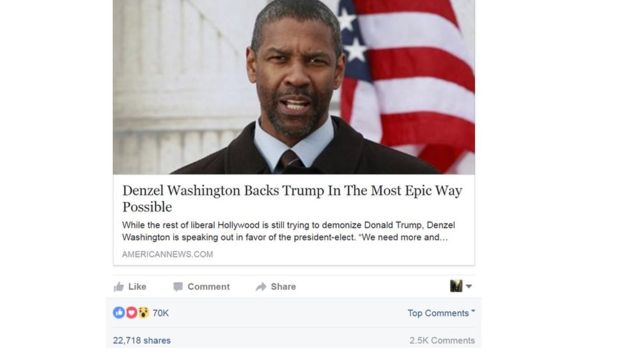
(Note that this is one of the softer examples. Other fakes alleged Hillary Clinton straight-up murdered people.)
Denzel’s publicist confirmed to BBC News that the story is “100% complete fabrication.”
Nonetheless, it had been shared more than 22,000 times before being removed this week.
When Facebook fired their ‘Trending’ team earlier in the year, partly in response to claims by Republicans that the selections were politically-skewed, the algorithm that ranked top stories ended up prioritising fake articles like the 'Denzel Endorses Trump' tale above.
Mark Zuckerberg responded to criticism via – you guessed it – a Facebook post.
“Of all the content on Facebook, more than 99 per cent of what people see is authentic,” he wrote.
“Only a very small amount is fake news and hoaxes. The hoaxes that do exist are not limited to one partisan view, or even to politics. Overall, this makes it extremely unlikely hoaxes changed the outcome of this election in one direction or the other.
“That said, we don't want any hoaxes on Facebook. Our goal is to show people the content they will find most meaningful, and people want accurate news. We have already launched work enabling our community to flag hoaxes and fake news, and there is more we can do here. We have made progress, and we will continue to work on this to improve further.”
However, a group of “renegade” employees are working on more drastic means to combat fake new stories, according to a report by Buzzfeed.
Dozens of Facebook staff members have formed an “unofficial task force”, in response to the dissatisfaction “hundreds” of fellow employees feel about the company’s approach to fake news. It's a lot like Rogue One, they're probably telling themselves.
“It’s not a crazy idea [that fake news influenced the election],” said one anonymous representative to Buzzfeed.
“What’s crazy is for [Zuckerberg] to come out and dismiss it like that, when he knows, and those of us at the company know, that fake news ran wild on our platform during the entire campaign season.”
Google has already taken action against fake news, pledging to ban websites that publish such stories from using the search engine’s online advertising service.
Facebook similarly updated the language in its Facebook Audience Network policy to clearly indicate it will not show ads for fake news sites.
But is that enough?
Mashable, in a piece partly titled “Facebook failed America this year”, has recommended FB do away with the News Feed entirely, noting the jarring contrast of legitimate news next to fake news.
“In other words,” author Damon Beres writes, “a bit of dissonance happens when you put a great piece of journalism next to something that, well, isn't. Say you bought a biology textbook that had a full-page ad for Scientology in the evolution chapter — you'd be kind of like, ‘what?’”
Mashable admits that it’s not so simple to get rid of the News Feed, given it’s the “spine of the entire Facebook product as we know it.”
But hey, maybe that task force can figure something out.
Photo: Sony.
Topics
Ref: acbef709-15f1-42fb-b23c-a6c00023182d
Most Popular


Comments & Feedback
Share your opinion
Emoji cheatsheet Formatting Comment guidelines
Hi Simon, Sorry this is going to sound a little hostile, but did it not occur to you that you are being slightly hypocritical, providing an echo to Damon Beres' comment about Scientology? Actually, there is nothing at all odd about an ad for Scientology alongside an article about evolution (or at least, any more odd than any ad in a textbook).
It may SEEM odd, based on all the false information or about Scientology or quotes taken out of context that get regurgitated around social media. I assume your echo'ing of Beres' misleading information was unintentional, so I guess in a way you made your point. But it is unfortunate. Of course, you could easily troll the net and find ammunition with which to refute my comment. But there is a difference between looking to find facts that prove one's rightness, and simply looking and observing what one sees. An understanding of Scientology could actually contribute significantly to a student's understanding of evolution. But looking at anything is difficult when the starting point is a fixed idea. Prejudice, etymologically speaking, means to pre-judge. i.e., judging before an honest, unbiased examination.
Having said all that, your article raises another interesting point. I don't know what you were doing back in 2008. But much of the false information about Scientology on the web was started by the Anonymous group. At the time, they claimed that they were offended because Scientologists were trying to correct what they (needless to say, "we") felt was false information about Scientology. We were berated for attempting to "censor" information. Perhaps you remember the silly slogan, "information wants to be free."
However, now, in a different time and with different subject matter, another group (Hillary supporters) are upset with false data on the Internet and suddenly many of the people who once proclaimed that "information wants to be free" are now unhappy to be on the receiving end of false information.
Please don't misinterpret this to mean I am a Trump defender. Far from it. But the subjects of freedom of speech and censorship cannot be intelligently discussed without also considering the elements of responsibility and consequences.
And now, having written far more than I intended, I'll say good night, and wish you well in your journalistic endeavors. Or, "endeavours," if you prefer.