Have You Read "Harry Potter and the Cursed Child" Yet? Of Course You Have: Let’s Talk About It
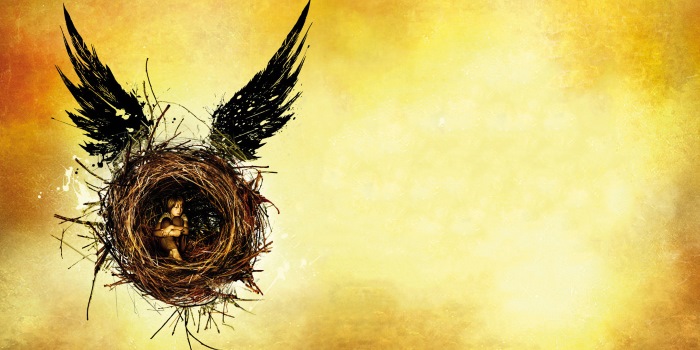
Here's our (kind-of) review of J.K. Rowling's latest project. Don't worry, we'll warn you before spoiling anything.
Unless you’ve been struck with a confundus charm, you’re probably aware that a new Harry Potter book was released over the weekend.
Only, it’s not a book. Not really. It’s not even written by J.K. Rowling. But it does tell a new Harry Potter tale, which makes it more official than Rowling’s Potter-adjacent Fantastic Beasts and Where To Find Them (the mock Hogwarts textbook that’s getting its own movie trilogy, because $$$).
Harry Potter and the Cursed Child is a new stage production that’s been mounted in London’s West End, and it’s apparently so epic it can only be staged in two separate parts. That’s four acts, told over multiple nights. Seems playwrights Jack Thorne and John Tiffany share Rowling’s disdain for brevity.
After making a comment like that, it’d be contradictory to waffle on when reviewing the published script for The Cursed Child; the aforementioned unbook that reminded people there is such a thing as brick and mortar bookstores, and that you can line up in front of them at midnight while wearing a wizard’s cloak and not be arrested for suspicious behaviour (as many did on Sunday).
Consider this, instead, a safe space to discuss its winding, time-twisty narrative, which takes place 19 years after the events of Deathly Hallows, with Harry, Ginny, Hermione and Ron (all married, in the pairings you’d expect) in their mid-30s and wrestling with parenthood and the potential return of He Who Must Not Be Named. (No, not him, the other one.)
Spoilers, ahoy. Seriously, if you have any intention of reading the script, or ripping off Gringotts to pay for a trip to London, do not read on.
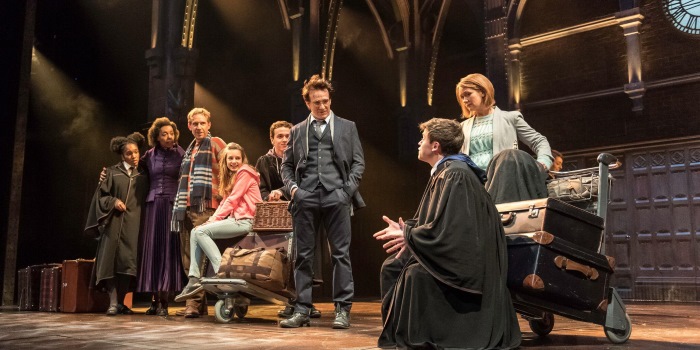
For instance, was it a worthwhile risk for Rowling – who helped devise the story but handed the actual writing reins over to Thorne and Tiffany – to return to the Time Turner device of Prisoner of Azkaban? Also, does it even make sense to have multiple timelines, one in the changing past and one in the unchanged future, occurring concurrently? Or, are we meant to believe that all previous established rules of time travel – that the past cannot actually be changed – are thrown out the window once a user goes back beyond the recommended five hours?
Side note: Considering how complicated this already was going to be as a live production – replete with live owls (well, for a little while) and dangerous lighting effects – attempting to stage time travel sequences, with multiple versions of the same characters, must have been a logistical nightmare. Respect, Thorne and Tiffany. Game recognise game.
We have more questions. How quickly did you pick Delphi as… (again, spoilers a’ coming, so get out of here, masochists!) Voldemort’s daughter? Even if you didn’t figure it out immediately, we’re going to assume you cottoned on to her malevolent intentions before Albus Severus, Harry’s frustratingly love-dumb son. C’mon, kid; forgetting the fact that she’s basically the Antichrist, she’s nearly ten years older too. Scorpius Malfoy has a better shot with Rose Granger-Weasley, and that’s even before he gives himself the nickname “Scorpion King”.
On that note, is Scorpius saying he’s “engorgimpressed” the absolute worst bit of wordplay in the entire Harry Potter series? That is seriously saying something.
Though dialogue is not Thorne or Tiffany’s strong point (like Rowling), they have indeed crafted an evocative, engrossing play, and the entire third act – set in the alternate realm in which Harry is dead, Voldemort rules, Snape remains alive/ annoyed and Scorpius, the true hero, rises – is darkly captivating. It also contains my favourite passage, evoking gory tween-vampire drama Let the Right One In (which the playwrights also adapted for the stage).
Scorpius: What is that screaming?
Polly Chapman: Mudbloods of course. In the dungeons. Your idea wasn’t it? What’s going on with you? Oh Potter, I’ve got blood on my shoes again…
Rowling has said that Cursed Child is the end of Harry Potter’s trials. Was it worth going back for one final crack, or would you have preferred if events wrapped-up with Deathly Hallows?
Though it was indeed a bummer to see Harry relegated to middle-aged angst, the final, moving moments of Cursed Child that reckon with his parents’ death convey the honourable burden of parenthood better than any previous instalment; it’s made all the more powerful that he shares the moment with his own son – at least two of the titular “Cursed Children” (though, you can probably offer that nickname to literally every character in here).
For those closing scenes alone, and the honesty with which Harry and Albus’ years-long fracture is approached, you have to concede that Cursed Child at least offers a more satisfying ending than the movie series (apologies to Daniel Radcliffe’s makeup artist).

Or maybe I’m way off and the play borked Harry Potter for good?
Let us have it in the comments section below. Give us your verdict on Harry Potter and The Cursed Child.
Photo: Manuel Harlan.
Topics
Ref: 0203b16e-119a-4a8f-b188-a656008f3e6f
Most Popular



Comments & Feedback
Share your opinion
Emoji cheatsheet Formatting Comment guidelines
I like it so, that's that. You're welcome everyone I am sure you dearly wanted my opinion ;)
I know that there was a lot of mixed reviews about this book, but i must say, I really enjoyed reading it. I found that it read quite fluently (which I wouldn't have expected from a script), and it didn't take long to read at all, so I was able to read it over 2 days in between my daily jobs.
I have read the script and I don't know wether I like it or not. I think the series didn't need it but it was nice to read anyway. I feel as though seeing the play would be very enjoyable, more so than reading the script.