Review: Surrender To The Future-Shock Of “Black Mirror” Season 3
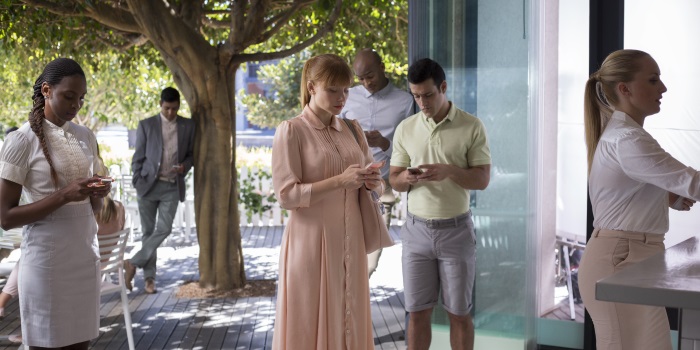
Charlie Brooker's pitch-black satire Black Mirror comes to Netflix. Mercifully, he offers a dash of hope within its bleak 'could-be' realities of the near-future. Still, it gets grim.
“I didn’t expect to find myself living in the future, but here I f***ing well am.”
So says Kelly Macdonald’s bafflingly techno-illiterate detective in the sixth and final episode of Black Mirror’s third season (now streaming on Netflix).
How a disaffected thirty-something officer in a major city got this far in her career without happening upon trolls and Twitterbots might be the show’s biggest mystery. But her exclamation rings true.
Any reasonable viewer watching the unfolding events of the program’s standalone episodes – always set just a few weeks, months or years from today – would think, “us too.”
Charlie Brooker’s despairingly dark ‘Twilight Zone for the technological age’ has been given new life on Netflix, following two series of three episodes (plus a Christmas special) on the UK’s Channel 4.
This third season comprises six episodes, each one disconnected from the others, yet joined in spirit. The narratives and universes are unique to each entry; the styles, independent in kind. (Meaning, you can start anywhere you choose.) That said, there’s no mistaking Black Mirror for anything else on television.
The thrust of Black Mirror is that technology makes life simpler - and more immoral - by detaching us from the world and all those icky feelings that come with it. Brooker, with his devastating vignettes, holds up a… don’t make me say it… forcing us to acknowledge how we could so easily slip into dangerous habits with the aid of these devices (if we’re not there already). When the measurements of sci-fi, satire, pathos and scolding in each individual concoction are slightly off, the result leaves a bad taste. When it works, it works terrifyingly well.
Most famous for predicting, in part, our obsessive social media consumption, the rise of Trumpism and even former Prime Minister David Cameron’s rumoured dalliance with a pig, Black Mirror has a reputation for demented, horrifyingly accurate futurism. Each instalment comes with a devilish twist. It’s irresistible television for self-described sadists – which is actually all TV-watchers these days.
And yet, empathy is the order of the day in Season Three. One ep asks us to pity our worst criminal offenders; another reveals what happens when a technological implant takes empathy out of the equation for soldiers working to expel genetically-inferior “roaches”. More relevant to mass audiences is the season-opener, “Nosedive”, where the ‘five-star’ review function of Uber (and, uh oh, film and TV criticism), becomes a social construct by which we’re all ranked. A 'three' has never seemed more cruel.
Brooker, who has a writing credit on five episodes and a story credit on the above, opens the show’s borders for its transition to the international streaming giant, with half of the season taking place in the United States. That includes “Nosedive”, which invites guest writers Rashida Jones and Mike Schur (Parks and Recreation), giving it the feeling of fan-fiction. Its premise is precisely what someone asked to improvise an episode off the top of their heads would come up with: “Um, maybe a world where people are scored for every interaction?”
Bryce Dallas Howard nonetheless gives a committed, open-hearted performance as a woman desperate to climb the social ladder, like her estranged bestie (Alice Eve), a 4.8. Director Joe Wright gives the mini-movie a polished, pastel sheen. You could call it The Stepford Fives.
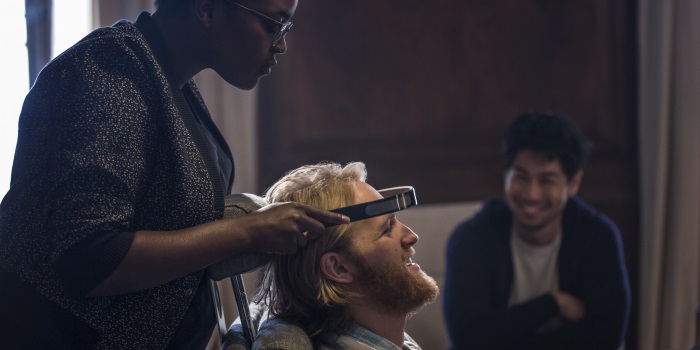
Much better is “Playtest”, directed by Dan Trachtenberg, in which Wyatt Russell’s adventurous thrill-seeker signs up for an experimental augmented reality video game that puts him in an empty mansion he can populate with the ghosts of his mind. It’s deviously funny and genuinely chilling, aided by Russell’s amiable charm (which turns to terror as the plot progresses). Too bad it missed the height of the Pokémon Go trend by literal weeks.
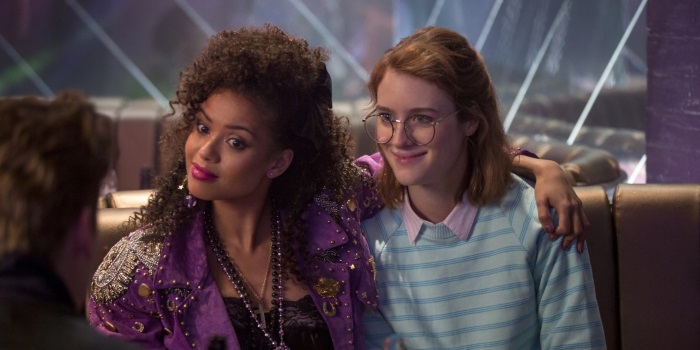
“San Junipero” is its equal; a sumptuous, sublimely art-decorated romance between the lonely, introverted Yorkie (Mackenzie Davis) and vivacious Kelly (Gugu Mbatha-Raw) in a simulacrum of 1987. Director Owen Harris, evoking Michael Mann, brings a neon-tinge to the night-time party sequences. It’s enigmatic and ambiguous, waiting forty minutes to reveal the true circumstances of Yorkie and Kelly’s time-hopping love story. The closing button is remarkably moving – and the song playing over it is given new, goofily euphoric meaning.
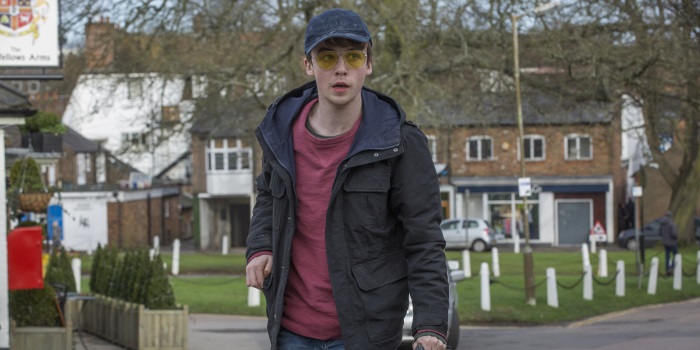
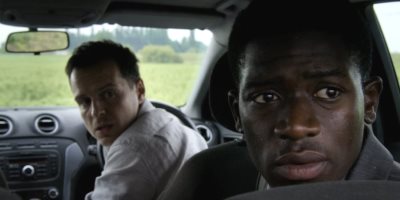
“Shut Up and Dance”, in which a teenage boy (Alex Lawther) and a married man (Jerome Flynn) are forced into collaborating on a series of crimes by cyber-blackmailers, and “Men Against Fire”, a wartime parable, are the darkest and most condescending of the set. They’re interesting subjects with audacious, allegiance-shifting kickers, directed with dread-inspiring panache by James Watkins and Jakob Verbruggen respectively. Both also show Brooker’s worst habits at play. The two of them are “Here. To. Make. A. Point. About. Us. And. Technology.” with the subtlety of an exploding Samsung Galaxy Note7.
The sixth, feature-length episode, “Hated in the Nation”, imagines a world where we’ve replaced bees (basically extinct) with autonomous bee drones that are helping keep our ecosystem alive – but, surprise, they're killing publicly-shamed pariahs too. It’s hysteria-induced future panic and also the basis upon which all great horror flicks are founded. Kelly Macdonald and Faye Marsay – an appealing buddy-cop pair investigating the deaths – help ground it, if James Hawes’ blandly Scandi direction perhaps makes it appear a little too banal given its B-movie inspiration.
Instinctively, we want to call Black Mirror a black comedy (because of Brooker’s rapier wit as a columnist and host of Weekly Wipe), but the laughs come infrequently. In fact, you could accuse the series of being overly-serious. As engrossing as it is, Black Mirror’s nervousness over progress and advancement can seem a little panicky – even silly. (The eye-rolling-est twist comes when someone fails to read a lengthy user agreement.) Still, Brooker's a better - and better-intentioned - dog-whistler than most.
Ultimately, you have to respect Black Mirror’s high risk, high reward storytelling. With this double-order of episodes, there are more opportunities for failure (admirable though they might be). However, when Season Four arrives on Netflix next year, expectations should remain elevated - if only for Brooker's soothsaying. Who knows which public figure he'll predict to rise, fall or become embroiled in another porcine-related controversy?
4/5
Black Mirror is now streaming on Netflix.
Photo: Netflix.
Topics
Ref: 8346eee0-2873-406b-8e96-a6a9003d8863




Comments & Feedback
Share your opinion
Emoji cheatsheet Formatting Comment guidelines