Movie Review: "Tenet" Is Christopher Nolan’s Backwards Bond Movie
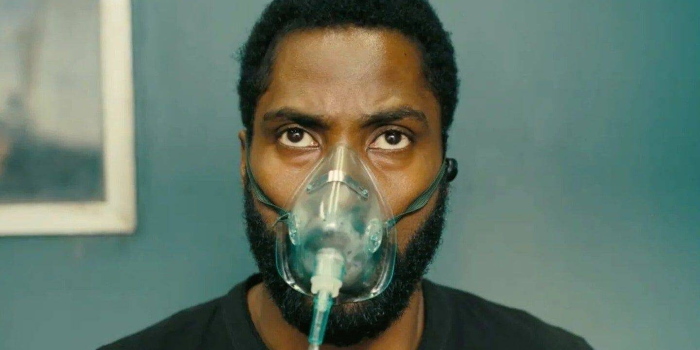
No spoilers. We’re not even sure we could spoil this one if we tried.
Christopher Nolan has too much time on his hands.
He’s the writer-director behind Inception and Interstellar, which both included characters operating at different temporal speeds. He also gave us Dunkirk, which weaved three timelines that crescendoed together. And now comes Tenet, a mystery box of a movie that’s been kept so tightly under wraps that the only words studio Warner Bros. was willing to commit to its tagline were "time runs out". And fair enough. Inception, Interstellar and Dunkirk collectively grossed more than $2 billion worldwide. When Christopher Nolan is involved, time is money.
Can he continue the streak with Tenet, which arrives after multiple delays into a marketplace that’s been rocked by COVID-19, in socially-distanced cinemas that haven’t seen a marquee title since March? And even without the deck stacked against it, would audiences respond to it the same way as they did to his previous blockbusters? The irony may be that, despite the head-scratching premise, Tenet is Nolan’s most conventional film since his straight-down-the-line cop thriller Insomnia. Take away the timey-wimey stuff, and you basically end up with Nolan’s version of a James Bond flick. The thing is, you can’t take away the timey-wimey stuff. It takes you out of the movie instead.
Read no further if you want to know as little about Tenet as humanly possible (or only what the tagline and trailer will allow). You can skip to the end for the star rating, though I’m sure you’ve already made up your mind as to whether or not you’re going to brave the cinemas for it (and that likely has more to do with your health and sense of personal responsibility than what went into your decision to see, say, Bad Boys for Life in January). However, take heart: there really isn’t that much more to Tenet than what has already been revealed. It is indeed about "time inversion" and the threat of an apocalypse. But if you’re seeking a big mid-movie reveal, you’re not gonna get it. As a scientist played by Clémence Poésy tells John David Washington’s unnamed lead Protagonist (as he’s called in the credits), "Don’t try to understand." Done.
The Protagonist is introduced as a CIA operative willing to bite down on a cyanide pill to avoid spilling state secrets. Luckily for him, the pill is a fake, meant to test his mettle. He’s then tasked with finding out about a potential world-ending event, armed only with the codeword 'Tenet' and a hands-clasped gesture that’ll "open the right doors; some of the wrong ones too". That leads him to Poésy’s laboratory, where he is taught about 'inverted' bullets, which have seemingly been planted by future generations to be used in reverse for nefarious means. What follows is the biggest information dump ever put on screen, as multiple people try to untangle the idea of "reversing the flow of time". Protagonist may be the main character, but Exposition is the real star.
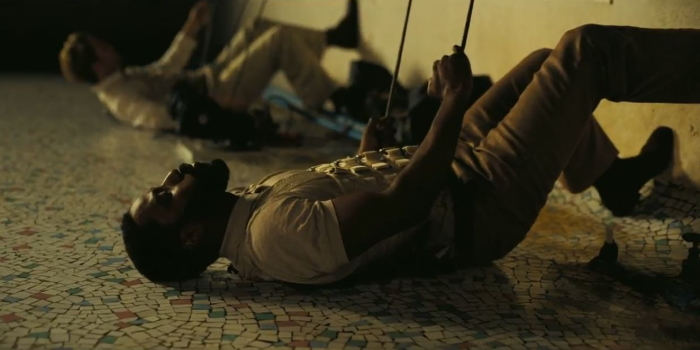
Washington’s determined—and patient—superspy traverses the globe, interrogates arms dealers and is paired with a mysterious assistant named Neil (performed with winking flair by Robert Pattinson), trying to figure out how, exactly, time inversion can be used against humanity. They also get involved with art forgeries and plane robberies, just to close in on the likeliest villain—a Russian oligarch played by Kenneth Branagh—and turn his trapped wife, Kat (Elizabeth Debicki), against him.
Which is to say: this is seriously just the bones of a basic Bond flick, right down to the evil, big-accented madman who wants to destroy the world for reasons as well-defined as the underpants gnomes’ strategy in South Park. There’s even a laughably bad sequence in which Washington and Branagh have a conversation during a foiling catamaran race (bringing back chilling memories of 007 surfing in Die Another Day). What sets it apart—slightly—are the fight sequences and car chases that involve one person moving backwards and the other moving forwards, though even those feel inert in execution. They’re also hard to justify, given the wobbliness of time inversion’s explanation. Honestly, I probably would have preferred Nolan simply make an action movie where the baddies are trained to fight and drive backwards because it looks cool as s***. Lean in, Chris!
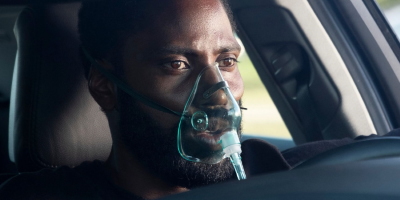
Nolan’s devotion to an altogether baffling narrative mechanic is maybe vindicated by the final act, which ventures into some nifty, innovative arenas (no, I won’t spoil them). However, he’s hobbled throughout Tenet by some other common missteps: a dark, droning score (by Ludwig Göransson, subbing in for Hans Zimmer) that likely sounds great in isolation but otherwise steps on the occasional moments of levity; and muffled sound design that obscures nearly half of the spoken dialogue, which doesn’t help our comprehension either. (If you thought Nolan only liked putting Tom Hardy in unintelligible masks, almost the entire cast gets to speak with something covering their mouths this time around; Branagh even delivers a climactic speech over a staticky walkie-talkie.)
And yet, there is no one else out there making pictures quite like Christopher Nolan, so cheers to that. After bringing gravitas to the superhero genre, he has dedicated himself to the task of enlivening philosophical conundrums with human stories, and depicting the bended laws of physics with a heretofore unseen sense of scale. Tenet is another addition to this very specific canon; not as successful as Inception, but better than the overly-sentimental and silly Interstellar. For those who don’t want to engage with Nolan’s academic exercises, just tune out and revel in its baser pleasures: thrilling spy set pieces and charismatic leads. The other stuff? Ain’t nobody got time for that.
3.5/5
Rated M for science fiction themes, violence and coarse language. There are advance screenings of Tenet on 22 and 23 August, ahead of its release in Australia on 27 August, only in cinemas.
Header Image: Warner Bros. Pictures
Topics
Ref: 55bf9c29-08d2-454a-840e-ac1e00838965



Comments & Feedback
Share your opinion
Emoji cheatsheet Formatting Comment guidelines