Movie Review: Christopher Nolan Goes Big and Goes Home With “Dunkirk”
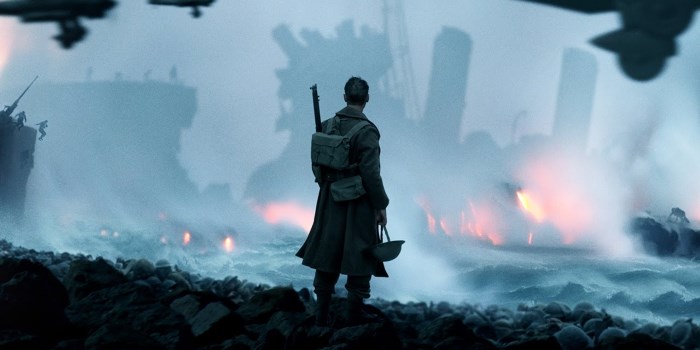
Christopher Nolan’s relentless Dunkirk turns a wartime retreat into a cinematic triumph.
Following big-screen flirtations with mind thieves, intergalactic farmers and Batman, writer-director Christopher Nolan grounds himself with Dunkirk, the true tale of (fittingly) a mass grounding during WW2.
With shockingly scant exposition, we’re immediately plunged into the fray, as British private Tommy (Fionn Whitehead) flees enemy fire in the French town of Dunkirk, arriving on its beach, where more than 300,000 remaining soldiers await rescue.
Fighters drop artillery overhead. Military brass beg for battleship support. Their lone promise of salvation lay in a fleet of English fishing boats, chartered by the Navy, making its way across the Channel, and a trio of Spitfires trying to out-fly their diminishing petrol reserves. Composer Hans Zimmer scores the impending doom with a metronomic ticking. My guest to the screening wore a Fitbit, and confirmed a jump from her resting heartrate for Dunkirk’s entire 106-minute running time.
(Upside: Dunkirk is only 106 minutes long. Hearts couldn’t take a minute longer.)
The simple plot is twisted in typical Nolan fashion: The events on the beach take place over one week; by sea, over one day; by air, over one hour. Nolan and his editor Lee Smith cut back and forth between all three strands, eventually tying them together in the climactic centerpiece. Just as he played with time in Inception, and structure in Memento, Nolan tinkers with our expectation of how a narrative should proceed, effectively turning Dunkirk into a thrilling, unbroken, three-pronged action sequence. And, as he did with The Prestige, he turns a deceptively plain yarn—bring the boys home—into a gob-smacking magic trick.
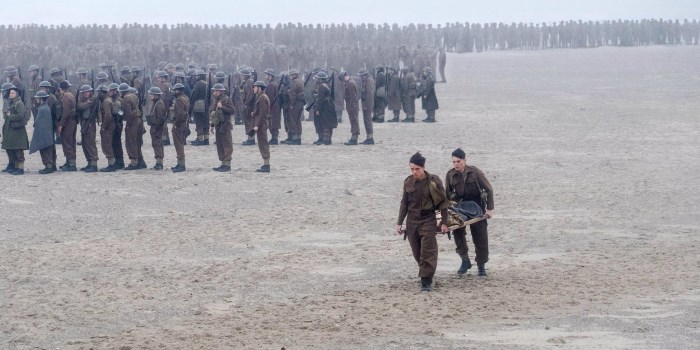
Is it a cavalier treatment of a real-life tragedy? Unnecessary window-dressing? I get both criticisms. But Nolan, a showman above all, knows movies should move, and by toying with the momentum, he pushes this story of strategic failure and wartime retreat forwards, giving it purpose and making it feel essential. It’s not simply the style of WW2’s great propaganda flicks—The Memphis Belle, The Battle of Midway—he cribbed for Dunkirk; it was their ability to reset a narrative as heroic too.
The goal, however, isn’t pure jingoism. (At least, not entirely, though Hoyte van Hoytema’s grand cinematography gives every actor a large enough frame to gaze aspirationally into the distance.) Dunkirk instead remembers the forgotten. Its heroes are those who would be later accused of cowardice; those who died, incidentally; and the shell-shocked soldiers who briefly betrayed their fellow man. We learn almost nothing about the characters, except for their immediate desire for survival and the understanding that who they were before is long gone. Dunkirk dehumanises, humanely.
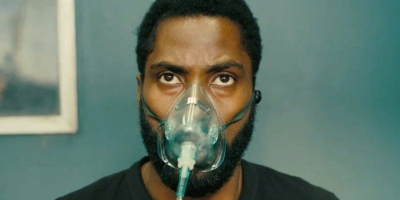
Whitehead, Aneurin Barnard and Harry Styles (yes, the Harry Styles you’re thinking of) do good as the teen boys frantically seeking escape from the beach, while Mark Rylance offers his solemn gravitas to the part of Mr. Dawson, a mariner who takes his modest boat to France. To underscore the allure of working with Nolan, Kenneth Branagh, as a high-ranking Commander, delivers all his lines from a jetty, while Cillian Murphy plays a character simply credited as “Shivering Soldier”. Meanwhile, Tom Hardy, as a fighter pilot, repeats his controversial shtick from The Dark Knight Rises, delivering his lines from within a mask. But all have turned up, ready to serve, and to deliver a wholly satisfying experience.
In the wake of (the actually very silly) Interstellar, it seemed increasingly unlikely Christopher Nolan could ever again reconcile his antiseptic blockbuster style with recognisable human drama. Dunkirk retains his auteurist tics (this is how his pictures look, sound and feel; make peace), yet still manages to show us new depth, humility and an improved ability to marry the massive with the intimate.
Plenty of war films have succeeded in placing the audience inside the action. Dunkirk makes you reckon with the consequences as well.
4.5/5
In cinemas July 20. Rated M for mature themes, violence and coarse language.
Photo: Warner Bros
Topics
Ref: 3e349bc8-89d9-4519-b96e-a7b5004bcd10
Most Popular



Comments & Feedback
Share your opinion
Emoji cheatsheet Formatting Comment guidelines
It's a great movie.