Debunking Daydreaming: The Good, The Bad and The Bizarre

Wait, there's science behind zoning out and thinking about Harry Styles multiple times a day? 👀
Perhaps you even got told off for it on the reg’ in primary school or were often described as being “away with the fairies” (like this writer…).
Scientists estimate we spend up to half our waking lives daydreaming – and according to our Insta poll on how often you daydream, many of you can relate:
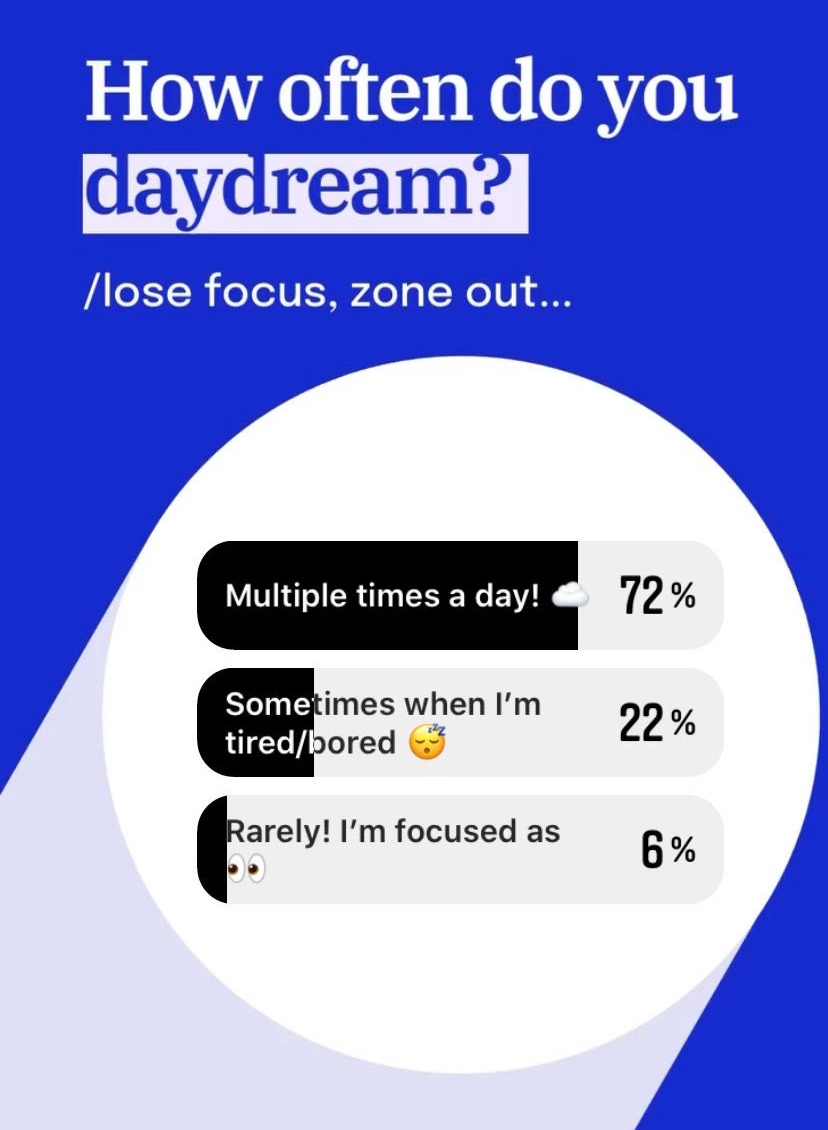
Since it's something we all do from time to time, let’s dive into the world of daydreaming, and whether it’s good or bad for us:
First of all, what is it?
Put simply – daydreaming is what happens when you zone out of the situation you're in, and your mind wanders.
In this temporary escape from reality, your mind forms mental pictures, usually in spontaneous and brief episodes.
What our brain does while we daydream is quite complex and sophisticated, with experts even saying it happens when parts of the brain fall asleep, while most of it remains awake.
 Via Pinterest.
It could seriously affect how we learn.
A recent study out of Queens University in Ireland looked at the impact of daydreaming on young people’s learning.
In the study, they found children were “mind wandering” a quarter of the time when being read a story. One kid spent 83 per cent of the time daydreaming (and same, tbh.)
It concluded that, while it’s unavoidable and impossible for children (and adults) to fully concentrate all the time, it can have a serious effect on the capacity and ability to learn.

Amongst the popular topics reported by the daydreaming subjects in the study were snacks, rain, Harry Potter, and TikTok. Again, same.
The study is the first of its kind to look at mind-wandering and learning in a demographic this young, and is notable because it found the frequency of mind-wandering doesn’t change with age.
Dr Agnieszka Graham, a developmental psych and senior author of the study, said: “The more we can learn about mind-wandering in the classroom, the better we can design our teaching strategies and educational spaces to optimise learning and engagement.”
What can we do about it?
There’s good and bad news here.
If daydreaming is interfering with your daily life, there may be a bigger issue at hand – a condition called maladaptive daydreaming.
This condition comes in the form of intense, highly distracting daydreams triggered by real-life events or sensory triggers.
Sleep deprivation is a major factor in daydreaming in general, but particularly in this condition. Remember that help and support are always available – you can call Lifeline on 131 114, Kids Helpline on 1800 551 800, or visit ReachOut to get support to help you with everything from everyday issues through to tough times.

On the flip side of this, there’s also such thing as positive daydreaming.
When done healthily, daydreaming has been found to lessen stress and anxiety, help with problem-solving, and even expand your creativity.
It takes a bit of mindfulness and brainpower to achieve this, but experts have recommend the following:

Moral of the science here: next time you catch yourself daydreaming, lean in and see if you can boost your mood and creativity. But maybe not while you’re at school/uni.
Header Image: Elias Strale via Pexels (edited).






Comments & Feedback
Share your opinion
Emoji cheatsheet Formatting Comment guidelines