Understanding the Economy Will Help You Predict Basically Any Democratic Election
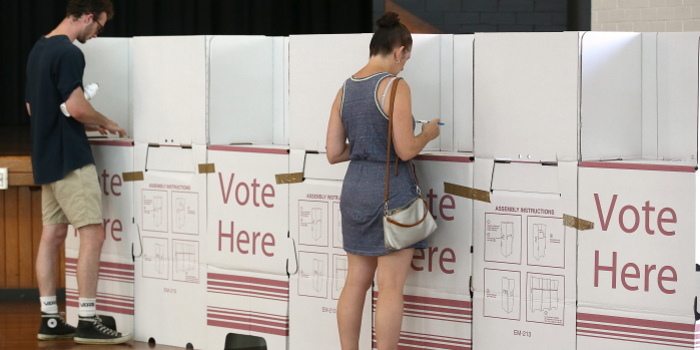
Here’s how your economic skills can kickstart a career in politics.
This post is presented in partnership with Monash Business School.
The old adage goes, as far as elections are concerned, "it's the economy, stupid".
Fact is, no matter what's going on in the world, the number one factor that seems to affect whether or not a president or political party is returned to power is whether or not the economy is doing well.
That’s why it’s important to know what a good or bad economy looks like, how it might affect which political party is elected or re-elected, and what specific economic factors drive this predictor.
So, if you’re interested in a future pathway in politics, law or commerce, you may want to consider upskilling in economics. Here's why:
How the economy predicts elections
When we refer to 'the economy' we’re talking about the position that a particular country is in based on the supply of money and the production and consumption of goods and services.
When the economy is doing well, more people have jobs, housing and access to amenities and services; this is called a boom. But when the economy isn’t doing so well, unemployment tends to rise, goods and services become more expensive and more people struggle financially. This is known as a bust. It becomes a 'recession' when the GDP shrinks for two consecutive quarters.
In basic terms, if the economy is bad under a certain government, the public tends to vote them out in hopes that the new party will bring economic success. If the economy is doing well, governments tend to stay in office as most voters believe that they don’t need change.
If, for example, a voter had recently lost their job under their current government, they might vote for the opposing party who is promising to bring in more jobs. Or if a voter was able to recently build their own home thanks to government grants, they may choose to vote for the current government in the next election, so that they continue to personally benefit from their policies.
How it’s worked in Australia
Let’s look at Australia as an example. In 2019, our GDP growth was at about 4 per cent, which isn’t exactly a boom per se, but it is economic growth. At the last election, experts almost guaranteed a Labour win (even Sportsbet paid out before we had the final result) but we were all shocked when Scott Morrison and the Liberals won again.
While it was surprising at the time—and there were certainly other factors at play—looking back , the health of our GDP and economy should have convinced more prognosticators that Australians were a lot more likely to vote for the party that was already in office.
Currently, (thanks to COVID) we are in one of the worst recessions of a lifetime, with the GDP dropping 7 percent in its June quarter. While we aren’t due for an election for another three years, it will be interesting to see if the Liberal party can turn the economy back around or if the effects of 2020 will continue to haunt them in 2023.
How it’s affected the United States
Based on data since the end of the second world war, elections in the US are almost always determined by the economy. The only American president since 1900 to be re-elected after a recession under his government was William McKinley the same year.
The US is right on the brink of its next election with a race between Democrat contender Joe Biden and Republican president Donald Trump. If we’re taking guesses based off the history of American politics and the economy, Biden is likely to win.
America, much like Australia, is in a recession because of coronavirus. Economic growth was at a high in February, but the country has since entered its first downturn since 2007 to 2009.
While the debate on policy and character is huge in US politics, Trump may have already lost this election just based on the economy alone.
If you want to learn more about the connection between US politics and its economy, head to FiveThirtyEight.com.
Pathways
So, you’re sold on the importance of economics and want to kickstart your career in politics, but where do you start?
Monash University offers a wide range of diverse and intersectional courses in economics, finance, politics and commerce. Whether you’re looking for an undergraduate degree or a master’s course, you’re sure to find a degree that will help you on your climb up the political ladder.
If you’re just starting out, why not try out Monash’s Bachelor of Economics, Bachelor of Commerce or Bachelor of Politics, Philosophy and Economics. Or maybe you want to combine your interests with a double degree? Why not try out a Bachelor of Commerce and Economics or even a Bachelor of Commerce and Finance.
Are you already doing an undergraduate degree and thinking about how to expand your skills once you graduate? Why not try out a Master of Applied Economics and Econometrics, Master of Global Business or a Master of Advanced Finance.
You can find out more about these courses and more on Monash Business School’s website here.
Whatever path you choose, it is so important to know your way around the economy and its large influence on how the public might vote. You never know, if you start keeping track of where your country is at financially, you could predict the next election.
Want a uni degree that will help you make a difference. Find out more about Monash Business School's wide range of single and double degrees, and learn how their graduates are leading change and making a difference.
Header Image: Jono Searle via Getty Images
Topics
Ref: 62f45f56-6208-41b9-a310-ac4000211ad3


Most Popular



Comments & Feedback
Share your opinion
Emoji cheatsheet Formatting Comment guidelines
lol