Will Facebook's Messenger Chatbots Lead To Better Communication Or Chaos?
If you're my age (seventeen) or older, cast your mind back to the glory days of AOL and MSN.
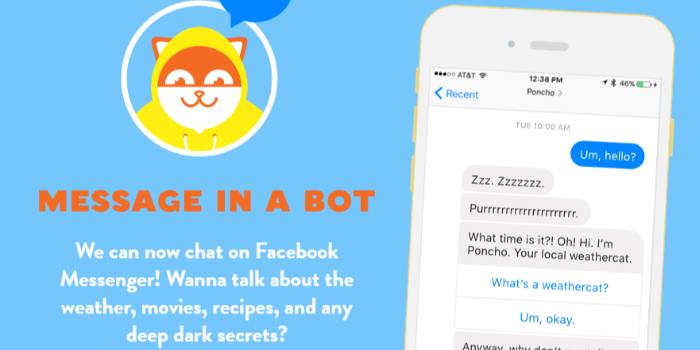
Who else remembers the frantic rush home from school to log on, only to discover your only online contact was SmarterChild, the automated chatbot? For those of us who miss spending endless hours harassing him and other bots, Facebook has recently begun introducing chatbots to whom we can communicate through Messenger. From a weatherman (weathercat?) named Poncho to a personalised shopping concierge, the concept is beginning to expand in seemingly all directions. Despite their apparent convenience and the obvious novelty factor, it is pertinent to consider the potential dangers in conjunction to their benefits. Bots are not perfect, after all. Earlier this month, it was announced at Facebook's annual F8 conference that their new 'Messenger platform' API will provide the opportunity for businesses to communicate with clients via bots: programs developed to interact with users in an autonomous fashion. So far, only a handful have been released to the public, but nevertheless a divide has already emerged between the naysayers and the supporters. Take Alex Heath from Tech Insider, for example, who certainly does not hold back when expressing his displeasure at Poncho's unreliability: “Do you hate me?” This brings to mind a number of other considerations which need to be made when pondering whether to jump on the messenger-bot bandwagon. As Ron Miller wonders in his piece for TechCrunch, is it really worth having the weather messaged to us when we can just as easily open the Weather app and view it in a more aesthetically pleasing manner? Aside from that, the extra notifications can be seen as just another distraction in our already technologically bombarded lives. There's also the fact that bots might not be entirely user-friendly due to their reliance on correct sentence structure and vocabulary. For those of us who are more comfortable typing in text slang than formal English, this could be a bother. Users may also run into issues with the simplicity of the information provided; for instance, the level of detail in reports given by the CNN bot does not even come close to logging on to the website itself. However, it's not all bad news. Beside the blatant ease of access, the increased use of bots may reduce our need to download an app for every purpose. It would cut down our time spent digging through websites searching for customer service details when experiencing issues with a company. It is more prompt than sitting on hold all day, and perhaps might be helpful for those who feel anxious about communicating with a stranger. Ultimately, whether or not this concept will take off as Facebook hopes will depend on how we embrace this new style of communication. Although bots are still in their primitive state, they hold a great deal of potential for both chaos and triumph. It is all dependent on the amount of influence Facebook, and the businesses themselves, allow them to have and the degree to which their 'humanity' is developed and monitored.Eloise Parks is one of Student Edge’s student contributors. Learn more about the contributors program.
Photo: PonchoTopics
Ref: df84e5a6-dc1b-4015-ae7e-a5f6003f851c




Comments & Feedback
Share your opinion
Emoji cheatsheet Formatting Comment guidelines