What It’s Really Like To Study Interior Design (Plus Five Tips To Keep Your Personal Space On Point)
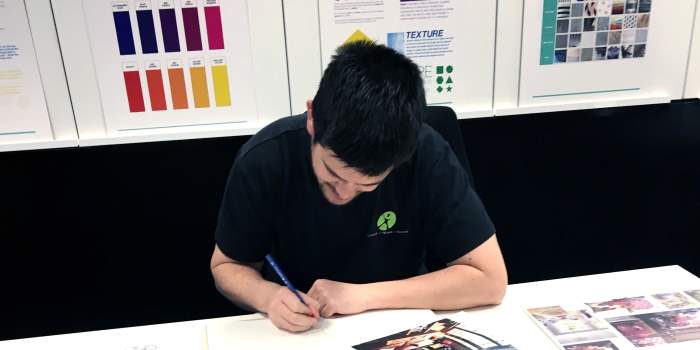
This post is presented in partnership with inSTUDIO.
When Marty Wright informed his closest friends he’d started studying Interior Design, their reaction was… well, not totally enthusiastic.
“They thought it was a career full of cushions and pillows and things like that,” he told Student Edge.
“Some of my friends were like, ‘Why didn’t you choose architecture?’"
It’s a question the 34-year-old - just graduated from inSTUDIO at ISCD - has faced frequently since taking on Interior Design.
“Growing up as a child, I actually wanted to be an architect,” he said.
It wasn’t until Marty started to investigate what that actually meant, and became obsessed with shows like Grand Designs, that the field of Interior Design presented itself as the more flexible, fascinating option.
“I thought, from a career point of view, there might be a larger demand for interior designers, because you can work on new projects as well as existing spaces, whereas architecture is just for new builds or renovations, and a lot of people probably don’t have the budget to do that,” he explained.
The former personal trainer and fitness consultant only recently changed the direction of his career ("probably in the last five to six years"), committing to Interior Design at inSTUDIO in 2015.
“[Initially] I didn’t actually tell many of my mates because they’re in more [stereotypically] masculine fields; like engineering, IT, things like that,” he said.
“They didn’t realise there was a lot more to it, in regards to [2D & 3D drafting program] AutoCAD and learning how to change structural walls and do detailing and joinery and things like that.”
It's precisely because of those lesser known aspects of Interior Design that he enrolled into the one-year diploma with inSTUDIO.
“I decided I needed to gain industry exposure and technical skills in regards to the computer side of it - with AutoCAD and Photoshop - that would allow me to take on larger roles and larger projects,” he said.
Not that the misconceptions about the industry have kept his friends from asking for decorating advice. “I actually find that a lot of my female friends or the partners of my mates will ask me a lot of questions,” he laughed. “I don’t think people realise the amount of study we have to do and the amount of knowledge learnt over the course. It surprised me how much I’ve learnt about things I didn’t think I’d learn about.” To prove it, Marty (now armed with an accredited Diploma of Interior Design and Decoration), shared with us five tips to help ensure your personal space – be it your house, apartment, or bedroom - is always on point. 1. Make sure your place reflects your personality. “I feel like a home needs to reflect the personality of an individual,” Marty said. “I find it’s important not to strip the soul out of a property and take away the personality of a space. I feel like a lot of people will remove everything, start from scratch, and place a bunch of designer furniture in the room. Then it lacks that warmth." That doesn't necessarily mean hoarding, but holding onto what's meaningful is certainly advised.“A lot of pieces should mean something to you; [pieces] you've accumulated through travels, or been handed down through generations,” he said.
2. Don’t be wasteful. “Too many people throw away things in this disposable society,” he added. “We’ve got to be a bit more environmentally friendly and choose more environmentally sustainable materials and pieces, and really educate people on where they come from and how they’re made.” Wondering where to find them? Marty recommends pieces “sourced from abandoned buildings or claimed from a business that has gone under.” 3. Find items that’ll start a conversation. “It’s nice to have a focal point in a room, whether it’s an antique piece of furniture or a vintage piece or something you bought on your travels; it should make people stop and talk,” he suggested. “You don’t want to put too many focal points in your room [though], otherwise the eye doesn’t know where to rest.” 4. Furniture is for using. Just because you’ve now got an antique in your home doesn’t mean it should be left to gather dust. Marty’s most prized possession is a vintage writing desk from Denmark. It’s not just for show, however.“That’s the piece I love sitting at and doing some work, or reading at,” Marty said.
5. Times change, so stick with what’s timeless. “Older pieces will fit into a room for years and years to come and that sophistication is what I try to put into the interior design of my rooms, rather than using what’s on trend,” Marty explained. “In two or three years’ time you think, ‘That was done to death, let’s move on from there.’ It’s about creating that timeless appeal." inSTUDIO students gain the technical skills needed for the real-world as well as the opportunity to work on briefs from exclusive industry partners (the perfect way to build a credible portfolio). You can get a taste for Interior Design, just like Marty, at the FREE Student Edge stylingID workshop at inSTUDIO. Find out more!Topics
Ref: c04c8721-707a-452d-81f3-a55b0043173d



Most Popular



Comments & Feedback
Share your opinion
Emoji cheatsheet Formatting Comment guidelines
Starting to go more in depth and understanding more. Thanks for the tips
Tips are easily given but not so easy to put into practice.
i have always wanted to do this sort of thing