What Is 'Queerbaiting' and Why Is J.K. Rowling One of the Worst Offenders?
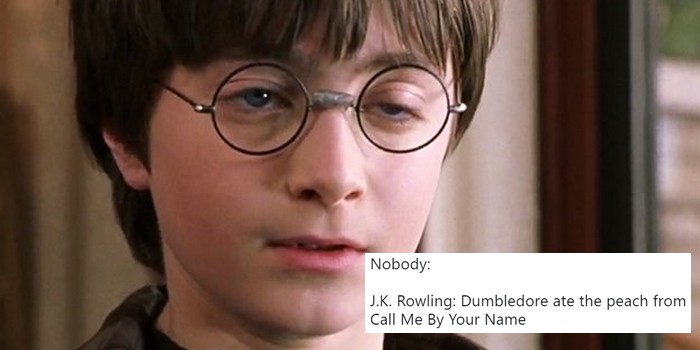
The Harry Potter author has a problem with queerbaiting.
J.K. Rowling is no stranger to retroactively adding facts to the Harry Potter and Fantastic Beasts canon. (It's called retconning, which stands for retroactive continuity.)
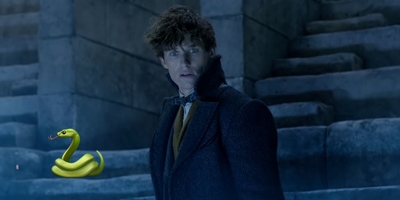
Ahead of the last Fantastic Beasts instalment, Crimes of Grindelwald, the author and screenwriter revealed that the Maledictus, Nagini, was Lord Voldemort's snake who appeared in the Harry Potter series. Some savvy fans noted the timeline didn't quite make sense, but Rowling brushed over it.
However, that's small potatoes compared to her comments regarding the sexuality (and race) of some of her characters. In fact, her attempts to retcon inclusivity into the Harry Potter series has inspired plenty of backlash, and accusations of 'queerbaiting'.
no one:
jk rowling: pic.twitter.com/jGPozyyJ8h— 𝕡𝕒𝕚𝕘𝕖 (@riophx) March 17, 2019
J.K. Rowling summed up in a tweet.
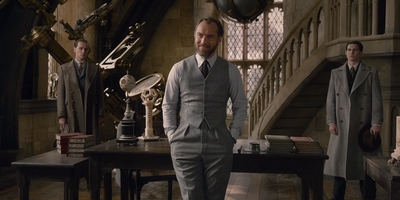
In a recent interview with Radio Times, Rowling spoke, in detail, about how the characters Dumbledore and Grindelwald shared a romantic relationship, as she'd previously hinted towards.
"Their relationship was incredibly intense. It was passionate, and it was a love relationship," Rowling told Radio Times.
"But as happens in any relationship, gay or straight or whatever label we want to put on it, one never knows really what the other person is feeling. You can't know, you can believe you know.
"So I'm less interested in the sexual side—though I believe there is a sexual dimension to this relationship—than I am in the sense of the emotions they felt for each other, which ultimately is the most fascinating thing about all human relationship."
Of course, none of this supposed relationship actually appears in the two released Fantastic Beasts movies, the eight Harry Potter films or J.K. Rowling's numerous books. It leaves us with a question: If Rowling has put so much effort into Dumbledore and Grindelwald's romantic backstory, why is it nowhere to be seen outside of interviews?
Hold up. What is queerbaiting?
Queerbaiting, as the name suggests, is the baiting of the queer community by subtly inferring characters might be LGBTQIA+, without ever explicitly saying it.
It can be hurtful for viewers from the LGBTQIA+ community, who are often starved for representation, because it hooks them on the idea that a non-heteronormative relationship might actually be depicted on the screen, without following through.
What has J.K. Rowling actually said that isn't in her books or screenplays?
Aside from her sticking to the fact that Dumbledore is gay (despite never saying so in the book or film series), Rowling is yet to actually include any queer characters in the Harry Potter-verse.
But, she has retconned other aspects too.
A few years after she first declared Dumbledore was gay (back in 2007), she retroactively confirmed there'd also been a Jewish character all along: Anthony Goldstein.
She's also suggested that Hermione, played by a white actor (Emma Watson) in the movie, might not have actually been white in the books. (Hermione was played by an actor of colour, Noma Dumezweni, in the West End production of Harry Potter and the Cursed Child.)
The fandom is understandably frustrated with Rowling only including queer and ethnically-diverse characters in the Potter-verse after the fact. For some, it reeks of Rowling desperately seeking credit for inclusivity without ever needing to explicitly commit to it in her literature.
jk rowling can log on here and tweet “dumbledore was a dom top” all she likes but the fact remains she actively leaves out any LGBT rep in her books and films so her profit isn’t affected
— laura (@lauraw97_) March 17, 2019
it’s performative activism that allows her to present herself as progressive while keeping her films ‘family friendly’ for the bigots that would undoubtedly kick off at the presence of a gay character
— laura (@lauraw97_) March 17, 2019
Perhaps with more outrage over her ridiculous retconning, Rowling will learn to stop dropping new background information retroactively to her storylines long after they've been cemented. Especially when there doesn't seem to be any legitimate intention to actually depict it, for readers and viewers who'd appreciate the representation.
Header Image: Warner Bros. Studios/Twitter (@prasejeebus)
Topics
Ref: 0ed8dd50-aa74-41ff-ac77-aa140037c3a7




Comments & Feedback
Share your opinion
Emoji cheatsheet Formatting Comment guidelines