What Does It Mean When They Talk About "Fidelity" on "Westworld"?
Things are about to get spoilery in Sweetwater, so don’t read on if you haven’t seen "Phase Space".
After a rocky start to the second season, Westworld has been on a bit of a tear lately.
We got the 'Delos in an Aquarium' experiment in "The Riddle of the Sphinx" and Akane’s Wu Tang-flavoured murder dance in "Akane no Mai".
But it seems to have all been building up to the season’s sixth episode, "Phase Space", which saw Bernard (Jeffrey Wright) get his consciousness uploaded into the "cradle", where the titular park’s robot hosts live out a simulation, presided over by dead human Robert Ford (Anthony Hopkins).
It—maybe—reveals that Ford (and Bernard’s bodysake, Albert) finally solved that pesky issue of mortality, figuring out a way to live forever in the cloud. Pity poor Delos (Peter Mullan) couldn’t take advantage of that same technology and had to indeed be reborn and killed over and over again in his glass enclosure.
Actually, whatever, that guy sucked.
The real question, however, is whether or not the deceased can actually get out of the cradle, and live on for eternity in a host’s body, potentially even beyond the confines of the park.
Perhaps "Phase Space" hid an answer to that very question. And they did so within one word: "fidelity".
Fidelity: Not just half the title to a great John Cusack movie.
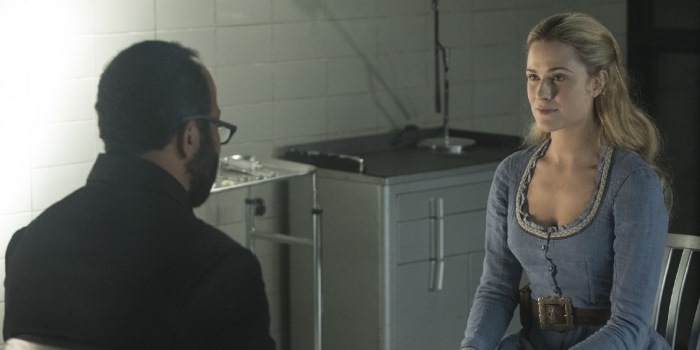
"Phase Space" began much in the same way as season-opener "Journey Into Night", with old-school Dolores having a chat with either robot Bernard or the late Arnold. As we wondered back in April, was this taking place in the past, or in the future?
We got a big clue last night, when Delores (Evan Rachel Wood) took control of Bernard’s body and revealed she was testing his "fidelity".

Two weeks earlier, young William (Jimmi Simpson) said he was testing Delos for the same thing.
The word didn’t raise too many eyebrows when William first uttered it; in tech terms, "fidelity" means the closeness of a reproduction (with 'high' or 'low' indicating the level of its quality).
So, when William is testing the host version of Delos for "fidelity", he’s trying to figure out how it fares when interacting with an element from its previous life as a human. And it was often at this point that Delos would start slurring and falling apart.
What then, does it mean when Delores tests Bernard? Was she used, back in the day, by Ford to evaluate his "fidelity", given her prior relationship with Arnold? Or, is this a glimpse of a future point where Delores might achieve the same God-level powers as Maeve (Thandi Newton) to reprogram hosts, or make them from scratch? If we go even deeper into the rabbit hole, are we to believe that Bernard isn’t just a replica of Arnold, but the holster for Arnold’s eternal consciousness?
In "Phase Space", another character came face to face with a figure from their past and seemed to similarly become unstuck: the Man in Black AKA Old William (Ed Harris). After reuniting with daughter Emily (Katja Herbers), he becomes highly suspicious of her human credentials, and then incredibly confused about their backstory. Which one is testing the other for their "fidelity"?
This brings us to Ford, physically dead but mentally chilling in the simulation of the cradle. He’s been tormenting the Man in Black by speaking to him through child hosts, egging him on as he embarks on the "game". Will he discover, at the end of this new trial, that he is in fact a robot too?
We have no idea. Welcome to Westworld. More "Shogun World" next week please!

Westworld airs on Foxtel’s showcase channel in Australia.
Photo: HBO
Topics
Ref: 09b0c58b-72e6-4494-8203-a8ef001c030a





Comments & Feedback
Share your opinion
Emoji cheatsheet Formatting Comment guidelines