What Does “Impeachment” Mean and Why Has Trump Been Charged With It?
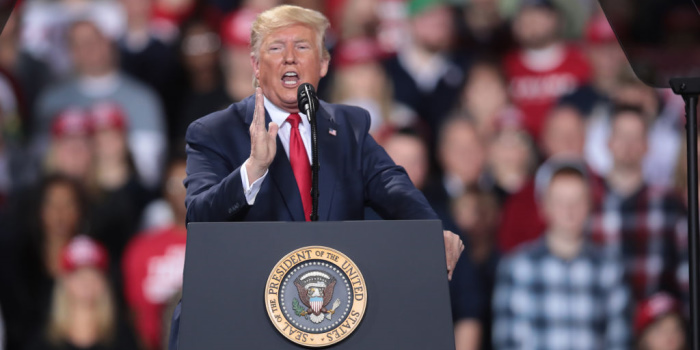
Here’s what you need to know.
There have been a lot of headlines regarding US President Donald Trump’s recent impeachment, and it all sounds very complex. In fact, "impeachment" is definitely not a term one hears every day, so you might be wondering what is actually means, and what exactly is going on.
Let's break it down.

What is "impeachment", and why was Trump charged with it?
Impeachment is the process by which a legislative body levels charges against a government official. Basically, it’s a way of charging a government official if they’ve done something incredibly wrong.
If the impeachment process is successful, the government official can also be removed from office. Although, that has not happened in the US before.
Back in September, a whistleblower claimed that Trump pressured Ukrainian President Volodymyr Zelensky to investigate Hunter Biden, the son of one of his political rivals, Joe Biden. This would have benefitted Trump politically and could have possibly affected the outcome of a fair election. That is considered a serious violation of the US constitution, and therefore, formal proceedings against the US President were launched.
Trump deflected the accusations, labelling it as "Witch Hunt garbage".
What has happened now?
The next step to impeaching Trump was a two-part process in the US Congress, where the House of Representatives voted on two articles of impeachment. These articles of impeachment accused Trump of abusing his power.
A simple majority was needed to pass each article, and the votes surpassed the 216-vote threshold, so Donald Trump was indeed impeached.
This makes Donald Trump the third US President to have been impeached before, along with Andrew Johnson in 1868, and Bill Clinton in 1998. Richard Nixon was subject to impeachment in 1973 and 1974, but his resignation halted the process.

So, what’s next?
Even though Trump has technically been impeached, that isn’t where the process ends. Next, Trump will be subject to trial in the US Senate, who will ultimately decide whether to convict the President and remove him from office. As the US Senate has a Republican majority, it’s unlikely that this will happen.
If Trump remains President, he will be able to contest the 2020 election.
While no date for the US Senate trial has been confirmed, it’s likely to happen early next year.
Header Image: Scott Olson / Getty Images News via Getty Images.
Topics
Ref: 2ef28f3d-f3ed-41df-8d3d-ab280034d26e






Comments & Feedback
Share your opinion
Emoji cheatsheet Formatting Comment guidelines