Is It Time To Ditch Gendered School Uniforms?
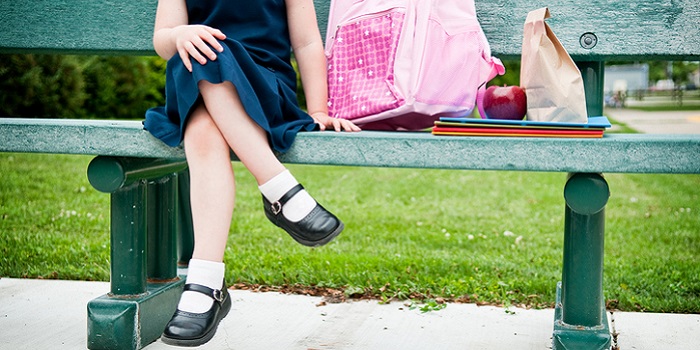
Uniforms are very much a staple mainstay; a traditional aspect of our education system. Is it time to address why they're still so gendered?
For some parents and education experts, the idea that girls are still required to wear skirts and dresses to school seems like an outdated expectation. It begs the question: Why are schools so hell-bent on dividing students down strictly regimented gender lines?
A study conducted in 2012 looking at one Australian primary school found girls did significantly less exercise over a two-week period when wearing a school dress compared to their sports uniform. Other research shows skirts and dresses “restrict movement in real ways; wearers must negotiate how they sit, how they play, and how quickly they move.”
In other words, dresses and skirts both consciously and unconsciously put limitations on the wearer’s range of motion. Further, they impose “considerations of modesty and immodesty, in ways that trousers do not.” As a female, I remember constantly being told by both family and authority figures to “sit with my legs closed” or, rather, to “sit like a ‘lady’.” The expectation for young women to police their movements and actions is something that appears to begin in the schoolyard.
Simone Cariss, a Melbourne mother, started a petition last year to raise awareness about uniform gender inequalities. As of this writing, the petition has 18,467 signatures, but Simone hopes to reach 25,000.
“Schools are a really long way behind,” she told Student Edge. “I did quite a bit of media [interviews] at the time… I challenged people to try and find a workplace that allowed the kind of discrimination schools do.”
In terms of how uniform policies are regulated, state education departments have the power to enforce consistent uniform rules, but this decision is largely left to individual schools. Simone said when she was researching the topic herself she found, “schools aren’t allowed to discriminate based on gender, but there’s a clause in [legislation] that says they can make their own rules.”
Amandar Mergler, senior lecturer at Queensland University of Technology, writes all states require schools to comply with anti-discrimination laws. However, these laws are often hard to decipher, leaving schools with little clarity about exactly what is required.
Mom Wins Petition to End School’s Sexist Uniforms Because Yes, #GirlsWearPantsToo https://t.co/e7MqfvVJkv pic.twitter.com/f5fo0UgUIZ
— Babble (@BabbleEditors) 18 May 2016
Simone’s petition came about when her daughter’s primary school had declined a request for her to wear pants as part of the winter uniform. Pants were only approved school uniform items for boys, while girls had to wear tunics and dresses.
The movement prompted the creation of a social media hashtag: #girlswearpantstoo. Given the vast number of supporters, her daughter’s school eventually agreed to the arrangement. While it seems Simone has already won the battle, she still wants to win the war. “I’ve had a local win for my daughter but it’s too important to just let it go,” she told Student Edge.
She continued, “18,000 people have signed my petition, so it’s important to other people [too].” Simone believes it’s significant, not only for girls, but for boys as well, “so that they don’t have those entrenched gender stereotypes from the moment they start in the school system [which] just sets the precedent for the rest of their lives.”
Excited to deliver my school uniform gender equality petition to @FRichardsonMP #Vicforwomen #girlswearpantstoo pic.twitter.com/xukCppaNpR
— Simone Cariss (@simonekil) 26 August 2016
Speaking to Fairfax media, Mergler said some schools promote skirts and dresses because girls simply “look better in them”. It’s an expectation that is simply regarded as tradition, without acknowledging the underlying elements of sexism involved in it all.
The Victorian Equal Opportunity and Human Rights Commission said requiring female students to wear dresses, without exception, may amount to direct discrimination. Mergler notes that while no schools have been forced to remove the requirement for girls to wear skirts and dresses, there’s a growing desire for change among parents.
Simone has since met with local members of parliament to continue fighting for uniform gender equality to be legislated. “I honestly don’t believe that every girl has to fight for the right to wear shorts or pants to school,” she told Student Edge.
“If we ever hope to achieve gender equality we need to start with school children,” said Simone. “It’s so important that they’re able to be themselves and not have these gender stereotypes as soon as they start school from age five.”
Photo: iStock



Most Popular



Comments & Feedback
Share your opinion
Emoji cheatsheet Formatting Comment guidelines
Yeh is time to ditch gender percific uniforms. I use to go to a school with gendered uniforms and even know iwas transgender they said because I was born a girl I had to wear a skirt.
Girls should have the option to wear pants if they want to (and boys to wear skirts, but we're not quite there yet). But I feel one of the biggest factors to gendered school uniforms is puberty and the differences between male and female becoming apparent.
Just why
Yes for sure
One of my friends goes to a school where they all have to wear the same shirt but can wear whatever bottoms they want. That seems like a pretty fair solution to me.
definitely yes