With the Star Wars hype dying down a bit, we’ve finally mustered the courage to talk about it - critically.
Sure,
despite being widely loved, the franchise has had its fair share of criticism already. That’s usually because, well, the prequels. (And because bad guys actually have ‘sleaze-bag’ in their name -
Elan Sleazebaggino, in case you missed it.)
It must be said that
Star Wars makes exceptional use of special effects and that the films, as a whole, are visually stunning. But beneath all that,
Star Wars is a political story about dictatorship and democracy; oppression and freedom. And when we become conscious of that, we can’t help but ask: Are the Jedi really the good guys?
“No one can kill a Jedi.”
When the Jedi are on a mission, no-one’s going to get in their way. Should someone try, a quick flick of the lightsaber will chop their head right off. It’s easy to overlook how crazy that is when their enemies are a homogenous mass, as cloned stormtroopers are bound to be. However, every Jedi weapon either kills you or at least severs a limb. To cause so much damage and care so little (they nearly never show remorse) doesn’t seem to be a good-guy attribute.
“Are you allowed to love? I thought that was forbidden for a Jedi.”
What is even more disturbing is that they are encouraged not to feel passion, or love. While the Dark Side is by no means good, they are allowed to embrace the depth of natural emotion. Yoda teaches both Anakin and Luke not to grow attached to anything, or anyone, told not to mourn or miss those who die.
“Don't forget, she's a politician. They're not to be trusted.”
The Jedi don’t just defend the Galaxy; they make decisions that determine its fate. In
Episode I, Qui-Gon and Obi-Wan (only an apprentice at this point) are sent to negotiate political treaties; and in
Episode 3, Widu orchestrates a military takeover to get rid of or, if necessary, kill the elected Palpatine. It is almost absurd that in a democracy, an unelected group of men wield so much power.
They had no right to act; but they had the power, so they used it.
And this power is uncontrolled. There are loose references to the ‘Jedi Code’, yet no-one is ever punished for breaking those rules. Qui-Gon’s consistent defiance of the Code has no real consequences: he is denied a place on the Jedi Council but retains his lightsaber and Jedi status, so whatever. It’s like a police officer doing whatever they want, and instead of having their badge and gun taken away, they are simply never promoted.
Anakin kills an entire Tusken community in
Episode II, including “the women and children”, telling Padme that he “slaughtered them like animals”. She simply says, “To be angry is to be human." To paraphrase the most morally upright character in the franchise, it’s apparently okay to single-handedly commit genocide if you’re angry.
Maybe her excuse is that she was blinded by love. But it wouldn’t take the wisdom of a Jedi to determine that the wounds were inflicted by Anakin’s lightsaber. It is only when he kills the ‘younglings’ - children training to become Jedi - that anyone begins to protest.
“We'll figure it out. We'll use the Force.” “That’s now how the force works!”
In the opening of
Episode VII, Finn distinguishes between ‘doing the right thing’ and being part of the resistance that yearns for the return of the Jedi. This stems partly from his reservation to identify with one group, as naturally happens when you’ve grown up with this lot:
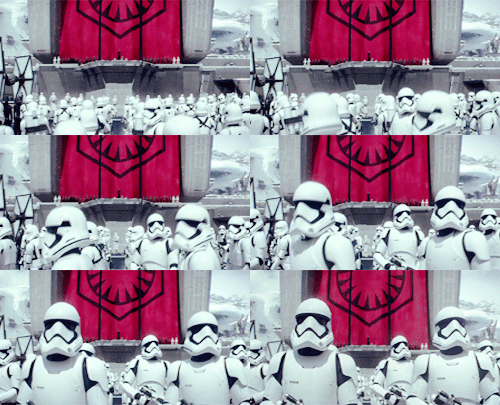
Also, perhaps, it stems from a lack of assurance in the moral uprightness of the Jedi. While the fight for the Jedi is justified - to remove the tyrannical First Order from power - the Jedi remain distinct from what is purely ‘right’.
In a frolicking scene in the meadows of Naboo (
Episode II), Anakin proposes that, “We need a system where the politicians sit down and discuss the problem, agree what’s [best] and then do it.”
(If you sat through the whole scene, well, I’m sorry; take comfort in the knowledge that suffering builds character.)
Padme responds, “That is exactly what we do. The trouble is that people don’t always agree. In fact, they hardly ever do.”
“Then they should be made to.”
At first, it seems that Anakin is drifting away from the teachings of the Jedi, away from the democratic values they profess to protect. But maybe, just maybe, the role of the Jedi in this “system” is to make people agree; to be the dictators that protect democracy.
Thoughts?
Susan Alfayadh is one of Student Edge’s student contributors. Learn more about the contributors program.





I only recently watched the Star Wars movies but I agree that the Jedi seem to have too much unrestricted power. Plus, I feel as though repressing their emotions is the reason for such drastic turns to the Dark Side, instead of being taught how to harness their emotions positively.
Yes. Sith all the way