A Russia-Ukraine Explainer, in the Simplest Terms Ever (Cos It’s Confusing)
Putin it into context.
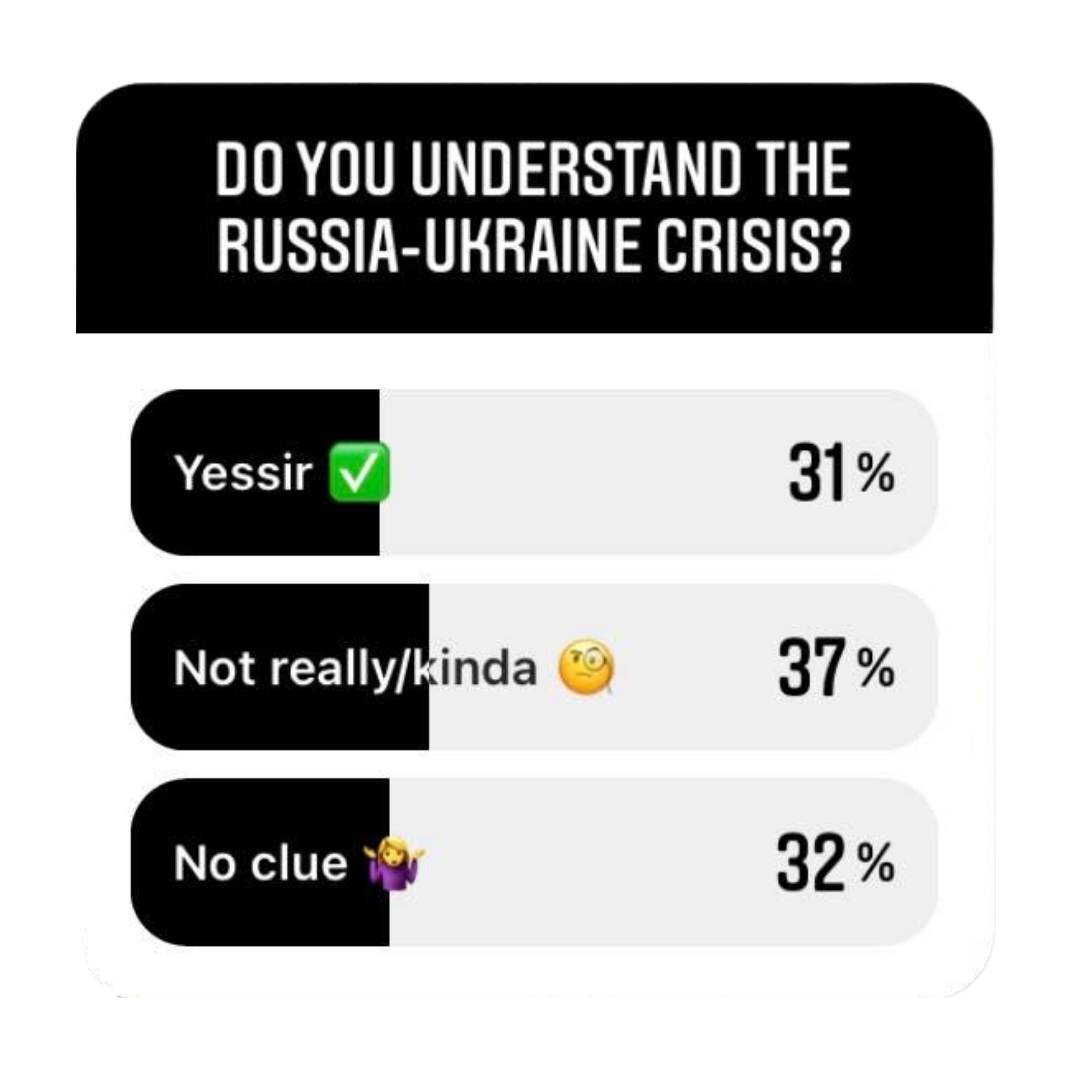
Right now, there are up to 130,000 Russian troops along parts of the Ukrainian border—and 69% of peeps we polled don’t really know why.
 With the US warning “an invasion could begin at any time”, Australia urging its nationals to leave the Ukraine immediately and the Kremlin moving more military equipment and medical units to the front lines… there’s a lot happening.
We’ve broken it down for you, because it might all seem like a bit much atm.
How did it all start?
Ukraine gained independence as its own country in 1991, after the break-up of the Soviet Union.
They gave hundreds of nuclear warheads back to Russia under the agreement they’d be protected from a potential Russian attack.
Fast forward to 2014… and Russia invaded Ukraine largely due to protests in Ukraine against their pro-Russian President—which didn’t go down too well with Vladimir Putin. Russia took over the eastern region. The conflict killed more than 14,000 people.
Why does Russia even want to invade Ukraine?
Russia has pretty big security concerns if Ukraine turns to the West.
Let’s quickly go over the role of NATO in all this. The North Atlantic Treaty Organisation (NATO) is a military alliance by 12 countries including the US, Canada, and the UK. Article 5 of the NATO treaty states that an attack on any NATO country is treated as an attack on the entire alliance.
Now, Ukraine isn’t joining NATO in the near future. But the country is the fourth-largest recipient of military funding from the US. Ukraine and the US have also been cooperating on intelligence matters in response to threats from Russia.
So… let’s say, hypothetically, Ukraine joins NATO. If Russia carries out a military attack on Ukraine, that would bring Moscow into conflict with all other NATO members. That’s a lot of powerful countries going head-to-head with Russia. So they may want to act now before Ukraine possibly join.
What is being done to mitigate this?
The White House has been trying to reach a diplomatic resolution, but after many efforts with Russia late last year, it doesn’t seem to be working out.
Instead, the US is considering sanctions against Russia, sending money and weapons to Ukraine, and boosting their military presence.
What would a Russian invasion be like?
Russia is known for using “hybrid” warfare, meaning a mix of irregular military force, cyber hacks and spread of disinformation. Since the invasion in 2014, Russia has undermined Ukraine by spreading disinformation campaigns.
So, one possibility is that these kinds of cyberattacks and “proxy wars” simply escalate. But Russia’s already been doing that, and it can only go so far.
Another possibility is that Moscow sends more troops, seizes strategic regions, or even blocks Ukraine’s access to waterways.
And the final possibility is that Moscow actually marches on Ukraine’s capital, Kyiv, in an attempt to retake the country in a full-on invasion. The US has estimated the civilian death toll from this could exceed 50,000 and create 1-5 million refugees.
This option is risky for Moscow. There’s a lot of political and economic consequences, including casualties.
What happens next?
Remember, US troops won’t fight in Ukraine because it isn’t a part of NATO. However, the US has deployed 3,000 troops to Europe as a sign of solidarity.
The Biden administration and European allies are trying to come up with a plan to punish Russia for its actions, should it invade Ukraine. This might include cutting off oil and gas exports, or the ability for Russia to make global financial transactions.
Unfortunately, this is an unpredictable event which will play out day-by-day – so we’ll have to keep our eyes peeled.
Header image: Canva.




Comments & Feedback
Share your opinion
Emoji cheatsheet Formatting Comment guidelines