Read This Before Wasting Your Vote in the Federal Election
Picture this. You open your newsfeed. Your friend is publicising her breakup on her Instagram stories (you throw it a sad react). Another celeb has something to say about Will Smith slapping Chris Rock. And Scomo has just called the Australian federal election—for today (don't worry, you'd get a bit more notice in real life).

You scramble down to a nearby voting centre, ‘cos you’d rather not cop the $20 fine. You’re guided to a booth and are faced with what appears to be a cryptographic puzzle covered in boxes and names you’ve never heard of. It’s the infamously misunderstood ballot paper.

Honest question—if the election was suddenly called today, would you know how to vote?
While some youngins can fill it out like it’s their ATAR Politics paper, others find it (understandably) difficult to even distinguish between the Lower and Upper House ballot.
Here’s the thing: if you understand how a vote works, you won’t waste yours. So, here’s everything you need to know (feat. Senator Nicki Minaj).

What exactly are you voting for?
In the three-yearly federal election, you’re voting for the outcome of three things:
- Which candidates will sit in the Lower and Upper House of parliament.
- Which party gains majority government.
- Who the next Prime Minister will be.
How does voting work?
On federal election day, you’ll be filling out two ballot papers—one for the House of Representatives (Lower House) and one for the Senate (Upper House).
It’s important to remember the House of Representatives is where government is formed. The Senate is like their scrutinising parent, checking all the laws they try to pass.

Both Houses use ‘preferential voting’ to elect candidates, meaning you just have to order your preferred candidates (from 1 to 6, for example). But there are some differences between each House, so let’s break it down.
Voting for the House of Representatives.
This House is made up of 151 seats. A party must hold the most seats, aka the majority, to form government.
These seats come from ‘electorates’, which are divided like cutting up Australia with scissors. There’s roughly one seat for every 100,000 Australians.

So, when you vote for the House of Representatives, you’re really voting for one member of a party (or an Independent).
You'll most likely go into the voting booth with an idea of some of the major parties but may not know the name of your local MP. It’s useful to know that the party names are listed under the candidate on the ballot.
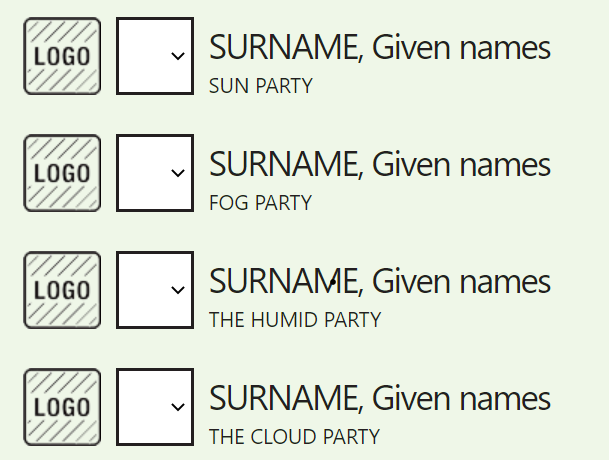
Credit: Australian Electoral Commission
Once you’ve wrapped your head around that, you’ve just gotta fill in your preferences.
Now for the tricky part—how our votes are counted.
Australia has a two-party system, meaning one forms government and the other forms the opposition. That’s why you’ll be familiar with two main parties, but you would have also heard of a few others.
Let’s say the Student Edge Team all quit their jobs and decided to run for government. Intan, Jas, Simmy and Teri all formed their own parties and became the four most well-known in Australia.

In a quaint little place called Edgetown, these four parties received the lion share of votes.
29% of Edgetown residents put the number 1 next to their local member from Intan’s Calm Your Farm Party.
30% put the number 1 next to their local member from Jas’s Everyday Vacay Party.
22% next to Simmy’s Share the Love Party, and 19% next to Teri’s United Doja Cat Party.

You can see that while Jas’s Everyday Vacay Party has the most first preference votes at 30%, this isn’t considered a ‘majority’. A party must gain 50% in order to win a seat.
Here’s where the wacky part comes in. The party least likely to form majority—that is, the party with the least votes—has their votes redistributed.
In this case, that’s Teri’s United Doja Cat Party (sorry Doja). Vote counters will then look at the second preference on every ballot which had number 1 next to Teri’s party, and give that vote to the corresponding party.
For example, someone may have voted 1 for Teri’s United Doja Cat Party, but put number 2 next to Intan’s Calm Your Farm Party.
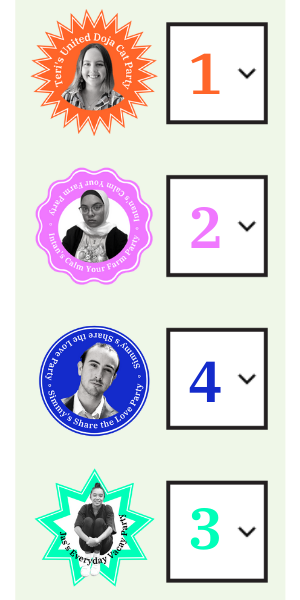
So, the vote will be redistributed to Intan’s Calm Your Farm Party, and all the other votes distributed accordingly.

The process is repeated until a majority (50%) is reached.

And the winner of the seat of Edgetown is…

Rightio, so that’s one seat out of 151 nation-wide, and Intan’s Calm Your Farm Party needs a majority of those to form the government of Australia with Intan as Prime Minister.
If the party manages that, we’ve got government! And it’s looking like they’ll be head-to-head with Jas’s Everyday Vacay Party as opposition…
We’re not done yet! Now onto the Senate.
The way votes are distributed for the Senate is the same—the method is preferential voting.
But the ballot looks pretty different, and there’s some other stuff going on, too.
Each state has its own 12 Senators, and the territories have two each. But, because Senators have six-year terms (rather than three in the House of Representatives), only half of the Senate is voted for every three years at the federal election.
Here’s a look at some of Edgetown’s candidates.

Because there’s a fixed number of Senators (rather than having one Senator per 100,000 Aussies, for example), there needs to be some measure of evenness. That’s where a quota comes in.
A quota is calculated by dividing the number of formal votes cast by the number of seats up for grabs. A party will win a Senate seat by filling up that quota.
That’s all pretty technical, so in essence, let’s take a look at what’s on the ballot.
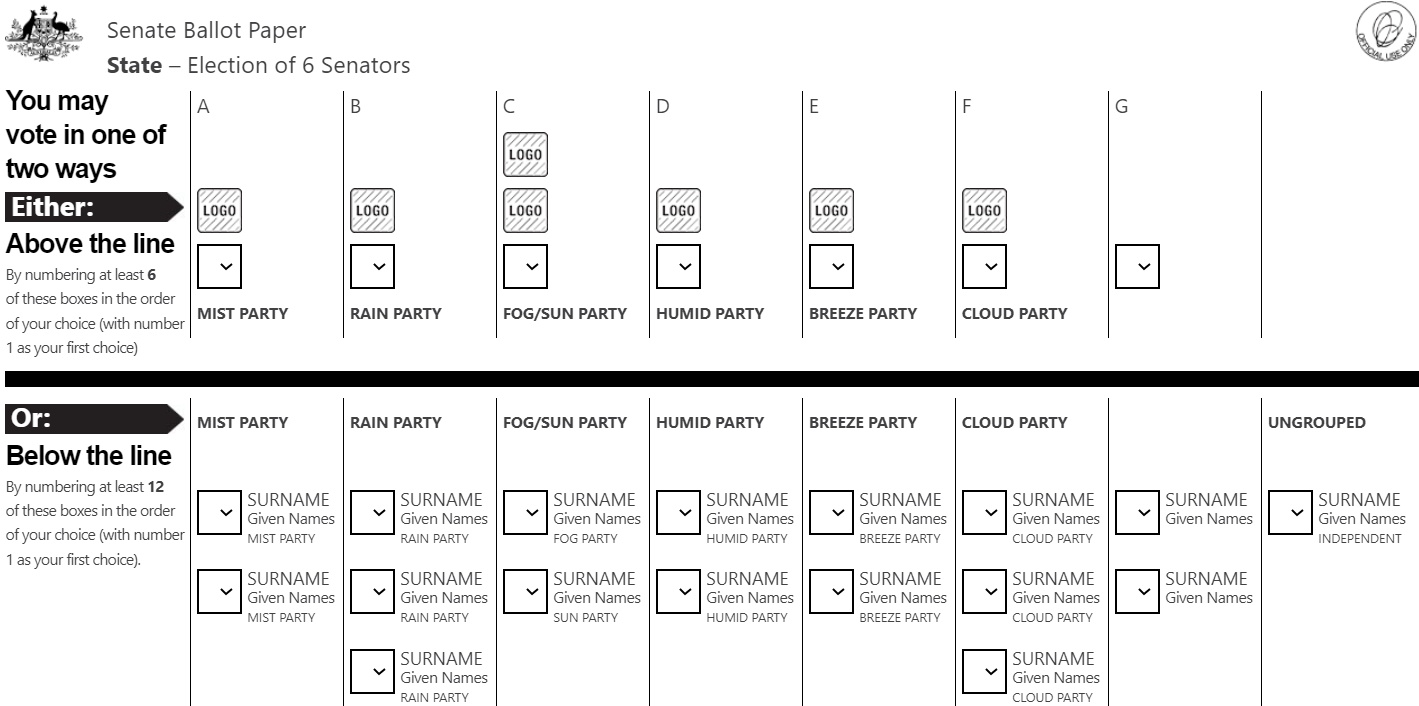
Credit: Australian Electoral Commission
There are two ways you can choose to vote.
'Above the line' is kinda similar to the Lower House ballot (that being, a lot simpler). Only thing is—you’re not voting for a specific candidate. You’re only voting for the party, who will select their candidate for you.
You must number at least 6 preferences.
If you want more control over which candidate from a specific party you want, you can vote ‘below the line’. Here, you must number at least 12.
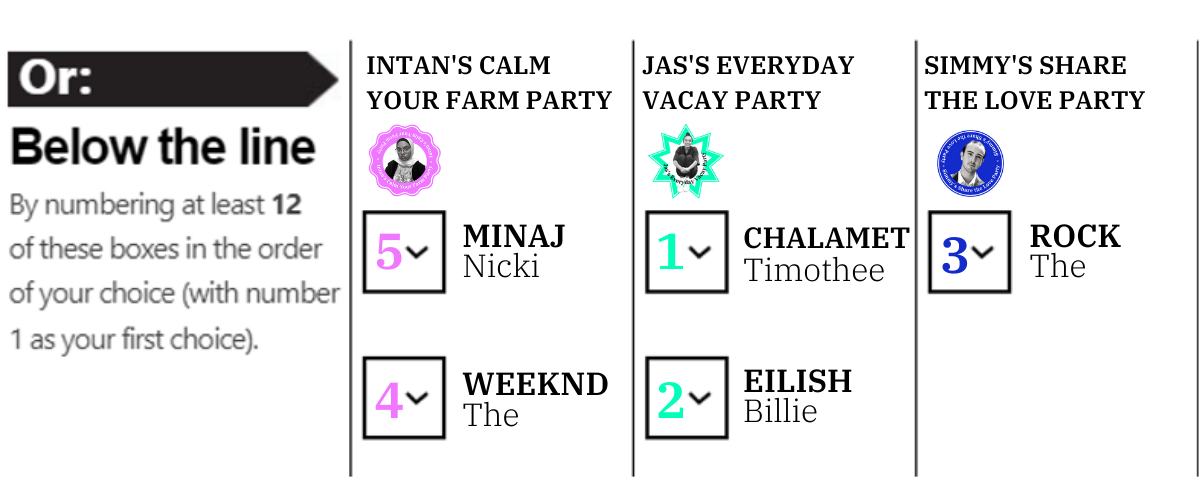
Credit: Australian Electoral Commission (edited)
Remember—the Senate is generally a ‘check’ against bills being passed in the Lower House, so political diversity can be a good thing!
You’ve made it to the end!
Phew, the election’s over. The votes are in. You turn on Channel 10 and Lisa Wilkinson is doing a wrap-up of the breakdown in Parliament.
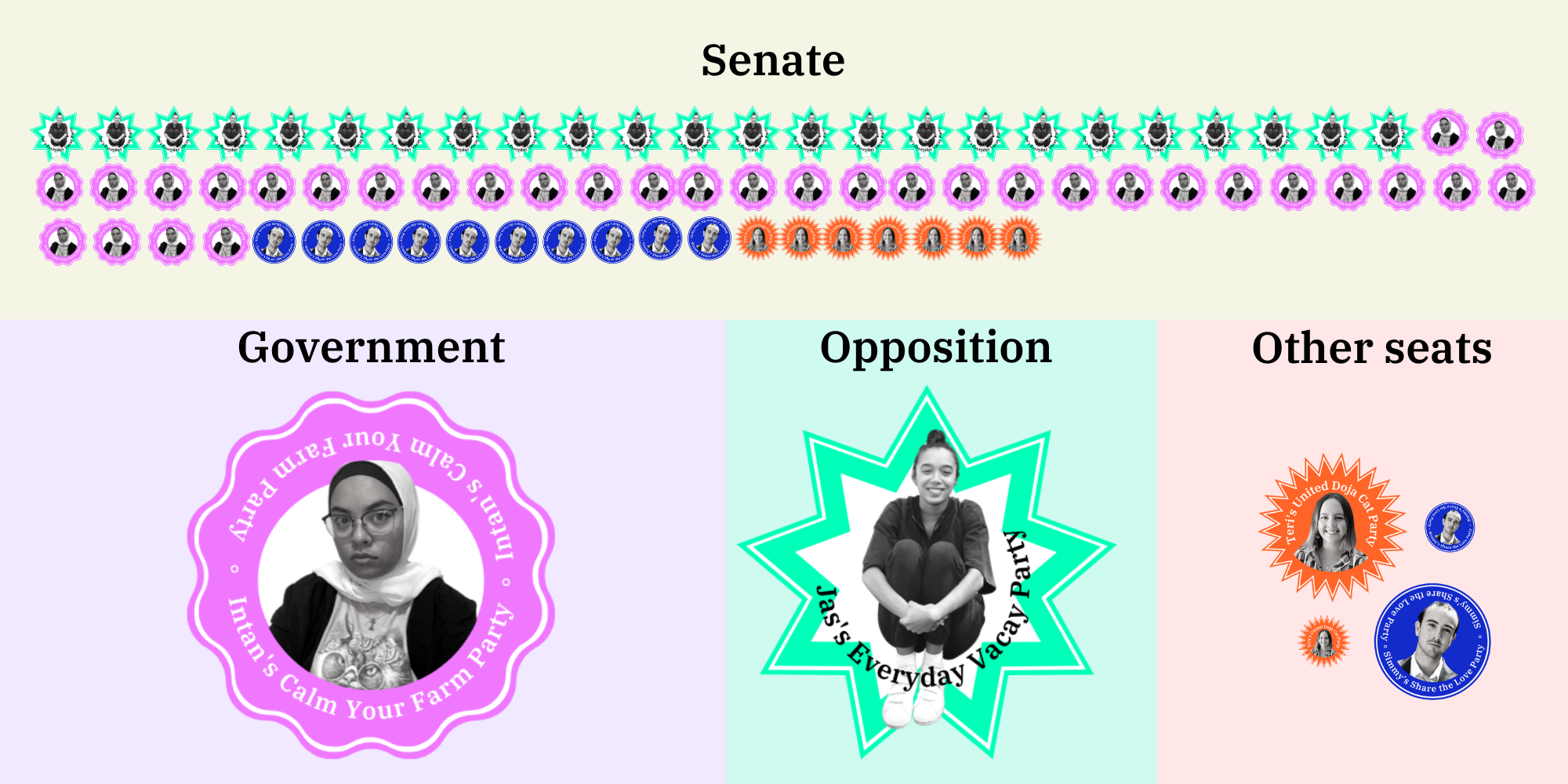
Intan is our new Prime Minister, leading Intan’s Calm Your Farm Party with a majority. It was a close win against Jas’s Everyday Vacay Party, who have formed the brutal opposition.
We’ve got Senator Nicki Minaj causing havoc in the Upper House, while the Hon. Timothee Chalamet appears to be taking a more centrist stance.

Be sure to brush up on your voting skills by practising on the Australian Electoral Commission website. And keep up with our articles this month for more on the upcoming federal election!
If this article helped you understand politics just a fraction more, we've got courses on doing all things life. Check out Student Edge Plus.