Movie Review: Netflix’s “Death Note” Is a Remake Gone Wrong
Netflix, in its efforts to make movies you don’t need to see on the big screen, is now just making movies you don’t need to see full stop.
Its latest, Death Note, follows the disappointing, self-produced War Machine, Okja and approximately three dozen Adam Sandler flicks, of which only Sandy Wexler gets a pass, and barely.
Whatever alchemy they’ve got going behind the scenes of their superlative TV shingle is absent on the film production side.
But you can’t fault them for taking some adventurous stabs with their features. One thing you can say of all their efforts—okay, except the Sandlers—is that they’re daring. The problem is, quixotically so.
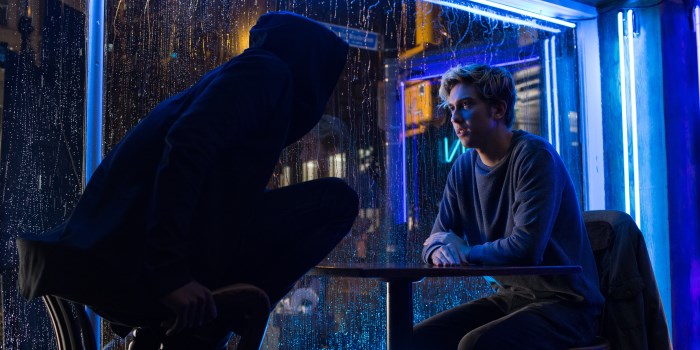
Adam Wingard’s Death Note, a remake and adaptation of the cultishly adored manga, transplants the original Japanese tale into an American school. It keeps the idiosyncratic name of its lead, Light, a student who magically comes into possession of a notebook into which he can write the names of anyone he wants cosmically killed. Light is played by Nat Wolff, who gets another kind of cosmic punishment for signing on to this needless do-over: frosted blonde tips. Does Wingard’s malevolence know no bounds?
Light is guided on his murderous mission by the cackling death god Ryuk (voiced by Willem Dafoe), wearing a wide, Cheshire grin and what appears to be a spiky version of Liza Minnelli’s fur coat. For his first kill, Light instructs the cosmos to decapitate the school bully, and the cosmos complies. He shares his superpower with schoolmate Mia (Margaret Qualley), and together, they devote themselves to a more noble cause: assassinating—from afar—the world’s worst people. Predictably, this gets them all hot and bothered, and murder becomes their form of foreplay.
Light, looking for a name to leave as a calling card at the site of his international murders of despots and paedophiles, picks Kira, a Celtic translation that also “sort of” means killer in Japanese. He argues that if the police try to arrest Kira, they’ll be looking on the wrong continent. “Wrong continent” is right. Death Note’s premise, stripped of its Japanese-ness, loses its already very limited appeal. In this new continent and context, it recalls a specific cultural stain: that of the American mass shooter. As if it wasn’t hard enough to watch fetishised teen violence. Now we have to side with a heroic, alienated student killer?
I was no fan of the prior live-action Death Note, which presented a tantalising ‘What If’ scenario and buried it in a sea of exposition and over-explanation; probably to be expected when your premise can’t stand up to more than thirty seconds of scrutiny. As Light exasperatedly says here after learning his own life is at risk due to the book’s baffling instructions: “There are so many f***ing rules.”
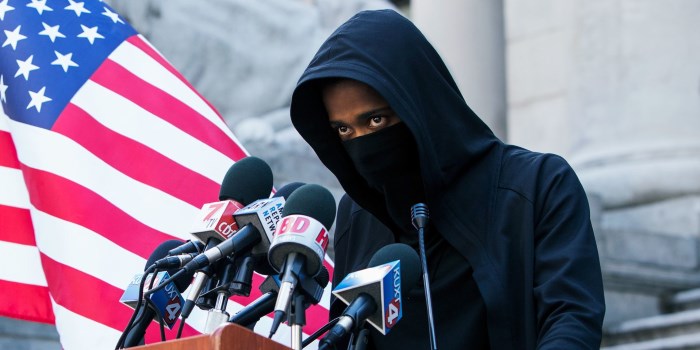
The remake, penned by Charles and Vlas Parlapanides, and Jeremy Slater, is faithful in that it maintains the strange streaks of black comedy from the Japanese version, as well as the extreme, grisly violence. It can even boast the casting coup of the excellent Qualley, who gets a lot of screen time (that’s good) but was likely absent from The Leftovers’ final season to film this (that’s bad). The likewise-great Lakeith Stanfield, a wildcard at the best of times, sadly struggles with the part of robotically-detached genius detective “L”. Death Note is smart enough to snap up some of the finest young talent in Hollywood, and in no other way.
Wingard, above all, needs to plot a better course for his career. After his wildly entertaining slasher-flick-during-a-family-reunion, You’re Next, he gave us the abysmal Blair Witch sequel. Now, this. At least Blair Witch seemed like a good idea. A ‘whitewashed’ Death Note was always going to be DOA.
The picture does have its moments of beauty: actors captured in artful shadows; cotton candy-colour lighting; a visceral climactic foot chase. It even has a moody, ‘80s-flavoured soundtrack (with a surprising penchant for Aussie artists like Australian Crawl, Air Supply and INXS).
However, the unnecessary and unsuccessful Death Note ultimately feels like a movie for no one, failing to interrogate its inherent ideas of alienation, revenge, teenagerdom and the ethics of vigilantism.
It's fitting that a movie about writing names should be a blank space, baby.
2/5
Streaming on Netflix from August 25. Rated MA15+ for strong violence, strong blood and gore, strong horror themes.
Photo: Netflix
Topics
Ref: 612b296c-37a4-4156-8bfc-a7d6003c5855



Comments & Feedback
Share your opinion
Emoji cheatsheet Formatting Comment guidelines