Movie Review: Ghost in the Shell
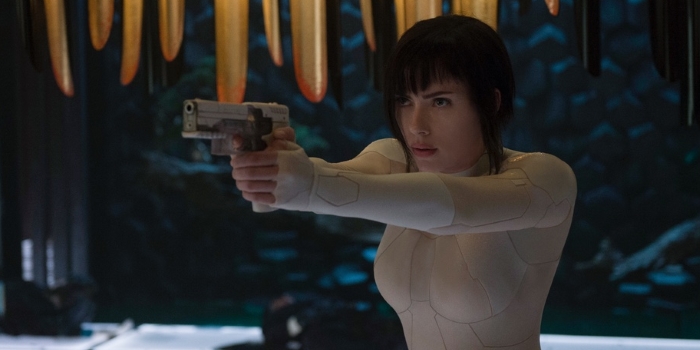
The live-action interpretation of the iconic anime Ghost in the Shell is kind of like Blade Runner, if Harrison Ford ran around in a skin-tight unitard.
The journey of Ghost in the Shell from beloved manga to big Hollywood production begins in 1989, with the publication of Masamune Shirow’s original comic, which told of a cyborg in future Japan investigating her human past while fighting baddies almost entirely in the buff.
But, in a more fiscal sense, the journey began in 2014, with the release of Luc Besson’s gonzo “what if a woman became a God?” action flick Lucy, starring Scarlett Johansson.
With the massive global success of that film under her belt, she became the sensible choice to play Major in Ghost in the Shell, which unfurls like Lucy in reverse (with a God-like cyborg recovering her humanity). Bankable, charismatic and convincing in a shootout, Johansson ticked all the boxes.
Oh, except for one glaring box, critics were quick to point out: She’s Caucasian. Like, ‘allowed in multiple Woody Allen films’ Caucasian.
There’s no way to talk about Rupert Sanders’ remake of this legendary Japanese text without diving into the whitewashing debate (even though the director of the 1995 animated feature, Mamoru Oshii, has no issue with Scarlett’s presence as Major). It remains an ongoing tragedy that opportunities for Asian actors go continually squandered, and in the wake of Doctor Strange and The Great Wall, Hollywood can no longer call these individual slights anomalies.
It is a cold comfort that screenwriters Jamie Moss, William Wheeler and Ehren Kruger find a decent creative justification for Scarlett Johansson’s casting as Major, in place of a woman of Japanese descent. It’s kind of like when Cloud Atlas made-up Halle Berry as a Korean man and Doona Bae as a Mexican woman: we appreciate the demonstration of human fluidity; now, please don’t do that again.
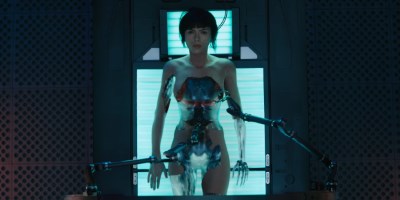
Sanders’ adaptation begins as Oshii’s did, with Major’s cybernetic physique being crafted from scratch; a process that includes a dip into one of those Westworld milk baths. (Is this where the whitewashing happens?) A human brain is implanted into Major’s enhanced body, awakening the Scarlett Johansson-resembling fembot that the Japanese government plans on using to take out cyberterrorists. The doctor (Juliette Binoche) wipes Major's human history, but she lets her keep her bangs, which is nice.
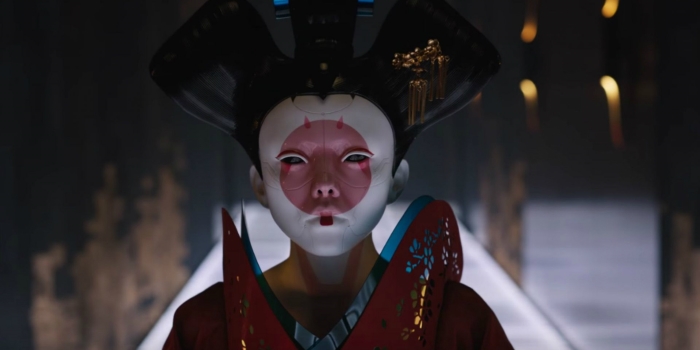
As with every project inspired by (or that inspired) Ghost in the Shell, the virtuous human side of Major creaks through her steely, murderous shell, and she becomes obsessed with learning of her past, having been given a nudge by a perpetually-buffering half-man, half-WiFi villain named Kuze (played by Michael Carmen Pitt, resembling Max Headroom). A meeting with a kindly woman (a scene-stealing Kaori Momoi) brings some clarity, further thrusting Major into crisis. If you came to Ghost in the Shell for slow-mo fight scenes in the rain and robotic geishas with guns for faces… well, you’ll get a lot of that here, but the superb Johannsson would have been wasted if this didn’t also put her on a moody path of existential despair in a sumptuous Asian setting. She’s a pro at that.
That is where the similarities between Ghost and Lucy end, however. Besson’s feature was infectious fun and more than a little silly. ‘Fun’ is not a phrase that has ever been used to describe a Sanders film. It’s likely he’s heard a joke in his lifetime, yet his cinematic works indicate he probably didn’t enjoy it. There's a flatness to his proceedings that threatens to undo the good of his SFX wonders.
Ghost in the Shell has lived many times in the media, and will likely live again. With ScarJo as Major? Only if Sanders’ take triumphs at the box office. A shame it’s not a more memorable experience, given Clint Mansell and Lorne Balfe’s pulsating score, the spectacular special effects and the presence of co-stars “Beat” Takeshi Kitano and Pilou Asbæk as Major’s colleagues. This one could have been something really special.
Alas, there’s no denying the asterisk that goes alongside this Ghost in the Shell, having come into the world whitewashed. At its core, the series poses insightful questions about the blurring line between humankind and the technology we eagerly surrender our bodies and minds to, just like Blade Runner before it. Still, it’s hard to sign-up for that internal autopsy when you spend much of the movie instead wondering: Is this problematic?
3/5
In cinemas now. Rated M for science fiction themes, violence and stylised nudity.
Photo: Paramount
Topics
Ref: ab442c02-b9fd-4b4e-9b63-a746003a1d93




Comments & Feedback
Share your opinion
Emoji cheatsheet Formatting Comment guidelines