Marriage Equality Returns As Key Election Issue Days Before The Vote (And You Can Thank Tony Abbott)
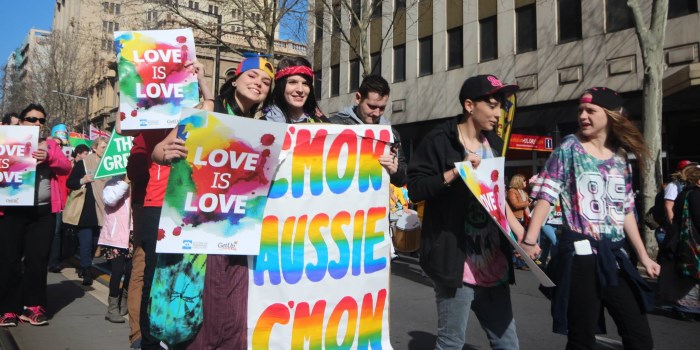
We’re in the waning hours of the 2016 federal election, and what a long, strange trip it’s been.
With just days before the big vote, the nation’s attention has returned to a topic that dominated discourse even before Prime Minister Malcolm Turnbull pulled the ‘double dissolution’ trigger: marriage equality.
(Funnily enough, the very thing that sparked his election call – the failure of Parliament to pass a bill reinstating the Australian Building and Construction Commission – has barely been uttered this election season.)
How did we get here?
Ever since he wrested the Prime Ministership from Tony Abbott, PM Turnbull has pledged a plebiscite on same-sex marriage, to take place shortly after the election (presuming the Coalition is returned to power).
For those who aren’t sure what exactly a plebiscite is, we wrote this handy explainer back in March.
But basically, it’s a bit like a referendum, in which voters will be able to publicly support marriage equality, or oppose it. Unlike a referendum, however, the results of the vote will not be binding.
What it will be is compulsory for Aussie voters, Turnbull has confirmed, with only a simple majority required to solidify a winning side. (In short: Most votes win. No need for a “double majority”, which requires the majority of voters in a majority of states.)
A referendum is only necessary when the Constitution needs to be amended, and Australia’s does not need to be changed for same-sex marriage to become legal – in fact, Parliament can legalise it whenevs. (Opposition Leader Bill Shorten has said there would be no plebiscite under Labor leadership; instead, he would make it his first legislative act.)
Will a successful plebiscite really, truly result in a change to the law?
Turnbull has continually reiterated that, should the public vote in favour of same-sex marriage, it will ‘sail’ through the Parliament, where it will officially become law.
But this is where things start to get sticky, as several prominent frontbenchers – including Scott Morrison and Julie Bishop – have evaded the question of how they would vote if plebiscite returns a resounding ‘yes’ (or perhaps just a mild one) from the Australian public. This is partly because the PM has said that none of his MPs will be bound to support the public’s verdict, affording them instead a “free vote”.
Roy Morgan Research suggests the reason why Liberal MPs are being cautious is because "three million Australian voters believe homosexuality is immoral—and the Coalition would find it hard to win Government without them," based on a new poll. (That's one in five Australians, btw.)
(Re-)enter Abbott. The former Prime Minister today said Aussies will feel “ripped off” if MPs refuse to pass same-sex marriage legislation should the plebiscite indicate the nation is in favour of it. The comment puts Turnbull's feet to the fire on the matter, potentially tying his fate to the plebiscite's result (and how his party responds to it in Parliament). Abbott's former Chief of Staff, Peta Credlin, also recently chimed in, predicting "a very big schism inside the Liberal Party" as a result of the plebiscite.
Abbott reiterated, however, that he still opposes gay marriage, despite supporting the plebiscite.
"Something like 80 per cent of the public, whatever they think on the issue, think that it is very properly determined by the people rather than, in this instance, by the Parliament,” he said.
"[If] it is going to change, I think more conservatively minded people will feel much more reconciled to any change, should it ever happen, if it comes from the whole people, rather than just an easily lobbied Parliament."
Are there other risks to a plebiscite that need to be considered?
Polling shows 72 per cent of Australians support same-sex marriage, and that number rises to 81 per cent when you just ask young people aged 18-24. (In our recent survey of members, marriage equality was considered the third most important item on the cards at this coming election.)
Despite those numbers, Australian Marriage Equality opposes a plebiscite, because research shows “the mental health of lesbian, gay, bisexual, transgender and intersex (LGBTI) people suffered significantly during referenda debates on marriage equality” in the United States. LGBTI Americans reported a 248 per cent increase in generalised anxiety disorders at the time.
Brian Tobin, a lecturer at Ireland’s University in Galway, explained this uptick - based on personal experience during Ireland's referendum - as the result of “homophobia masqueraded as concern for children’s welfare and anti-gay views [being] widely shared for many months before [Ireland’s own] referendum.”
Labor senator Penny Wong raised this last week, saying many “don’t understand that for gay and lesbian Australians hate speech is not abstract… it’s part of our everyday life.”
Morrison countered by saying those who oppose gay marriage are similarly targeted by “hate speech and bigotry”.
Will same-sex marriage play a deciding factor in Saturday’s election?
If you ask the PM, nope. At a National Press Club speech today, he said “the decision on Saturday is not about gay marriage,” though even this acknowledgment seems to prove that it has once again become a significant subject of debate this past week, aided by Abbott's most recent comments.
Whether or not he’s right is something we may only be able to acknowledge in retrospect, after Saturday, as the Coalition is still tipped to win by most pollsters. The fact Malcolm Turnbull publicly supports marriage equality also makes it difficult to discern whether or not the public will turn against the Coalition for their proposed plebiscite. If the three major party leaders – Turnbull, Shorten and the Greens’ Richard Di Natale – are all for same-sex marriage, will voters even consider it a factor in their vote, up against other pressing items such as education, defence and the economy (in the face of the EU’s impending Brexit)?
Should the Coalition win, however, Malcolm Turnbull might face an uphill climb with the plebiscite and his party. The SMH has compared Turnbull to British Prime Minister David Cameron, who reluctantly agreed to a referendum on the UK’s membership to the EU, resulting in his resignation when a ‘leave’ vote was returned. (Elsewhere, the same publication has called the plebiscite a “Faustian pact” with his party’s “conservative core”, noting that Turnbull would have rather preferred “swift parliamentary determination”.)
We’ll know more about the future of same-sex marriage in Australia after Saturday night.
Photo: Facebook / Australian Marriage Equality.
Topics
Ref: 843530ea-dbb9-4df5-9249-a63500535d5c



Comments & Feedback
Share your opinion
Emoji cheatsheet Formatting Comment guidelines