Everything You Need To Know About Julian Assange's "Arbitrary Detention"
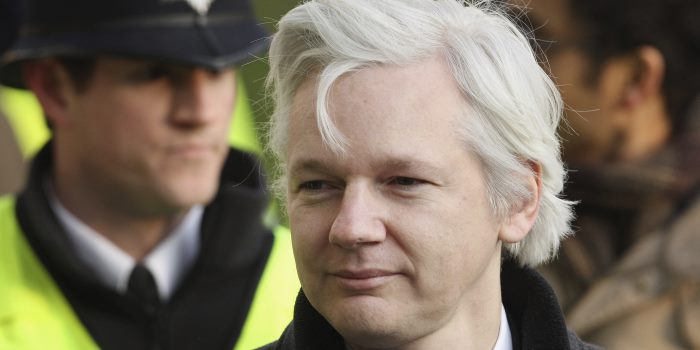
Last week a UN panel said WikiLeaks founder Julian Assange was being “arbitrarily detained” in London’s Ecuadorian Embassy by the Swedish and UK governments. Wondering what that means? Let’s dive in.
Do you remember that time in 2010 when The Age was still a broadsheet? It always seemed to have a pale man with white hair on the front page, with a caption that was some variant of “Is Julian Assange the digital age’s Che Guevara?” WikiLeaks founder Julian Assange had just leaked an indiscriminate heap of information, mostly involving politicians bickering like high schoolers, but also war logs from Iraq and Afghanistan. He was an overnight sensation who offended almost everyone in power and put ‘freedom of speech’ and ‘journalistic responsibility’ on everyone’s lips. Speculations floated around about the making of a film. Some hoped the Australian would be played by Draco Malfoy; others, the creepy guy from The Da Vinci Code. Everyone was vaguely disappointed when Cumberbatch got the part. So, what did he leak? Well, everything he was given by whistle-blower Chelsea Manning, then a soldier for the US army and now a convict at a military prison in Fort Leavenworth, Kansas. However, it was the horrors contained within Manning’s 391,832 classified military documents that most shocked the world; specifically, the revelation that 66,081 civilian deaths had been catalogued during the Iraq War and footage of US military gunmen shooting 15 people, including two journalists, while shouting, ‘dead bast**ds’. (The military refused to discipline the crew involved and said that they were unable “to discern if [the journalists] were carrying cameras or weapons.”) To see a more thorough list of leaks, head here. Since WikiLeaks’ launch in 2006, Assange has been criticised for not keeping the names of informers secret and been held responsible for endangering their lives. He has also been criticised for leaking the list of sites set to make up Australia’s internet blacklist, inadvertently encouraging children to seek them out. (Absurdly, these sites included a travel agency and a dentist’s website.) Was this why his arrest warrant was sought by Sweden and the UK? Despite how embarrassing, and at times incriminating, the leaks were for the people and agencies mentioned, including Hillary Clinton (who apparently used diplomats as spies), Assange’s arrest warrant had nothing to do with the leaked files. In 2010, two women raised allegations against Assange of sexual assault and rape in Sweden. The Swedish government sought to question Assange, then residing in the UK. Hence the warrant. Did he do it? Maybe. Maybe not. The reflexive response at the time was to dismiss the accusations as bizarre; even Women Against Rape met them with scepticism. He hasn’t been charged with anything yet and the Swedish authorities desire only to question him. They rejected his offer to make a statement from London. Perhaps his allegations were conveniently timed; however, they shouldn’t be so easily dismissed. He has refused to give DNA and STD samples as evidence. He has also been known to “boast about how many children he had fathered in various parts of the world,” according to former WikiLeaks spokesman Daniel Domscheit-Berg. And he has shown no intention of helping the women he has impregnated. We also know that these two women were involved in the WikiLeaks movement and actively opposed the US, making it unlikely they would ruin their careers for its government. That doesn’t prove they’re telling the truth, but there’s nothing to prove they’re lying. How does the Ecuadorian Embassy enter the scene? The British Department of Foreign Affairs has said “an allegation of rape is still outstanding and a European arrest warrant in place, so the UK continues to have a legal obligation to extradite Mr. Assange to Sweden.” The possibility that, after arriving in Sweden, he will be bungled off into another van and taken to the US is not one that he is willing to face. Assange has said that he fears suffering the same fate as Chelsea Manning, who is serving a 35-year prison sentence. As Homer Simpson taught us, when you enter an embassy, you enter a new country and are subject to its laws.
Susan Alfayadh is one of Student Edge’s student contributors. Learn more about the contributors program.
Topics
Ref: 299ca0b3-c701-4074-88fa-a5a6007152e9



Comments & Feedback
Share your opinion
Emoji cheatsheet Formatting Comment guidelines