Album Review: Lemonade by Beyoncé

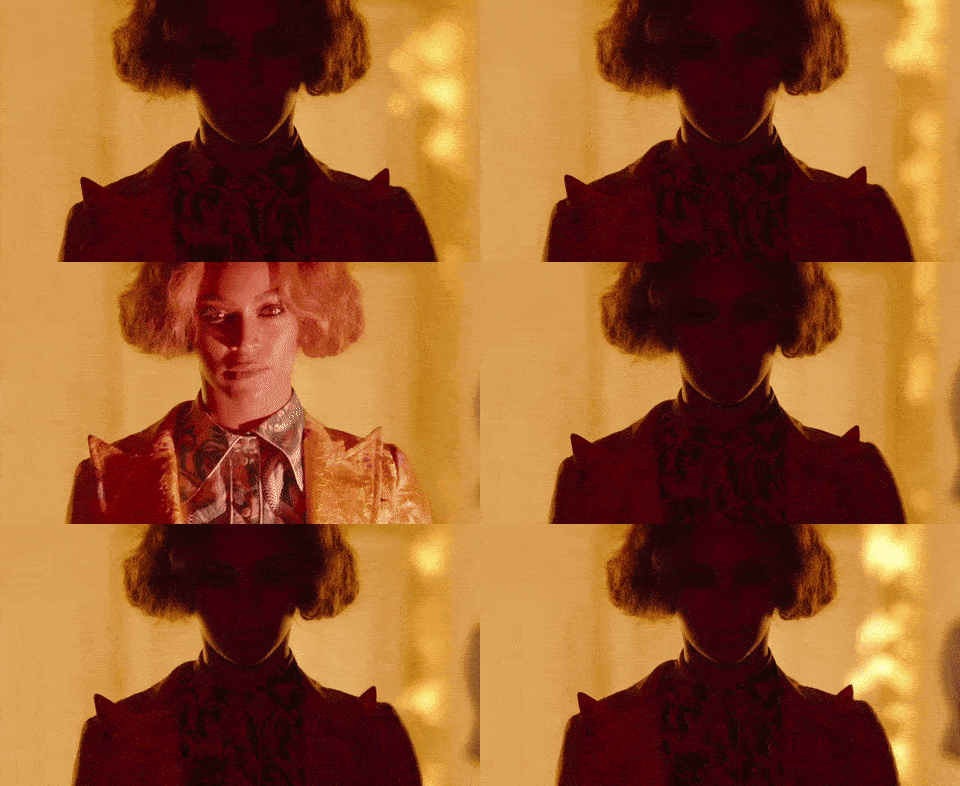
It takes a village to make an album. Or, should that be ‘a hive’? Beyoncé has assembled hers for surprise release Lemonade, a seeming take-down of husband Jay Z and tribute to black womanhood, all in one.
Ben Lee once asked, “What Would Jay Z Do?” Nearly a decade later, the more pertinent question is, “What did Jay Z do?” In his 13 years on Beyoncé’s arm, the rapper and mogul has been followed by countless infidelity rumours. It all appeared to culminate in an elevator brawl with Bey’s sister Solange at the 2014 Met Ball. In leaked security footage, Beyoncé looks on impassively as Solange strikes Jay, reminding us that the interview-shy Queen Bey is, above all things, unknowable. She’s been slightly less sphinx-like in her music, alluding to philandering as far back as 2006’s “Irreplaceable”. But, having largely avoided press since that elevator incident, she’s offered fans and voyeurs little insight into the current state of the Knowles-Carter household. Then Lemonade happened.
Jay Z watches Lemonade. pic.twitter.com/KiWAv7DnE3
— Libby Hill (@midwestspitfire) April 24, 2016
Jay-Z rn bc he finally got 100 problems pic.twitter.com/Fc8S48F1yA
— sam weir (@98schild) April 24, 2016
Has anyone’s spot been blown up on this scale before? (For his part, Jay has kept mum. In fact, all we’ve heard of Hov lately is his two-line Tweet-rap from Drake’s “Pop Style”. Not even a month old, his tiny verse – “They still out to get me, they don't get it. I cannot be got, and that's a given.” – now seems terribly dated.) As a pop cultural moment, Lemonade is massive. In the wake of Prince and David Bowie's passing (and cries that unifying musical legends are now few and far between), Lemonade reminds you that the monoculture is alive and well. But memes can’t mask bad music. Mercifully, just like ‘13’s Beyoncé, Lemonade is a solid, interesting and idiosyncratic record; socially conscious, adventurous and hugely catchy. Usually, those last three things are mutually exclusive. Bey finds a way. Opening track “Pray You Catch Me” sees her distorted voice (not unlike experimental Kanye collaborator Caroline Shaw) twist into a melodious admission: that she’s grown wise to Jay’s wandering. Co-writer James Blake’s trademark, synthetic piano tinkling segues into the airy, Diplo-produced kiss-off song “Hold Up” (which offers writing credits to fellow alt heroes Ezra Koenig and Father John Misty). Rather than being jarring, the transition from mournfulness to the musical equivalent of “Bye Felicia” reminds us this ain’t no pity party. To describe the following two tracks as 'bangers’ would be a gross understatement. On the demonic “Don’t Hurt Yourself” (featuring Jack White) and bouncy “Sorry”, Bey drops memorable, foul-mouthed diss after diss. “Keep your money; I got my own,” is not the most striking, but it’s the only one I can probably print.Bey looking at Jay on the couch during #LEMONADE like pic.twitter.com/7bLZZe99cD
— Brett S. Vergara (@BrettSVergara) April 24, 2016
(For more reading on the ways in which Beyoncé intersects with the #BlackLivesMatter movement and how Lemonade is about "the undeniable power of a black woman's vulnerability" - thoughtful takes that, notably, were not written by a white dude - I recommend those two hyperlinked roundtables from Vulture.) Becky be damned, Lemonade builds to something like a presidential pardon of Jay Z, with the euphoric, magnanimous “All Night” (buoyed by the irresistible horns of OutKast’s “Spottieottiedopaliscious). “True love breathes salvation back into me; with every tear came redemption, and my torturer became a remedy,” she croons. The song convinces you of communion. Still, can any tale that ends with the hero reuniting with their “torturer” really be considered happy? No artist - not even one as indomitable in stature as Beyoncé - makes an album in isolation. (Even Kanye, offered the 'genius' designation by this very writer for The Life of Pablo, had a little help from more than 100 collaborators.) However, the artist who gives their name to an album gets credit for curation, especially if their name is as big as Bey's. After two decades in the industry, she knows well how the public perceive her and her records. So, it matters not that her latest effort has dozens of producers, song-writers and creatives on board. The ultimate product is hers. So too are her distinctive line-readings. (Her “sh-ee-eets” from “Hold Up” is just one example of an unexpected, delirious-making lyric. See also: “surfbort.”)

Lemonade is now available.
Topics
Ref: 8b9c8114-4a3d-4403-9f85-a5f4005b6d0a





Comments & Feedback
Share your opinion
Emoji cheatsheet Formatting Comment guidelines