Album Review: A Seat At The Table by Solange
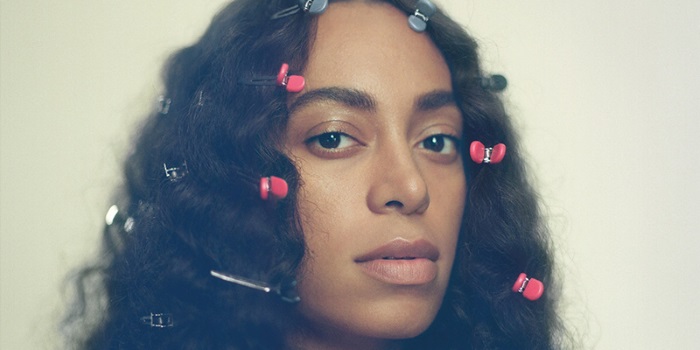
With the conscious A Seat at the Table, Solange Knowles emerges from her sister's shadow - all while offering the ideal companion piece to Beyoncé's own Lemonade.
Solange Knowles' most famous moment was recorded in an elevator and delivered to us with not one but two TMZ watermarks spoiling the surveillance camera's god's eye view.
The footage of a furious Solange kicking Jay Z at the Met Gala came without sound. Her sphinx-like sister, Beyoncé, could be seen silently observing the attack.
Ever since, Solange has been best known for a moment of inscrutable silence. No longer.
The surprise-released A Seat at the Table - her third album to date - reveals that the younger Knowles sister indeed has something to say; boy, does she know how to say it, too.
(Don't expect an appearance from Bey, however. In an incredible troll, the one Child of Destiny to cameo here is Kelly Rowland.)
Beginning with the hymnal "Rise", the album opens in earnest with "Weary" and its tone-setting refrain: "I'm weary of the ways of the world; be weary of the ways of the world."
From there, Solange despairs over the state of her nation, detailing the various manifestations of racism met by the black community on a daily basis. And yet, through it all, she advises the listener - and herself - to not feel defeated. She's cautiously optimistic, emphasis on the 'cautious'.
On the secretly-subversive slow-jam "Mad", Solange and Lil Wayne agree they've "got a lot to be mad about", fending off questions from some "girl" who wonders why they're always complaining. (The unnamed girl's political persuasion is assumed.)
Solange tenderly, if insistently, draws a line in the sand with "Don't Touch My Hair", noting the significance and history of her "crown". The hook sees Solange, with an assist from Sampha, asking the rhetorical question, "What you say to me?" on a loop - probably to that aforementioned "girl".
Spoken-word interludes from various guests make explicit Solange's intentions. One is a first-person memory of an encounter with the KKK; others are inspirational tales of actualisation and enterprise. (Fittingly, the record was partly released through Knowles' own label, Saint Records; it also offers a tribute to "FUBU" - For Us, By Us.) Master P is given space to tell his story across several interludes, concluding with the lesson to his community: "You gotta rehab yourself." Solange's mother, Tina Lawson (formerly Knowles), meanwhile, talks about the "beauty in being black", and clapping back at those accusing her of "reverse racism".
Nonetheless, the songs still stand as powerful statements independently. With production from Raphael Saadiq, Q-Tip and Questlove, A Seat at the Table has sparse drum beats, tinkling piano threads that stretch across songs and a hypnotic groove ("Cranes in the Sky", most hypnotic of them all). None match the breeziness of her 2012 shoulda-been-a-summer-hit "Losing You", which is fine, because A Seat at the Table has grander aspirations than soundtracking backyard barbeques.
Of late, the Knowles sisters have made a point of offering their considerable voices to political movements, such as #BlackLivesMatter, and calling for serious social change, in a manner that many pop artists are encouraged to avoid. (Quick: What does Taylor Swift think about literally any cause?)
Whether by chance or orchestrated synchronicity, they have shared individual, intersectional releases in 2016, all about what it means to be a black woman in America (though, their experiences are not exclusive to the United States). This writer, sitting at the exact opposite end of our unequal social strata, can offer no specific insight into that particular worldview; however, the mainstreaming of it by Beyoncé and Solange is surely helping to encourage empathy in anyone who was previously happy to let disenfranchised voices remain silent.
The most subversive track is the stealthy closer "Scales", ostensibly a love song by a woman for her man, in which she has to acknowledge a harsh reality: "Your world is kind, but your world ain't blind." There's a lingering threat that hangs over this romantic entanglement, for no reason other than circumstance and prejudice. The song brings back the memory of Diamond Reynolds, live-streaming the shooting of her innocent partner Philando Castile: "Please don’t tell me my boyfriend just went like that."
Maybe the patriarchy will simply topple itself if more Knowles family members keep releasing haunting, sultry, irresistible and empathetic albums like A Seat at the Table.
4/5
A Seat at the Table is now available digitally. It will be released as a physical album in November.
Topics
Ref: 4eef8ee0-65b3-4b57-bd69-a69600897257





Comments & Feedback
Share your opinion
Emoji cheatsheet Formatting Comment guidelines