Why Do Queer Movie Posters Always Show Girls (Almost) Kissing? And Why Never Guys?
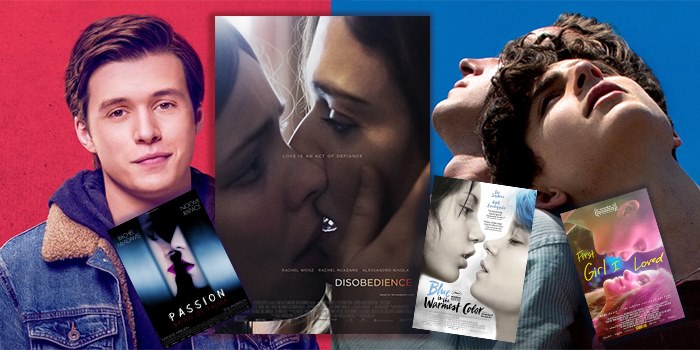
It’s kind of a thing. So, we asked some experts about it.
Disobedience, in Australian cinemas this week, is being promoted with a poster of Rachel Weisz and Rachel McAdams in a provocative pose, almost kissing.
In the film, the Rachels play childhood friends (and onetime lovers) who reconnect as adults, still constrained by their strict Orthodox Jewish community. If the title didn’t give it away, the poster paints a clear portrait of what audiences can expect: forbidden tongue-touching.
It’s a striking one-sheet, and it brings to mind another McAdams movie with a similarly lusty title and poster (though the movie itself is more salacious): Passion.
The posters for Disobedience and Passion aren’t so far removed from those for queer dramas Blue Is the Warmest Colour, First Girl I Loved, Below Her Mouth, Allure, Women Who Kill and A Perfect Ending, which were all released within the last six years. Clearly, the almost-kiss is a trend in queer movie posters. In fact, we probably have enough examples here for an entire Near-Pash Film Fest.
"I think it’s definitely empowering,” says Dr. Stuart Richards, a lecturer at RMIT University and University of Melbourne, and author of The Queer Film Festival: Popcorn & Politics.
"If you look at a lot of queer films that have been nominated for Academy Awards—Monster, Brokeback Mountain, A Single Man, The Hours—where there are explicitly queer characters in those films, in all of the marketing materials, you do not see intimacy.
"So, definitely seeing something like Disobedience, where we have two A-level actresses being intimate on the poster, I think that’s incredibly liberating and should be celebrated."
However, Dr. Natalie Krikowa of University of Technology Sydney disagrees, telling Student Edge she "wasn’t a huge fan" of the Disobedience poster or its stars' positioning.
"The way that it’s framed is not for a queer gaze at all," she says.
"If it’s for mainstream audiences, what they’re presenting is this one type of intimacy and that type of intimacy is a sexualised one.
"There’s a complexity to love, and we’re only being presented with one vision of that love, and that is, two women looking lustingly at each other."
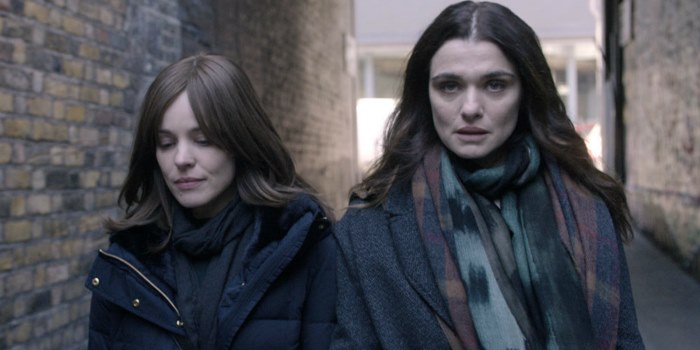
Disobedience
Natalie will be talking about the Disobedience poster at the upcoming ASPERA conference, in her presentation: "Intervention as Activism: Advocating LGBTIQ representation through independent film production".
Ten years ago, she used a not dissimilar poster for a short she co-wrote and produced, titled Lightswitch—with one key distinction: the characters were positioned to resemble a heart shape.
"It wasn’t about lust, necessarily; it was about love," she explains.
A question remained. Why aren’t movies with queer male leads (think Call Me by Your Name; Love, Simon; God’s Own Country; Moonlight and BPM: Beats Per Minute) commonly advertised with the same level of erotic intimacy as their queer female counterparts?
"Audiences are generally more comfortable seeing women kiss than men kiss," Stuart concedes.
"There are several reasons for that: One is because intimacy between women is more culturally accepted. It also is titillating for heterosexual male viewers, whereas that’s probably not the case for male kissing.
"There’s a longer history of men having to hide their intimacy. Even straight men have to hide their intimacy, for fear of appearing too gay."
"It’s still not socially acceptable," Natalie adds.
"But 'two women' has always been that straight male fantasy. That gets a lot of people going, 'Ooh, that should be good. That should be interesting.'
"When the straight male producer is making the film, he’s okay with that level of sexuality in females but not in males. And that’s still unfortunately the case with most distributors of mainstream Hollywood cinema."

Love, Simon
There’s no denying queer cinema is getting more mainstream acceptance and promotion than ever before; not so long ago, flicks like Moonlight, Call Me by Your Name and Disobedience might have been relegated to the fringes.
And yet, representation remains a massive issue, with GLAAD annually noting the dearth of gay, lesbian and transgender characters across film and TV.
Stuart nonetheless points towards Love, Simon as a move in the right direction.
"With something like Love, Simon, the trailer is very open about the queerness of the film, and it's doing well at the box office, so that serves the point that these movies can sell, and Love, Simon is the first major studio-backed film that has a gay teen character as the lead," he says.
Ultimately, the larger problem isn’t simply that movie posters featuring queer female leads are more sexualised, or that those featuring queer males sometimes hide their queerness; it’s that there are so few types of queer movies being made, and even fewer being made by queer voices.
"In queer cinema, you’ve got two stories that get foregrounded, and that’s either a coming-out story or 'I’ve fallen for the straight person and I get my heartbroken'," Natalie says.
"We’re not really getting any counternarratives or anything beyond that from alternative perspectives."
So, if we want more kinds of queer movie posters, we’re gonna need more kinds of queer movies first.
Photo: Roadshow / Sony Pictures / 20th Century Fox / Arcadia / Paramount Pictures
Topics
Ref: 2fffa593-32e2-4c70-9537-a8fc003bcb1f





Comments & Feedback
Share your opinion
Emoji cheatsheet Formatting Comment guidelines