Movie Review: Moonlight
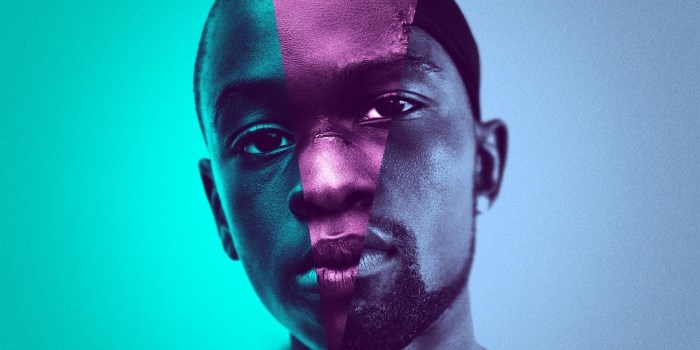
Barry Jenkins’ artful awards contender Moonlight defies convention and cliché to become one of this decade’s most essential movies.
What makes a person? Their colour? Sexual orientation? The scars created by those who flit in and out of their lives, or those who remain and more gradually leave a lasting indentation? One's choice of driving music? Hey, a lot of us put quite a bit of thought into that last thing.
Moonlight, only the second feature to writer-director Barry Jenkins’ name, eschews a traditional narrative to get to the heart of these questions of identity. As shorthand, people will no doubt refer to it as that film about the gay black man, just as Paterson will go down as the film about the bus-driving poet. Both accurately describe who the movie is about, but not what the movie does, or how well it does it.
Moonlight follows, in three parts, the life of Chiron in the Miami housing projects (where Jenkins and playwright Tarell Alvin McCraney, who penned the drama school project In Moonlight Black Boys Look Blue upon which the picture is based, grew up). Chiron’s played as a child by Alex R. Hibbert, then as a teen by Ashton Sanders, and finally as an adult by Trevante Rhodes. Each act is marked by his evolving nicknames (Little, Chiron, Black) and in each he’s confronted by Kevin (Jaden Piner, Jharrel Jerome and André Holland), a childhood friend who becomes something more, and more complicated, over the years.
There’s little else to it than the chronological winding of the clock, from childhood to adulthood, but again, reading that paragraph does not reflect the experience of Moonlight fully, or even partly.
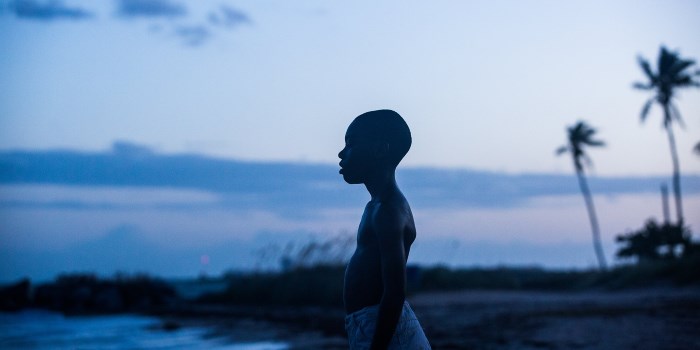
Scanning the seemingly-uneventful synopsis does not do justice to the performances, particularly of the three Chirons, each sensitive and vulnerable yet gradually hardened by time (though never fully). It doesn’t capture the generous warmth of Mahershala Ali, as the drug-dealer Juan, who takes young Chiron under his wing and faces a quiet reckoning of his lifestyle; or the brittle Naomie Harris, as Chiron’s crack-addled mother; or Janelle Monáe, as the more ideal, sturdy maternal figure you wish would sweep in and save Chiron from his life.
On paper (or whatever the internet is written on), each is fulfilling the role of a tired stereotype from black cinema (or Hollywood’s interpretation of it). However, the performers—presumably guided by Jenkins, wrangling varied casts across three timelines—offer shading to previously pigeonholed characters. Each identity winds up under interrogation as a result.
As a young boy, Chiron asks Juan what a gay slur, overheard by schoolyard bullies, means, and if it applies to him. As a teen, he angrily questions why people call him 'black' (old nickname 'little' no longer applies). Later, Chiron hopefully prods Kevin into admitting he cries too. By the time a slowed-up version of Jidenna's “Classic Man” plays in the final act over Juan’s old car—now Chiron’s—it’s clear Barry Jenkins has sowed the seeds of doubt in Chiron, and us. What are we? And which labels apply?
The recitation of plot alone couldn’t convey the significance of individual moments. Words fail Nicholas Britell’s chopped and screwed symphonic score; an unlikely marriage of orchestral stings and hip-hop remixes that disorients, much like Jenkins’ treatment of time. Reviews can’t recreate cinematographer James Laxton’s high contrast interpretation of Miami’s neon nightlife and its coast, or the deliberate, jarring sound mix either.
Moonlight defies more than the movies. It defies the way we identify ourselves as well. If you’re looking for shorthand, call it the portrait of a person. Say it's also beautiful to behold, and brilliant.
5/5
In cinemas January 26. Advance screenings January 20 – 22. Rated M for drug use, coarse language, sex and violence.
Photo: A24
Topics
Ref: 63f42379-3152-462b-9a22-a6fa003ece44




Comments & Feedback
Share your opinion
Emoji cheatsheet Formatting Comment guidelines