Flipping the Script in Western Sydney: We Found the Spot Australia's Emerging Teen Poets Are Born
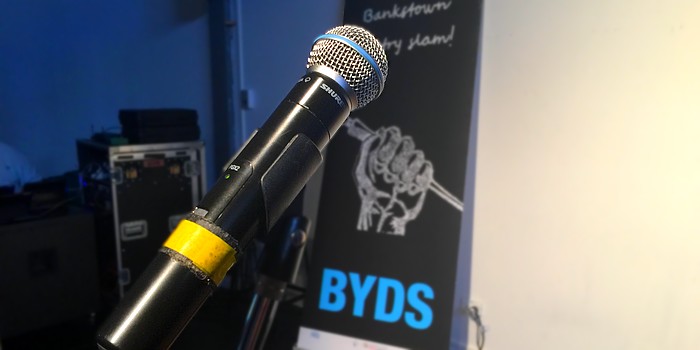
Western Sydney is home to some serious talent.
In the centre of the hall, an overhead light illuminates a bare stage with a rug and a microphone, casting the remainder of the space in blue shadows. This is where, in a few hours, some of Sydney’s best slam poets will compete, but right now it’s a practising ground for young, emerging poets who want to hone their craft and prefer the comfort of smaller crowds.
At Flip the Script, run by Bankstown Youth Development Service (BYDS) in the suburb's Arts Centre, the idea is simple: Sign up before the doors open at 5pm and get a chance to perform on the same stage as the main event, which starts two hours later, with some feedback from resident poet Bilal Hafda. It's poetry slam with training wheels.
There are a handful of performers sitting around the well-landscaped lawn outside the main theatre, reciting their lines and waiting for the doors to open. There’s Hareem, 19, a regular at Flip the Script, and Jessica, 22, who has been writing poetry and listening to Button Poetry since she was in high school, but hasn’t performed to a crowd before.
"It's uni holidays and I've always wanted to perform at slam poetry," Jessica admits. "I've been putting this off for so long."
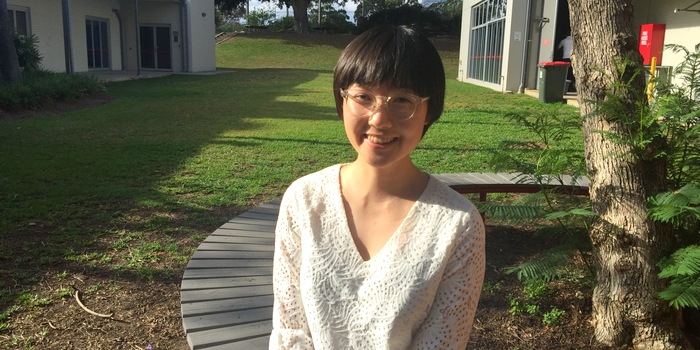
It was Jessica's first time at a poetry slam.
It’s also Alayna’s first time here as an audience member, though she’s no stranger to this scene; she regularly performs at Parramatta Poetry Slam.
"I think it’s important for anyone, from any single background, to voice what they want to say to people," Alayna explains. "[Poetry slam offers] a unique medium to do that creatively."
Hareem, on the other hand, has become a regular since discovering the project at one of the centre’s monthly poetry slams.
"I try to come to as many as I can," Hareem says.
The centre’s main event—the monthly poetry slam run by Bankstown Poetry Slam (BPS)—started in 2013 and is now the largest slam in Australia. Co-founders Sara Mansour and Ahmad Al-Rady were apparently sick of having to drive to the city to watch poetry that didn't reflect their experiences in Western Sydney. It was then that they decided to create their own poetry slam in Bankstown.
Fast forward to 2017 and the slam is blooming. Budding poets put up their names just before the event and are picked at random to perform to the packed theatre. They have three minutes to perform their stories and are graded by audience members straight after.
The currency of performances here, however, isn’t clapping, like you might find at a concert. It’s finger snapping. Bilal explains to the audience that clapping can disrupt a performance, whereas finger snapping offers subtle encouragement.
Anyone who has been to BPS will tell you it’s a passionate and electrifying experience. Participation isn’t just encouraged, it’s expected.
But at Flip the Script, there are no scores, there are no time limits and there are no boundaries on what you can perform. As BPS Co-founder and Artistic Director Sara Mansour explains on the website: "[It’s] a space for you to perform whatever you want to, without any rules."
Equally, with fewer people around, those wracked with nerves can perform in a more comforting and encouraging setting.
"I've only just started performing poetry recently and that’s because I’ve only just started to gain the confidence to do so," Hareem says.
"With Flip the Script, it's much less intimidating because it’s not a competition like the slam is."
The subjects of the performances vary greatly too.
"You can come to slam poetry with some articulacy or you can come with just some raw, potent images," Jessica says. "You can talk about anything."
The performances today range from poems of love and self-nurture to experiences of ableism and suicide. It's a confronting experience as an audience member, having such honest and fervent accounts of the performers' lives shared with you.
"I think it's very important for young people of all backgrounds to have an outlet for self-expression," Jessica believes. "I think poetry can be very emotive and very accessible."
Hareem echoes this sentiment. She believes young people should have the opportunity to have their voices heard, no matter where they live.
"Especially in Western Sydney, I tend to find that our voices aren’t heard," she says.
That's why Bankstown's and Paramatta's slams are so important to the local youth who are disillusioned with Sydney's geographical class and culture divide.
"I think it's a really flexible and powerful form of self-expression," Jessica adds. "That’s great to make available to everyone."
Photo: Sarah Basford
Topics
Ref: dca55523-87d8-4c9a-88a6-a841004a7e8b



Comments & Feedback
Share your opinion
Emoji cheatsheet Formatting Comment guidelines