What the ‘Two-Person’ Rule for Social Gatherings Means for You

Get ready for some serious social distancing.
Each day, the coronavirus (COVID-19) pandemic becomes even more of a serious issue than it was the day before.
We’ve already watched our government put drastic regulations on workplaces, schools and social gatherings, as well as restrict the use of countless businesses, all in the fight to protect the vulnerable and elderly people in our communities.
As these rules tighten, Prime Minister Scott Morrison has announced that the previous rule restricting gatherings to a maximum of 10 people would instead be minimised to just two.
This change illustrates the urgency in the fight against the coronavirus pandemic as it is considered the most radical decision yet in response to this crisis.
But how exactly does the 'two-person gathering' rule actually work? And what will it mean for your everyday life? Let’s find out.
What exactly are the new rules?
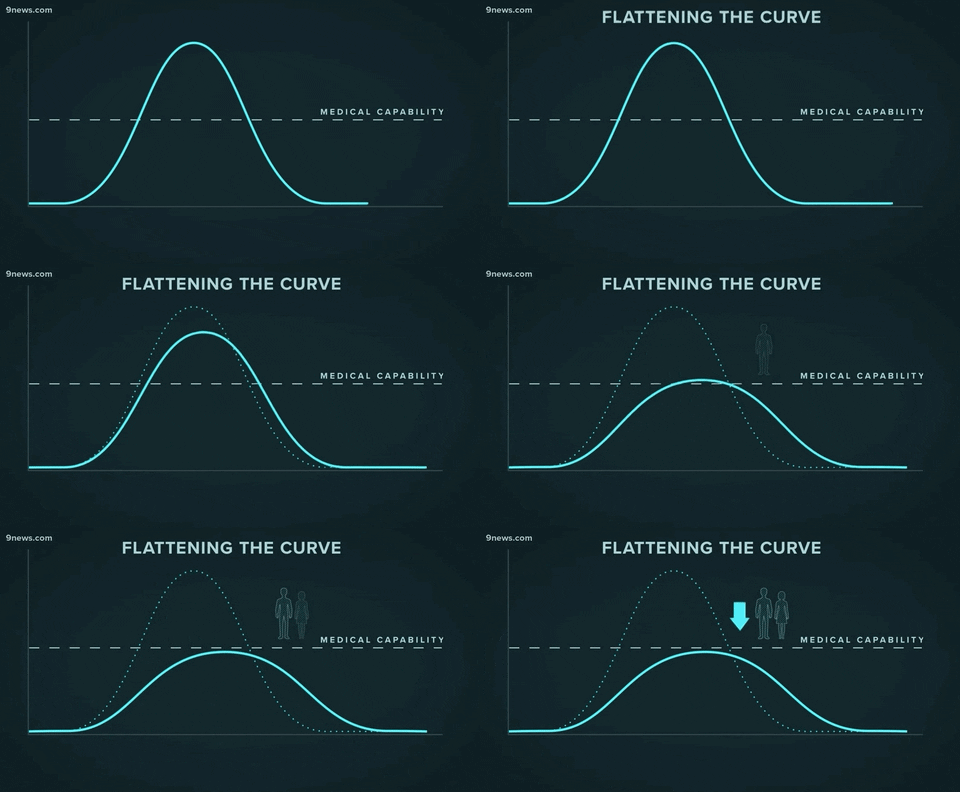
Previously, the government had restricted both indoor and outdoor non-essential gatherings to a maximum of 10 people to try and “flatten the curve” (flattening the curve refers to taking measures to try to slow the spread of the coronavirus to minimise the strain on our healthcare system).
As of now, those rules have since been scrapped and replaced by a limit of just two people, applicable to both indoor and outdoor gatherings as well as private properties, tightening the definition on social distancing.
While the new rule applies to everyone in our communities, there are further restrictions on individuals aged over 70, individuals aged over 60 living with a chronic illness and Indigenous people over the age of 50, who are all being encouraged to stay home and self-isolate.
The government has also enforced closure of all public skate parks, outdoor gyms and public playgrounds.
The only gatherings unaffected by the new rules are weddings, which are limited to five people, and funerals, which are currently capped at 10.
Can I still leave my house?
This all seems very strict, so, you may be wondering, 'Can I even leave my house? Can I go to Woolies? What about my job?'
While everyone is encouraged to stay in their homes when possible, in this instance you can leave your house, but only for the four acceptable reasons outlined by Mr Morrison.
These reasons include work and education, medical care or compassionate needs, shopping for necessities like groceries or to exercise (provided it is compliant with social-distancing guidelines).
So basically, if you need to leave your house, you can do so but make sure you continue to steer clear of other people and avoid unnecessary activities outside of your home. And be sure to triple-check the guidelines of your state (see below).
What about visiting family or friends?
Before you freak out because you live with three people and are worried about breaking the rule, don’t worry! The rule does not apply to people within your household.
So, you and your roommates (and your dog) are fine to hang out in your house and socially distance together.
Families of more than two people can also still go out together as long as they keep a distance from anyone they don’t share a home with.
As for visiting people you don’t live with, the two-person limit does apply.
Families split across two houses can meet, as long as common sense and caution is taken and you can still meet up with your bestie for a run or your partner for a home movie, as long as it is just the two of you.
While you technically can still visit people that you don’t live with, you should consider against doing so, because the best way to protect you and others in your life is to stay away as much as you can.

What are the penalties for non-compliance?
If you’re wondering how strict these new regulations are, you might be a bit surprised when you find out that there will be penalties for people who just can’t follow the rules.
When it comes to the actual penalties for non-compliance, it really depends on which state or territory you live in as they have determined their own individual enforcement rules. (These are accurate as of 2 April.)
In NSW, Premier Gladys Berejiklian said offenders will face a maximum penalty of imprisonment for six months or a fine of up to $11,000 (or both) plus a further $5,500 fine each day the offence continues.
In VIC, Premier Daniel Andrews said that individuals will be up for an on-the-spot fine of more than $1,652 and businesses will face a fine of $9,913 if they breach the rule.
In QLD, on-the-spot fines of up to $6,672.50 for corporations and $1,334.50 for individuals will be enforced by police authorities.
The ACT Chief Minister Andrew Barr said a focus on education and warnings would be enforced but the second phase of execution would include the capacity for police to issue fines.
For TAS, Premier Peter Gutwein has suggested arrests and foreshadowed on-the-spot fines. Those fines could be as much as $16,800, or offenders could otherwise face six months in jail.
In the NT, Chief Minister Michael Gunner said there will be no police enforcement for the new rules, however he encouraged individuals to do the right thing.
For SA, the Australian Police Commissioner Grant Stevens said that the new national advice would not be implemented in the state. Instead, SA will still be enforcing the 10-person rule, and individuals who don’t comply will face a $1,000 fine.
Lastly, WA’s state government announced that on-the-spot fines of $1,000 for individuals and $5,000 for businesses will apply to those who do not comply with the rules (if it passes through parliament), though individuals are not forced to remain at home just yet.

So, whether you’re isolating at home, or heading out for a run with a friend, do your best to keep some distance and stay safe.
Header Image: Sisoje via Getty Images
Topics
Ref: f7f5a423-74b3-4e51-9b4d-ab8f0052c919



Most Popular



Comments & Feedback
Share your opinion
Emoji cheatsheet Formatting Comment guidelines
Wow. What's best is best. How do you know if your 1.5m apart?