What Do I Absolutely, Positively Need to Know (and Do) to Vote on Marriage Equality in Australia?
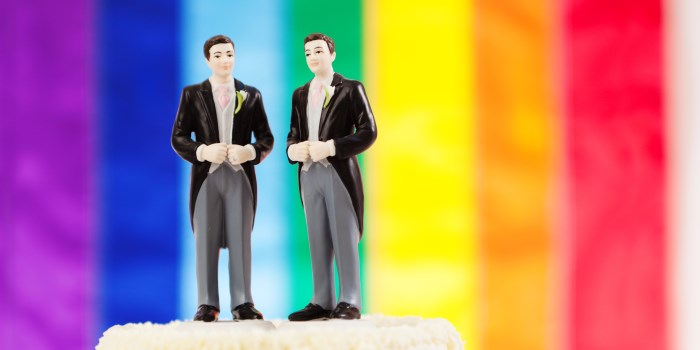
We are rocketing towards a conclusion in the same-sex marriage debate, with Australians about to cast their votes in a national survey.
For the Government to legalise same-sex marriage, a ‘yes’ result will need to be returned in the upcoming postal survey.
And if you want to have your say, you’ll need to be enrolled to vote.
Want to make sure you’re on the electoral roll? Wondering if you’re old enough to vote? Wondering how to make your case to your voting-age friends and family?
Let us break down what you need to know (and do) to vote on marriage equality.
The Postal Vote: What It Is and How It Works
Australians will have their says on same-sex marriage in 2017 via a voluntary postal survey administered by the Australian Bureau of Statistics (ABS).
The ballot will likely ask: "Do you support a change in the law to allow same-sex couples to marry?" Voters can respond with either ‘Yes’ or ‘No’. You may also refuse to respond without being fined—but don’t be like that.
To receive a ballot in the mail (yes, mail is still a thing, although barely), you’ll need to be on the electoral roll by 6pm AEST on August 24, 2017.
Ballot papers will be sent out from September 12, and you can only request a replacement by October 11. You should have received your ballot by September 25 at the latest.
Here it is: your first look at the same-sex marriage postal form #auspol pic.twitter.com/7R5b9nhNk1
— Bevan Shields (@BevanShields) September 11, 2017
and the envelope #auspol pic.twitter.com/m8R1lSpbPd
— Bevan Shields (@BevanShields) September 11, 2017
The ballot papers will need to be returned by November 7 at the absolute latest (remember, this is snail mail: the ABS encourages you to send your ballot back by October 27, for safety's sake).
The result will be announced at 11:30am AEST on November 15.
If the forms follow traditional postal votes in Australia, they will come with Reply Paid envelopes, so you won’t need to buy a stamp. However, be wary of fake voting forms that may slip into your slot.
Update, August 18: Though you may be tempted to fill your envelope with glitter, the ABS is warning it could spoil your vote. Better to be safe than sorry. You might want to save the glitter for your personal home use.
Update, September 14: Also, don't share pics on social media of your ballot that reveal your unique identifying barcodes, as that too could invalidate your vote!
Enrolling to Vote: Am I Old Enough to Do It?
If you are over the age of 16, you can enrol to vote with the Australian Electoral Commission (AEC). However, only those over the age of 18 will be eligible for the upcoming survey.
(Right now, the Greens are urging Prime Minister Malcolm Turnbull to give 16 and 17-year-olds the opportunity to cast their vote, given they are of legal marrying age—and that this is simply a survey and not an actual electoral vote.)
Unfortunately, if you’re turning 18 sometime between midnight on August 25 and November 7, you won’t be eligible to vote, even if you enrol beforehand. This effectively disenfranchises approximately 50,000 18-year-olds, according to Greens senator Janet Rice.
If you’re already on the electoral roll, you do not need to specially enrol or re-enrol for this particular ABS survey. However, if you’re not sure if you’re enrolled, you can check your enrolment here. And if you moved or need to update your enrolment details, you can do so here. (Seriously, it doesn’t hurt to double check!)
If you’re living overseas, you can’t simply get your parents to cast a vote for you, nor will you be able to rock up to a consulate and vote. You’ll need to let the AEC know of your whereabouts and register as an overseas elector. Again, all of this must be done before 6pm local time on August 24, 2017. If you’re not on the roll before then, you will not receive a postal form and will not be able to cast a vote.
(Update, August 18: The ABS is mulling over a "paperless" option for those in remote communities and those who'll be travelling at the time of the vote. It could mean an online vote, or an SMS option. We will update again once those details have been revealed. In the meantime, you still need to enrol. And, if you're definitely going to be overseas, it would be still best to update the AEC on your overseas address.)
(Update, August 23: Turns out the ABS will allow you to nominate a "trusted person" if you can't access your survey form, because you'll be overseas or perhaps live in a remote community. Find out how to do so here. Otherwise, eligible Australians in need of a "paperless" vote can request a Secure Access Code—required for any survey response via telephone, call centre or secure online form—from the ABS. Get it through the Information Line (1800 572 113 or +61 2 6252 5262 if you're outside of AU) or the ABS website between September 25 and October 20, 2017. There will also be "pickup" locations for people experiencing homelessness who also want to cast a ballot. Forms will be available for pickup between September 25 and October 20, 2017, with locations to be revealed on the ABS website.)
It is not yet known how “silent electors” (aka those who have their addresses taken off the roll because they work in the police force, are victims of domestic violence, or have some other security concern) will receive their forms.
(Update, August 23: The AEC will be responsible for sending "silent electors" their ballots, not the ABS.)
Why Is Australia Voting on Marriage Equality?
According to a recent survey by the University of Melbourne, more than two thirds of all Australians believe same-sex couples should have the same marriage, parenting and employment rights as heterosexual couples. This follows years of increasing support for same-sex marriage in Australia.
Those advocating for marriage equality want Australia to follow in the footsteps of the United States, England, Ireland, Scotland, Wales, Brazil, France, Argentina, Sweden, Norway, South Africa, Spain, Canada, Belgium, New Zealand and numerous other nations in legalising same-sex marriage.
Australian Marriage Equality argues, “The failure of the law to allow same-sex couples to marry sends out the message that it is okay to discriminate on the grounds of sexual orientation and gender and that same-sex partners are not capable of the level of love and commitment associated with marriage.”
To that point, a report by Beyond Blue stated that lesbian, gay and bisexual Australians are “twice as likely to have a high/very high level of psychological distress as their heterosexual peers”.
As a result, the report continues, LGBTQI people have “the highest rates of suicidality of any population in Australia”, with same-sex attracted Australians having up to “14x higher rates of suicide attempts than their heterosexual peers”. The average age of the first suicide attempt is 16, usually before someone’s “coming out”. It is these worrying statistics that same-sex marriage advocates are looking to battle, with the belief that marriage equality will lessen the discrimination against LGTBQI people.
Some Australians argue that same-sex partners already receive the same benefits as married couples. However, that is only true to an extent.
Religious organisations have also protested the legalisation of marriage for same-sex partners, despite the fact that marriage in Australia is secular (meaning, non-religious) and is regulated by the state rather than the church. Approved religious institutions and celebrants perform marriage ceremonies according to their beliefs.
The rules against “malicious campaign material” usually imposed during regular elections do not apply during this particular vote. Although the Government is working on legislation to prevent homophobic material being distributed as part of either campaign, already, supporters of same-sex marriage have been hit with abuse.
If you see something upsetting during this period, please consider contacting someone:
Support is available right now. Call Lifeline on 131 114 or Kids Helpline on 1800 551 800.
Visit ReachOut to get support to help you with everything from everyday issues through to tough times.
Why Is the ABS Doing This Instead of the AEC?
At an estimated cost of $122 million, the Government could never convince Parliament to approve funding for a postal vote, given they already voted down their proposed plebiscite.
However, Finance Minister Mathias Cormann has the authority to fund a postal vote via the ABS without parliamentary approval. That’s why, technically, it’s a “survey” and not a true “vote”.
Nonetheless, the decision has raised some eyebrows, given how the ABS bungled last year’s census and that the current Minister responsible for them, Michael McCormack, previously published a newspaper editorial describing homosexual behavior as “sordid”.
Small business minister Michael McCormack has apologised for his anti-gay newspaper editorial from 1993. pic.twitter.com/cks6CqwazT
— Alice Workman (@workmanalice) August 11, 2017
Will the Vote Go Ahead?
It’s all systems go… unless the High Court rules it as unconstitutional. There are two separate legal challenges to the postal survey that will be heard on September 5 and September 6.
Expect a ruling sometime between then and September 12 (when ballots are sent out).
Basically, if you find a ballot in your mailbox, you should expect that it’s on like Donkey Kong.
(Update, August 23: The High Court has ruled in favour of the postal survey. It is indeed on.)
What Happens After ‘Yes’ or ‘No’?
If ‘Yes’ wins, a bill proposing a change to the Marriage Act will still need to go to Parliament. However, the Government will give its MPs a conscience vote (which is precisely what they’ve kept from happening thus far), allowing each member to vote however they like.
It’s expected that, when combined with the conscience votes of the other parties and independents, the Marriage Act will be changed to allow same-sex marriage.
If ‘No’ wins, the Government will not allow a conscience vote and will also block legislation attempting to legalise gay marriage. However, Labor have pledged to legalise same-sex marriage in their next term of governance if the Coalition fails, regardless of the survey’s result.
We will continue to update this post as we learn more about the survey in the days leading up to November 7. Feel free to share your questions below.
Photo: iStock.com/enigma_images
Topics
Ref: fb3d263d-8e94-457b-a99b-a7d000691cd5




Comments & Feedback
Share your opinion
Emoji cheatsheet Formatting Comment guidelines