USA Women’s Soccer Team Win Equal Pay, But What Does It Mean for Women’s Sport?
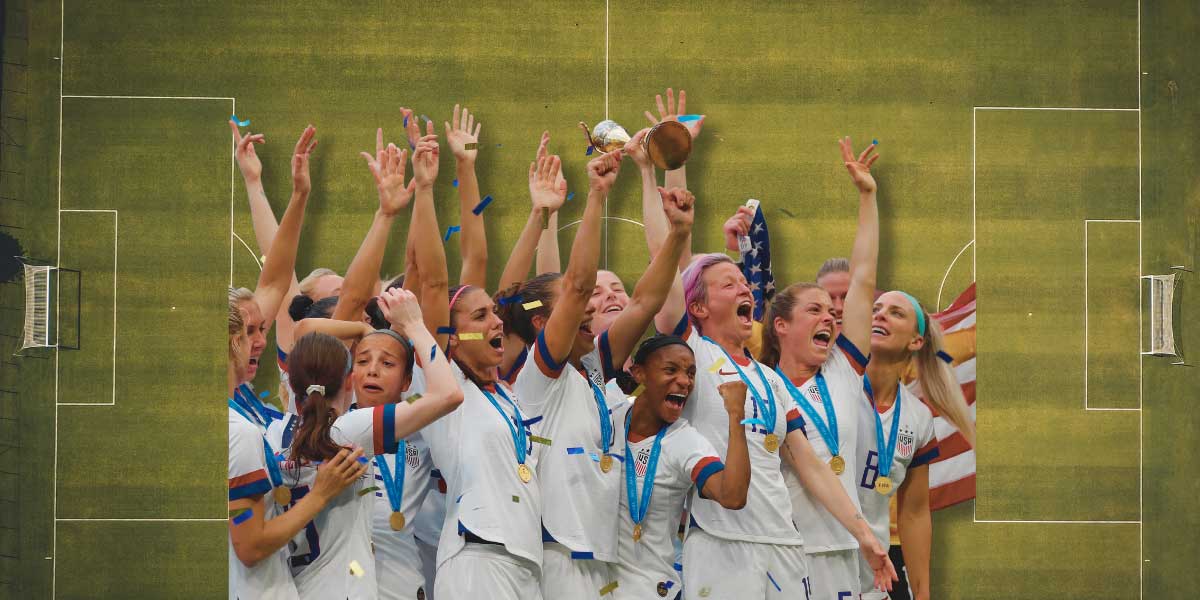
"It's been years and years of fighting for equality within our sport."
The national women's team will now be paid the same as their male counterparts in bonuses and prize money in the control of the US Soccer Federation, with the bulk of the money being back paid to compensate the players.
How did this all start, and what does this mean for women’s sport? Here’s the lowdown:
How the most high-profile legal cases in sports history began.
In 2016, five American soccer players, led by Alex Morgan and Megan Rapinoe, complained to the federal Equal Employment Opportunity Commission about their pay.
Three years later, they sued, seeking damages under Equal Pay and Civil Rights Acts.
This latest win comes despite their equal pay claim being thrown out in 2020, and appealed by them.
According to ABC, the fight took a heavy toll on the game. Major sponsors withdrew and fans turned their backs when court filings emerged, revealing US Soccer claiming women players had “less physical ability and responsibility” than their male counterparts.
It’s worth noting that the US women have won four World Cups since the program’s start in 1985, while the men haven’t reached a semifinal since 1930.
Here’s an epic video from 2019 of a crowd chanting “equal pay” when the US won:
Is this deal too good to be true?
We’re collectively hoping not. But, like most legal battles, things take a while, and it can be tricky.
This deal will only be completely finalised once the team and federation approve a collective bargaining agreement. If all goes smoothly, the money will be distributed to 61 players, with a smaller chunk going to a fund that’ll support players’ and other charitable efforts.
Ultimately, it’s a powerful step forward. Here’s what Megan Rapinoe said once the settlement was made:
“For our generation, knowing that we’re going to leave the game in an exponentially better place than when we found it is everything. That’s what it’s all about because, to be honest, there is no justice in all of this if we don’t make sure it never happens again.”
The reality of being a woman in sport.
Although the tides have been slowly turning in women’s sport over the years, there are still some ways to go.
According to research by Swinburne University, coverage of women’s sport during the pandemic fell from a small 8.4 per cent in April to 7.6 per cent in May 2020.
And if this says anything about the pay gaps—it’s pretty much the norm for professional female sports players to have other jobs.
In 2019, The Matildas revealed the “side hustles” they had to take to top up their wages, and they ranged from Uber, Pizza Hut to school or health assistants.
In the AFLW, players often work overnight shifts at their day jobs to make a decent wage and even have to take annual leave to get to training and games.
Collingwood's Erica Fowler told Code Sports: “It’s not just impacting players now, it’s impacting the whole competition with regards to support staff, that they’re not full time at the club as well.”
A snapshot of women’s sport in Australia.
Despite increasing interest in female sport around the world, work is still needed in supporting our female sports stars.
That's not to say nothing is being done, though. Last year Aussie surfing icons Mick Fanning and Stephanie Gilmore backed an NSW campaign for equal prize money for men and women in sport and urged for the scheme to go national.
Also on the bright side—back in 2019 there was a landmark deal that saw Australia's top women soccer players, The Matildas, earning the same as their male counterparts.
Following that, the Women’s T20 cricket world cup was wildly successful and attracted a record audience at the final. AFLW audiences are breaking records, too.
Header Image: sergio souza via Pexels, @ajplus via Twitter
Topics
Ref: c47c71b4-7988-43bc-9aa1-ae47003e03a9






Comments & Feedback
Share your opinion
Emoji cheatsheet Formatting Comment guidelines