Understanding Australia’s Asylum Seeker Policy With Julian Burnside
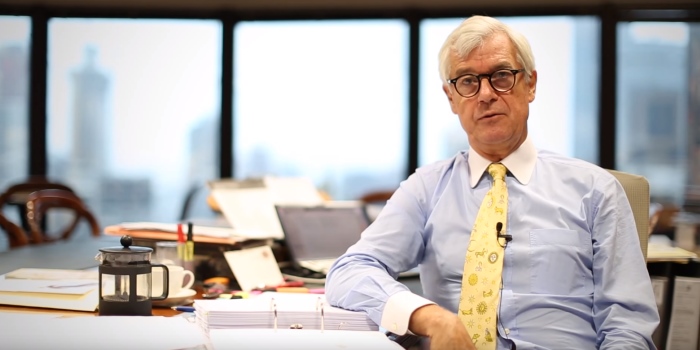
The election is fast approaching and, as has been true for more than a decade, our asylum seeker policy promises to be a key election issue.
The recent declaration by Papua New Guinea’s Supreme Court that Australia’s detention centre in Manus Island is illegal and the desperate protests of two refugees who set themselves on fire in Nauru place increasing pressure on Australia to adopt more humanitarian policies.
Despite this, both major parties remain in favour of indefinite mandatory offshore detention as a way of preventing people from drowning on their journey towards Australia.
But “not drowning is little consolation for people who are being persecuted by the Taliban.”
So says Julian Burnside, the Australian barrister best known for his persistent advocacy on behalf of asylum seekers.
To get a better idea of why Australia’s refugee policy is the way it is and how it could be better, I visited Burnside’s office, where files and folders lay sprawled across his desk. The only thing my non-legal eyes could recognise with any certainty was the pile of newspaper clippings. Judging from the headlines, they were all about refugees.
I began by asking him what he thought about the increasing politicisation of the asylum seeker debate and the reduction of complex issues to key campaign slogans like “stop the boats”.
To answer that question, he took me back in time to when the Howard Government began using this kind of rhetoric for what he describes as “purely political purposes.”
In the lead up to the 2001 election, Burnside says that the Liberal-National Coalition was concerned that many of their supporters were drifting to One Nation. At the time, it looked like Howard might lose the election, but the public’s opinions turned by November on the issue of boat people.
He brought up the story of the Norwegian cargo ship, the Tampa, which rescued a sinking boat carrying mostly Hazara refugees who were fleeing persecution from the Taliban. Despite being denied permission to enter Australian waters, the Tampa “steamed” towards Christmas Island. When they tried to bring the 433 passengers ashore, the “SAS took control of the ship at gunpoint.”
This event coincided with the September 11 attacks in New York which Burnside says “significantly altered the political calculus.” He identifies this as the point that refugees were branded “illegal” by John Howard.
Kim Beazley, the opposition leader at the time, “did not challenge” this rhetoric.
In 2013, Scott Morrison, who was then the Immigration Minister, renamed the Department of Immigration to the Department of Immigration and Border Protection. But, Burnside asks, from whom are Australians being protected?
Burnside believes that language such as this suggests Australians “are being protected from criminals”, even though the “UN is clear that boat people don’t commit any offence.”
As an alternative to these “cruel” policies, Burnside suggests that there are two different models we can consider.
The first is the policy Australia had under Malcolm Fraser in the 1970s. Under this model, people seeking asylum are processed before they reach Australia, in either Malaysia or Indonesia.
Burnside says that they must be promised “swift, safe resettlement”. He emphasises that if Australia readopts this policy, “the boats would stop” and there would be “no drownings”.
However, he points out that of those who are assessed, some will not be granted refugee status.
“That would cause a problem for Malaysia and Indonesia, and Australia would have to help them cope with non-refugees”, he said.
He stresses that this model relies on “genuine cooperation" between these three nations.
(For more information on Fraser’s asylum seeker policy, head here).
Burnside’s second proposal provides an alternative to offshore processing.
First, boat arrivals would be detained for one month for preliminary health and security checks.
They would also be granted a visa which allows them to work and gives them full access to Medicare and Centrelink benefits.
Burnside emphasises that the “key part” of this model is that while their claims to refugee status are being assessed, asylum seekers must live in rural or regional areas in Australia. As regional towns are “slowly perishing”, an “injection of population would help them,” he argues.
However, Burnside expressed caution in regard to this second option, saying that this policy could be done in either “the right or the wrong way.” For it to be effective, Australia will have to invest in a “re-education campaign to counter the corrosive propaganda” perpetuated by successive governments.
Papua New Guinea’s Supreme Court recently declared Australia’s detention centre in Manus Island “illegal” and Burnside believes this indicates that “PNG’s human rights are greater than Australia’s.” In light of this, I asked what motivates him to continue to fight what appears to be an endless, uphill battle?
It is only at this point in the interview that he hesitates, unsure of the answer.
Almost thinking out loud, he describes himself as being very “results-oriented”. As a barrister, he is “fighting with a view of winning.”
He turns to Arundhati Roy (who is a brilliant writer; if you haven’t checked her work out, do).
She says, “the trouble is that once you see it, you can't unsee it. And once you've seen it, keeping quiet, saying nothing, becomes as political an act as speaking out.”
“To remain silent” is not an option for Burnside. He simply states, “to my last breath, I want to be able to say I tried.”
Susan Alfayadh is one of Student Edge’s student contributors. Learn more about the contributors program.
Photo: Australia Cares / YouTube.
Topics
Ref: f9f32720-9e77-4419-b3a2-a604005219a3
Most Popular



Comments & Feedback
Share your opinion
Emoji cheatsheet Formatting Comment guidelines
Great article of a valid concern.
This article is amazing <3