There's a Rare Super Blood Blue Moon This Week: Here's How You See It
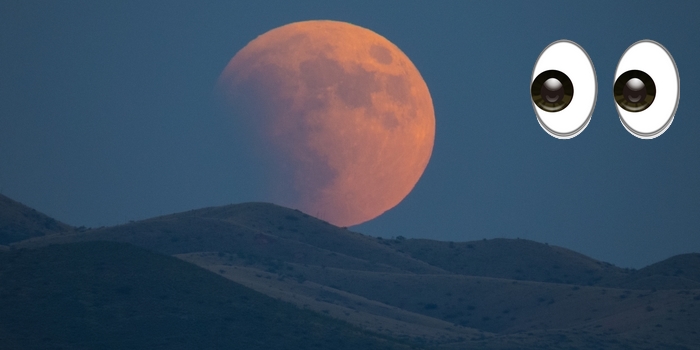
It's been more than 150 years since the last time this happened.
While it sometimes feels like there's a super-rare moon or sun event every year, this one isn't a drill.
On Wednesday 31 January, three rare(ish) moon occurrences will coincide to create a super-rare phenomenon you most definitely will only see once in your lifetime (unless you live longer than 150 years).
First of all, it's set to be a huuuuuge moon a.k.a. a supermoon. Supermoons occur when the moon is closest to the Earth during its orbit and its technical term is perigee-syzygy (FYI, one of 2017's words of the year). These aren't particularly rare as they occur three to four times a year.
Secondly, it's going to be a blue moon. Deceptively, a blue moon refers to the phenomenon that occurs where there are two full moons within one calendar month. It can also refer to a moon that literally looks blue, but that only happens when there are particles in the air, like volcano ash, that give the illusion of a pastel blue moon.
In this case, it's the first term that applies here (sorry, no blueberry-like moon!) and these usually only happen once every three years or so.
Finally, it's going to be a 'blood' moon; a far-less deceptive name. Blood moons are a bit of hip term given to lunar eclipses due to the ominous reddish hue that occurs when the Earth's shadow covers the moon. Despite us non-scientific types assuming that the moon should be in total darkness, the rays of sunlight bend around the earth and reflect off the moon giving it a red look. Glamourous.
Just to emphasise, the combination of these phenomena last happened in 1866. That's about 50 years before electricity was even really a thing at home (a really long time ago).
So, how do you watch it?
Well, if you're on the East Coast of Australia, you've got a far more specific time to stay up to. According to Port Macquarie News, the ultra-rare super blood blue moon will begin at about 10.48pm, eclipsing fully from 11.51pm (DST) to 1.07am.
If you're in WA, it could apparently happen anytime between 7.30pm and 11pm, so keep one eye on whatever you're doing that night and the other eye on the moon.
The best part? You don't have to wear any special protective glasses to view it so there's no excuse!

Photo: iStock.com/CochiseVista
Topics
Ref: 6f0d3319-7e37-40bd-a0a3-a877001c5c9e




Comments & Feedback
Share your opinion
Emoji cheatsheet Formatting Comment guidelines