How to Become a World Champion In Paper Plane Throwing
There's an art to paper plane making.
In a giant aircraft hangar in Salzburg, Austria, the air near the ceiling is almost completely still. Unlike most regular buildings, there is no draft coming in and no air is able to escape. It's completely sealed off.
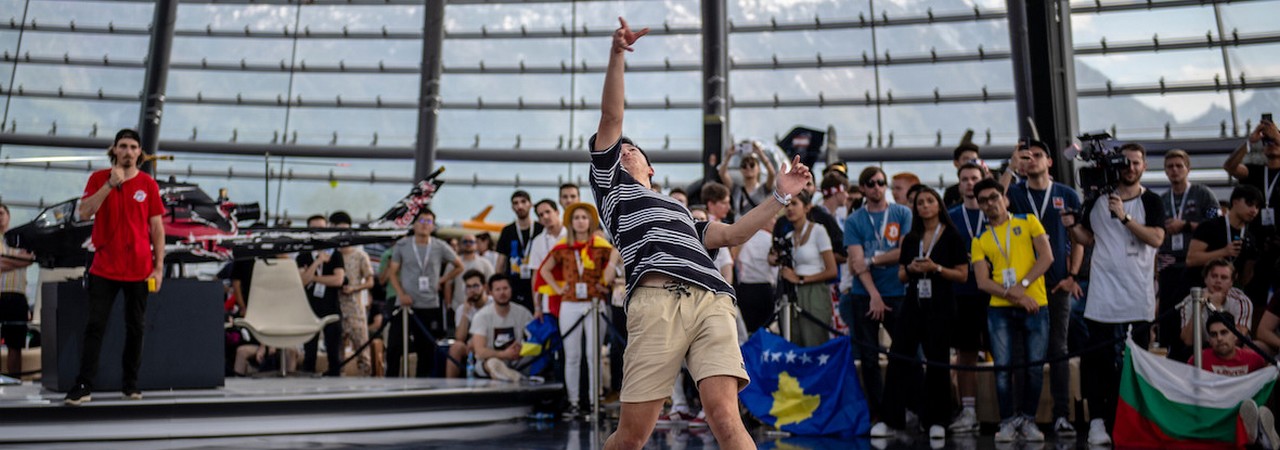
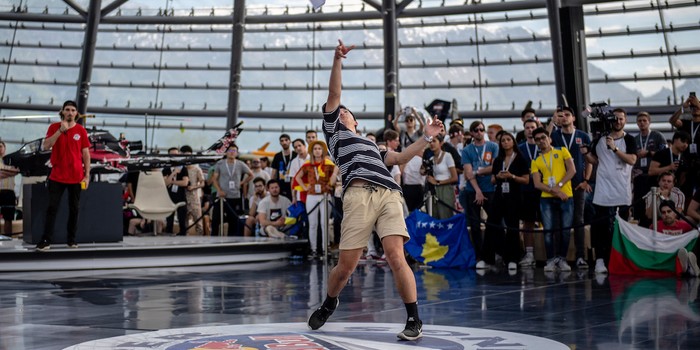
About 14.5 metres below the ceiling's highest point are scores of people from 64 countries watching in awe of a gliding piece of paper.
This is the Red Bull Paper Wings World Final and they're gathered here to compete for the title of world champion across three categories.
In the airtime category, the aim is to launch the delicate aircraft high into the ceiling and hope that each technical crease and fold has been executed perfectly to ensure a relaxed ride back to Earth. The ultimate goal is to stay in the air for the longest time possible. A simple task in theory but in practice, one that requires hours of studying, testing and perfecting.
Now, it's Australia's turn.
After a violent propulsion upwards toward the ceiling, the paper plane, crafted from a single A4 piece of paper, begins the slow descent back to the hangar's glossy floor.
It cuts through the air, maintaining a consistent curve above the cheering crowd, circling them as if it were doing a smug victory lap, knowing full well what it was about to achieve for its creator.
Eventually, the paper plane softly meets the ground. It was sailing through the hangar for 13.33 seconds; a full 1.08 seconds longer than that belonging to the Brit who landed in second place.
Cameron Clark, a 19-year-old engineering student at Swinburne University, is responsible for the throw and he's now donned the World Champion in the airtime category for the next three years.
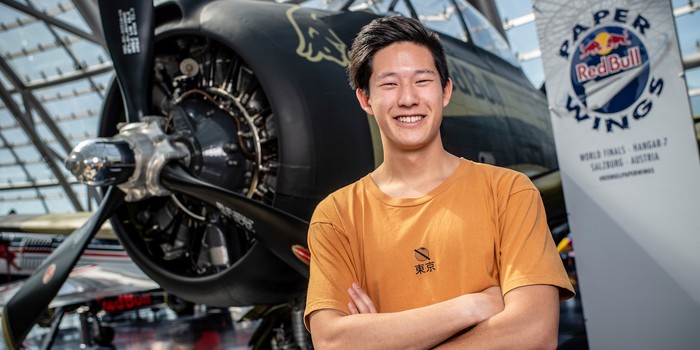
"When I won back here [in Australia], I thought that was as far as it would go," Cameron tells Student Edge.
"I never thought I'd win the world championship."
He had just beaten nearly 48,000 other people from around the world to take out the crown, which he'll hold until the next Red Bull Paper Wings championship in 2022.
Naturally, I asked him for the secrets behind his winning aircraft but Cameron maintains each plane is different and will yield unique results.
"Each plane has its own character and its own flight path... you can't make the same plane twice," he admits.
Even though he's made a different plane for each of the crucial stages, they've been pretty consistent at one thing: winning.
"I used to make them a lot when I was in primary school and early high school," Cameron explains.
"I used to borrow books from the library, like paper plane-making books.
"There was one book that I borrowed that I loved [which involved] a lot of cutting and measuring, pasting and folding… it was a bit more complicated."
Unlike the primitive paper planes many would have crafted and thrown during primary and high school, these planes have taken a lot more time and effort to perfect.
"We had two whole days to practise and experiment in the hangar so I was just changing little pieces of the design," Cameron admits.
"Most of [the early throws] would stay up for around 10 seconds, but you were just waiting for the one that worked really, really well."
For the airtime category, maximising the surface area of the wings is crucial for it to stay in the air for long periods of time.
"Each fold is so important," Cameron explains.
"Every fold has to be super sharp and crisp and precise.
"The plane needs to be perfectly balanced and any adjustment to the wings could keep the plane in the air longer or could make it come crashing down."
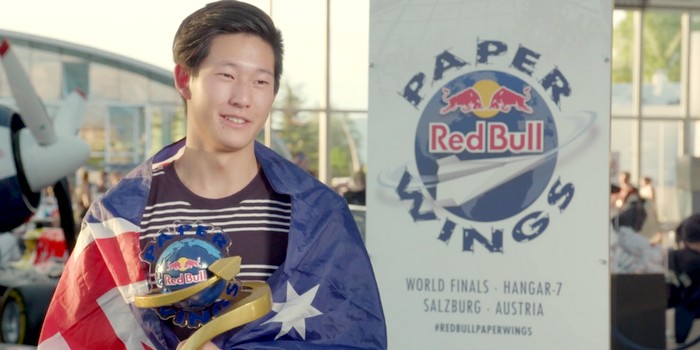
And all that careful preparation worked out pretty well. While he was chosen first for the qualifying round during the Salzburg finals, Cameron admits his nerves washed away after nobody could top his initial time.
"I went on to throw an even better time to win the finals," Cameron says.
With that all over, Cameron's just ready to get back to completing his first year of uni.
"With all this media attention and this title of world champion, it's almost nice to just get back into normal life," Cameron confesses.
"I'll definitely be coming back... I want to try and hold my title."
He'll have three years to work on his strategy for keeping the title and by then, he'll have more than half an engineering degree under his belt.
Watch Cameron's winning throw below.
Header Image: Supplied