The Wallabies Sang the National Anthem in Indigenous Language Before Saturday's Test Match
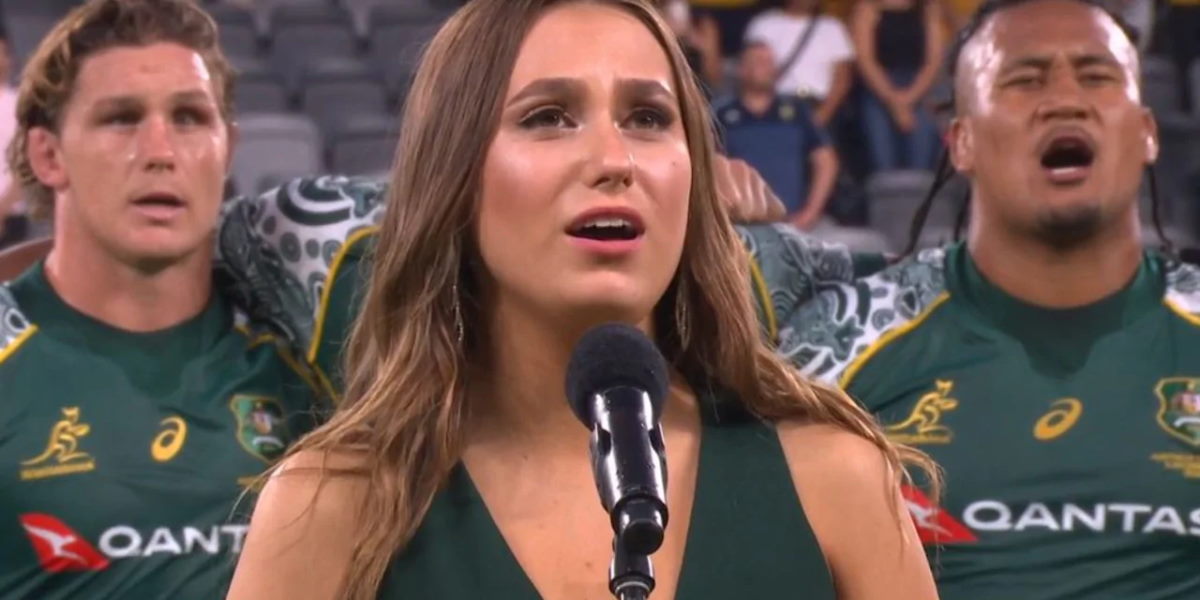
It was the first time it had been performed in a First Nations language at a Wallabies Test.
The Wallabies delivered a special rendition of the Australian national anthem in both Eora language and English ahead of their Tri Nations Test against Argentina on Saturday.
The performance—led by Wiradjuri woman Olivia Fox from the Newtown Performing Arts School—was a historic moment for the international sporting event, as it was the first time the national anthem had been sung in a First Nations language at a Wallabies Test.
Sing it loud and sing it proud - what an incredible rendition of our National Anthem 🇦🇺 #AUSvARG pic.twitter.com/sKRUkZBSCK
— 10 Sport (@10SportAU) December 5, 2020
Every Wallabies player, proudly wearing their First Nations jerseys, had learned all the lyrics.
The performance was met with widespread praise online and a boisterous cheer from the crowd.
How great was that! Listening to the Aussie anthem being sung in the Eora language of the Gadigal people. Inspiring stuff, well done @wallabies💪 #AUSvARG
— Paul Alo-Emile (@PaulAloEmile) December 5, 2020
Loving Olivia Fox singing the Australian National Anthem in Eora language and then in English, joined by the Wallabies wearing their magnificent First Nations jersey. Game on. #wallabies #ausvargentina #TriNations2020
— Robert Grasso (@RobertGrasso) December 5, 2020
Fox sang the majority of the anthem in the Eora language, finishing the last line of the song in English.
She has also previously performed the anthem in Eora language during the unveiling of the First Nations jersey alongside the Wallabies in November.
#RugbyAU acknowledges the significance of language for First Nations Peoples.
— Rugby Australia (@RugbyAU) November 12, 2020
At the launch of the First Nations jersey, Olivia Fox from the Eora Nation performed a beautiful rendition of the national anthem in the language of her people. #NAIDOC2020 #AlwaysWasAlwaysWillBe pic.twitter.com/AwVCKli2B4
While a flood of praise followed the performance, there was some criticism from the Indigenous sporting community.
Aboriginal boxer and former NRL player Anthony Mundine commented on the choice to change the language but keep the song.
Mundine, a Bundjalung man, said the performance was not a way to make change, as the song and the meaning behind it remain the same.
"If they want to change things then actually change the words of the anthem. But you can’t just sing the same original text in Aboriginal language and think it’s going to fly with people," he told the Daily Telegraph.
"It got people talking but it still ain’t the right message. It looks good and sounded good when the Wallabies sang it, and it looks like they’re giving back—but they’re not really giving back."
Advance Australia Fair has received significant backlash over the years due to many Indigenous people believing that the song is not inclusive of Indigenous culture and represents Australia’s colonial past.
In particular, there have been calls to change the lyrics "We are young and free" to "We are one and free", due to the false idea that Australia is a young country.
In fact, a genomic study revealed that Indigenous Australians are the oldest living culture on Earth, so the lyric in question is not reflective of that.
The @wallabies should be celebrated for singing the anthem in Eora language.
— Lidia Thorpe (@lidia__thorpe) December 6, 2020
But there’s a bigger conversation to be had.
The anthem should be for all of us - but this song doesn’t even recognise us.
We are not “young”.
And many of us are not “free”.
Regardless of the criticism, many Australians and Fox felt proud of the historic moment and saw it as a step in the right direction.
"I want it to be heard... I’m so proud to be singing this language, and the whole Indigenous community, I could feel them with me," she told SBS.
Absolutely fantastic: every Wallabies player sung the first half of the national anthem in Indigenous language. Learned the words. Paid respect. A great step forward 🔴🟡⚫️ #AUSvARG pic.twitter.com/Efy91gIRt7
— Jamie Pandaram (@JamiePandaram) December 5, 2020
Header Image: Fox Sports
Topics
Ref: 6618f5e4-17b6-4330-a5f1-ac8a0068625f




Comments & Feedback
Share your opinion
Emoji cheatsheet Formatting Comment guidelines