"A Long Way To Go": The Survey on Sexual Violence at Universities Is Only the Beginning

Trigger Warning: This article discusses sexual assault and rape.
The results of the Human Rights Commission's (HRC) report on sexual assault and harassment on Australia's university campuses are in, and they affect all 39 universities in Australia.
The findings highlighted some key areas of concern, such as the rate of incidence of respondents, the common locations of sexual harassment and assault, and the demographics of the survivors.
At the launch of the report, Monash University's Vice-Chancellor, Professor Margaret Gardner, announced that Universities Australia (a body that represents the universities of Australia) would commit to a 10-point action plan in order to address the issues that the report highlighted, particularly the visibility and accessibility of reporting procedures. This 10-point action plan included things such as:
- A national 24/7 helpline introduced from July 31, running until November 30, to complement uni counselling services.
- New principles for postgraduate student and staff interaction.
- Sexual assault and sexual harassment education and awareness training for university leadership and staff.
- Extending first responder training to more frontline university staff.
- An evaluation survey in three years to access the measures' success.
Student Edge spoke to academics Professor Paula McDonald from the Queensland University of Technology and Professor David Peetz from Griffith University about their concerns over the report's limitations, where the responsibilities of the universities end and how to improve the low rates of assault reporting.
Professor McDonald thinks the report shows a concerning link between attitudes displayed in broader society and those in university settings; unsurprising given that universities often are microcosms for society-at-large.
"What happens in university is integrally and inextricably connected to the broader attitudes towards women that are prevalent in Australia today," she explained.
"We still have a long way to go to get to a society where women are treated as equal beings and equal citizens."
The lines seem to blur, however, when students face sexual violence off-campus, for example, on their way to or from the university on public transport. Professor McDonald explains that while these particular instances aren't necessarily the responsibility of the university, the university's response to them is very important.
"It is reasonable, I think, to expect that if a university knows that that’s a particular problem, that they advocate with any other relevant agencies that may have responsibility or that have the power to do something,” she said.
This might mean universities taking a more proactive approach with local transport authorities to ensure students are getting to universities in a safe environment, or, at the very least, offering support services to those students who have been affected.
There is also the issue of the medium in which the crime occurs, whether it be in-person or through the use of technology. It's an issue Professor McDonald thinks deserves more focus.
"The issue of technology-related harassment is clearly an increasing concern and we definitely need to look at that more closely to understand it better and to provide education and training the standards of behaviour across the board," Professor McDonald outlined.
Professor Peetz believes the universities' 10-point action plan response and the report's recommendations are heading in the right direction.
"They seem to be emphasising the creation of a supportive environment; they seem to be encouraging people to report sexual harassment or assault when it occurs, and promoting a culture that’s opposed to [sexual violence],” he said.
He was concerned, however, that the problem in residential colleges might be harder to solve. This is due to them usually being operated by third-parties and, often, operating outside of the universities' by-laws.
"This seems to be the area where the biggest problems are occurring," Professor Peetz expressed.
"The report appears to suggest that the frequency of those being assaulted seems to be higher amongst those who are living in colleges, so that’s where a lot of the focus needs to be."
An important finding in the survey was the extremely low reporting rates, despite many of the offences occurring within university grounds or at residential colleges. The report found that 87 per cent of those who were sexually assaulted and 94 per cent of those who were sexually harassed did not formally report the offences to any official body within the university.
"Whatever it is the universities are doing, they’re not doing it well because otherwise there wouldn’t be such low reporting rates among the students," Professor Peetz said.
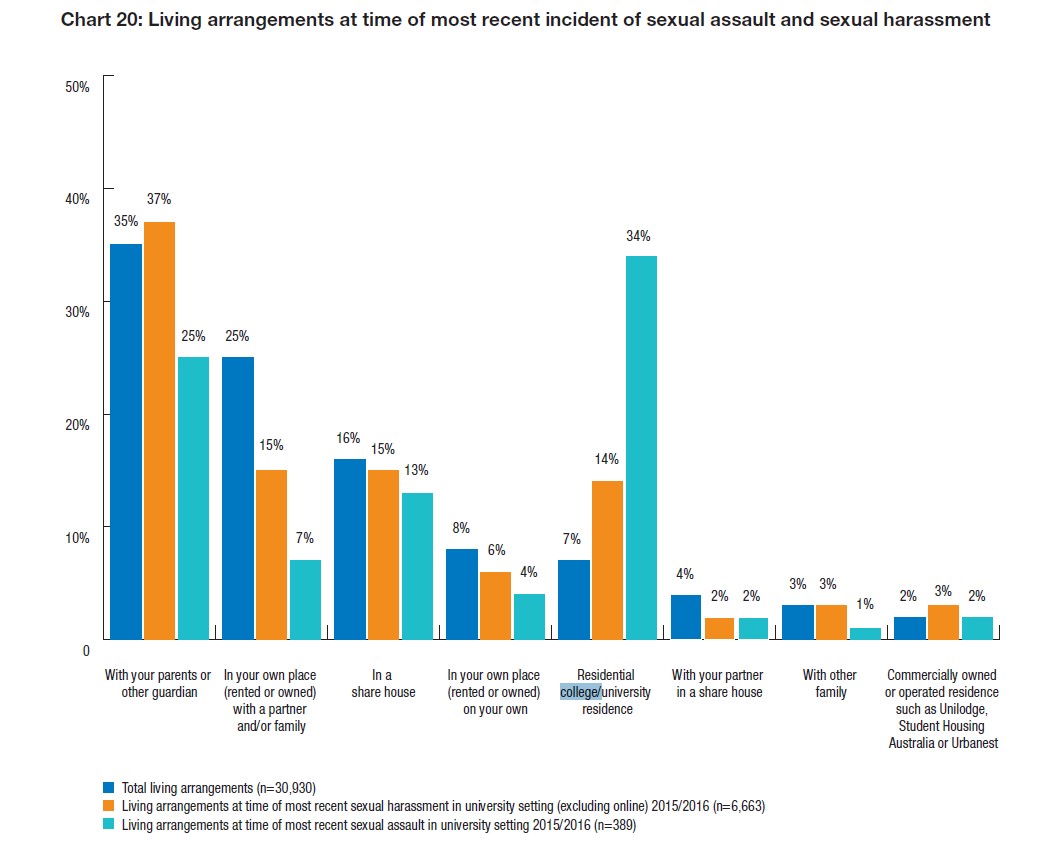
The report does seem to outline that residential colleges and university residences are among the problem areas, but the action plan set out by Universities Australia left that titbit to their tenth point. They have committed to providing best practices for the colleges and residences as well as offering their staff first responder training.
But something else important is missing from the reports and the recommendations. There has been very little discussion on how offenders who are found to be guilty will be reprimanded by universities. It an issue that many of the survivors focused on in the qualitative responses.
One survivor reported that she was punished for reporting the crime, instead of the perpetrator who committed it: "The perpetrator escaped all punishment by claiming he was 'too drunk to remember' what had happened, and instead, the university seemed to go out of its way to punish me by claiming I was mentally unfit to continue studying."
Another survivor heard that the perpetrator had done this to other women and received no punishment: "Valerie was raped by a senior student leader during her first year of university at an O-Week camp. Valerie later heard that the perpetrator had raped other female students at previous camps and that no action had been taken by the event organisers."
The Sydney Morning Herald reported that, despite there being disciplinary measures for things such as cheating and bullying, there are still no concrete punishment policies in place to address perpetrators who are also students. They outline how $55 fines and apology letters have been used as a way of ameliorating the hurt they caused the surviving students.
While the report is welcomed as a great step towards recognising the extent of the issue and the failures of the universities, it's still only one step. These next few months will be important to evaluate the effectiveness of the universities' ramped-up approach and whether it's enough to assist in curbing sexual violence on campuses, as well as appropriately assisting those who have been affected.
Only then can we truly start to make some headway with solving this issue.
If you have experienced sexual harassment, you can make a complaint to the Human Rights Commission. If you have experienced sexual assault, please see here for a list of sexual assault services throughout Australia or call 1800 RESPECT (1800 737 732).
Photo: iStock
Topics
Ref: 5eddcca5-ecdf-4f2b-8607-a7c5005c1c05





Comments & Feedback
Share your opinion
Emoji cheatsheet Formatting Comment guidelines