Meet The Student Whose School Assembly Speech Went Viral And Busted Open The Conversation On Mental Health
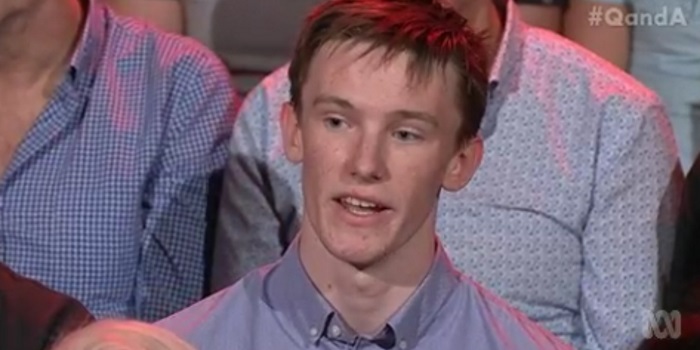
“What does it take to make society appreciate that mental illness can be as debilitating as physical illness?”
Xavier Eales, a 17-year-old student at Saint Ignatius' College in Sydney, posed that question on the ABC’s Q&A last month, as part of Aunty’s “Mental As” campaign.
It might have been the biggest forum in which Xavier raised the taboo subject of mental health, but it certainly wasn’t the first.
The teen garnered widespread attention in July for a 15-minute speech on his own struggles with depression, delivered in front of his peers at a Saint Ignatius assembly.
“From the age of 13 up until December last year, I had a diagnosable major depressive disorder,” he revealed.
“I became filled with an overbearing feeling of emptiness for which I could draw not cause.”
With the support of his family, his friends and his school, Xavier eventually sought professional help.
We caught up with Xavier on the other side of his watershed speech (not to mention his exams) to see how his life had changed and what lay ahead in his mission to continue the conversation on mental health.
“Since both [my speech and Q&A] a lot more people have reached out to me, but to be honest, I think that I need it less than other people,” Xavier told Student Edge.
“I’d prefer they redirect their support to people who need it more than I, because now I’m actually quite overwhelmed with it, which is very positive, but at the same time there are a lot of people out there who could benefit from the potential support.”
Over the past few months, Xavier has been approached by Beyond Blue, Headspace and Black Dog Institute for potential collaborations; he’s keen to take them up on their offers.
“I think it’s less of a tangible, monetary or funding issue that needs to occur to fix this problem,” he spoke of mental health awareness.
“It’s more of a cultural shift… by changing the language we use to discuss it in the first place.
“At the same time, I don’t want to become a poster boy for it. In an ideal world, I don’t think depression really needs a poster boy, to be honest. But, if there’s a call for one and it can do some good, then most certainly.”
Though Xavier believes depression and anxiety are perceived as being off-limits among young men – especially those battling the idea of the stereotypical “Australian man” – he insists it’s a widespread issue for both males and females.
“I think it’s a generational thing,” he suggests.
“You’ll find a lot of older generations, in their time, would simply dismiss [depression] as ‘being down’ or ‘needing to harden up’ and I think that’s really lasted in social discourse today.
“They were raised in a society and culture that denied the existence of mental illness altogether; it’s no surprise there is a stigma that exists and there is a taboo around it.”
Some of that has even resulted in backlash to his speech.
“It tends to be from older generations who say, ‘I noticed that you have acne on TV. That must mean you have a hormonal imbalance; that’s what’s causing your downswings rather than any mental illness.’ You’ve got a lot of people saying you’re not eating right, that it’s something to do with puberty.”
For the most part though, the reaction has been positive, with many turning to him for advice on their own anxiety.
“First and foremost, I congratulate them for telling me, because they never would have sought advice without admitting that they themselves are feeling down. That’s easily the biggest step: telling one person. After that, it becomes a whole lot easier,” he said.
“My next piece of advice is to vent it out, even if it’s not to a person. To write about it, or speak to yourself about it, or just make it physically exterior, so that it doesn’t build up inside and cause something much worse.”
Noting that some people are in “difficult situations” and may not be able to address their parents on the matter, Xavier recommends school counsellors as potential confidants.
He also had some advice for those being asked for help.
“When someone is speaking to you and saying, ‘The world is looking grim and I don’t want to be here anymore,’ it’s actually, counter-intuitively, a very effective tool to kind of agree with a lot of it and say you know where they’re coming from and you completely empathise with it,” he said.
“The sort of reaction like, 'No, you’re being ridiculous, you’re so lucky, look at how fortunate you are, look how privileged you are, how could you ever feel that way?' only breeds the problem.”
Support is available for anyone who may feel distressed. Call Lifeline on 131 114 or Kids Helpline on 1800 551 800.
For more information on counselling and treatment plans you can contact your school’s health services as well as the following organisations and helplines:
Topics
Ref: 14204622-ff76-4527-b53c-a546008c6a06



Most Popular



Comments & Feedback
Share your opinion
Emoji cheatsheet Formatting Comment guidelines
You are amazing for speaking out Xavier - well done :]