Slam Poet Abe Nouk Tells Us How He Went From Illiterate to Wordsmith In Ten Years
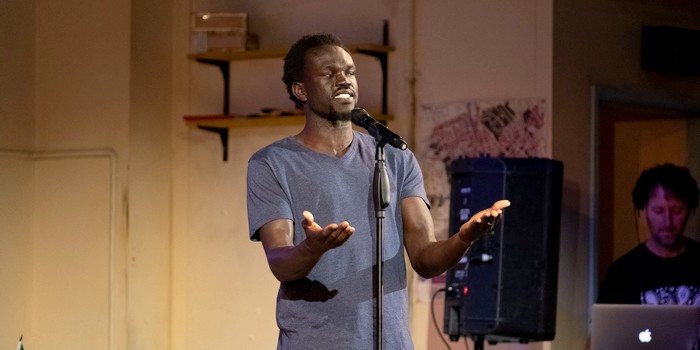
Abe Nouk tells us about mastering the English language through the power of poetry.
Abe Nouk isn't one to take a compliment. But he probably should.
The 28-year-old runs writing workshops while working as a substitute teacher, and has become one of the most renowned poets in Melbourne. (Okay, Australia.)
He's been a finalist in the Australian Poetry Slam numerous times (including this year), performed at the Sydney Opera House and has published two poetry collections.
Just don't call him 'one of the best', as I did; at least not to his face.
"If we buy into that notion of 'being the best', I think we start to devalue other people who aren't there yet," Abe explains to Student Edge.
"When we put it down to a competitive aspect, we start to realise that it's more about people's self-esteem."
Abe's latest project is the upcoming young adult novel Vicious Streets, originally planned for release earlier this year.
Unfortunately, it's been pushed back due to all the negative media surrounding "African" gangs, specifically of Sudanese heritage, further perpetuated by comments from federal and state politicians.
He's frustrated that the media's reporting on the matter has further exacerbated the demonisation of the African community.
"People trust the headlines," Abe explains.
"But it's like, okay, the [Sudanese] community's here, why don't you get to know these people during daylight if you're scared of them at night?"
"It's fascinating how everyone [like politicians] comes out and says they're going to solve the African problem," he laughs.
"The African community is really wondering the same thing. Where are these gangs that you speak of?"
Abe stands in stark contrast to these stereotypes and he's exactly what some politicians might be most afraid of: a refugee from Africa who grew up to become a successful figure in Australia's literary community.
But writing and poetry wasn't something Abe always envisioned for himself when he first arrived in Australia as a refugee.
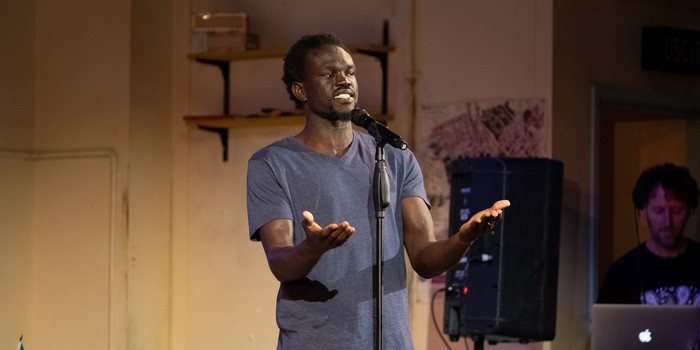
It was 2007 and Abe didn't know a word of English. He'd arrived in Melbourne from Khartoum in Egypt, where he'd stayed for a number of years after he and his family had left Sudan.
After doing a few rounds of ESL (English as Second Language) classes, he was eventually placed in a Melbourne high school where he learned how to prosper when the odds were against him.
"We were put into Year 9 and the environment was so awkward," Abe admits.
"I was the one who had to make everyone else feel comfortable.
"I had to embody a sense of confidence I didn't have, despite the fact that I was illiterate and how embarrassing that was."
It was this passion for conversations with people as well as listening to the words of Maya Angelou, alongside local poets like Luka Lesson, that eventually inspired him to write his own poetry from a more personal place.
"I've had a father but I didn't have that relationship that would've made me consider him a dad," Abe begins to explain.
"So, it was writing about that and realising how vulnerable I was in going 'You know what, if I don't share this then I'm not being authentic with what I'm really feeling.'
"That was the first piece I ever did."
With the emphasis Abe places on the meaning of words, it's no surprise he describes himself as a fanatic for American hip-hop.
"Back in Africa, we would barely speak English but we were like, 'This is so cool'," Abe recalls.
"We were inspired by the positivity, the uplifting adamance.
"It was the struggle of self-identity for black youth that, at the same time, kept itself open for more authenticity."
Still, I can't help but notice he uses the past tense when answering, and that the careers of the artists he mentions (Nas, Kanye West) peaked 15 years ago.
So, how does he feel about the genre's current state, which favours mumbling and self-aggrandisement over storytelling and hope?
"The current artists don't want to accept the reality of what the world is really like, so entertainment has become the main focus," Abe admits.
"[It's] full of insecurity."
In the case of Kanye, the rapper's transition from songs like "Jesus Walks" in 2004 to his most recent hit, "I Love It" (with prominent mumble rapper Lil' Pump), has also left Abe heartbroken.
"College Dropout and Graduation were Kanye West at his most authentic self," Abe says.
"Currently, Kanye West is trying to—not that I know anything about him [personally]—remain relevant."
As for Abe, he's just focusing on getting Vicious Streets out.
Given his track record of accomplishments in his relatively short but impressive literary career, you know it's going to be something special.
Header Image: Supplied
Topics
Ref: e266374d-3a3c-4366-88eb-a98c001672b4





Comments & Feedback
Share your opinion
Emoji cheatsheet Formatting Comment guidelines