Review: "BoJack Horseman" Reckons With the #MeToo Movement in S5
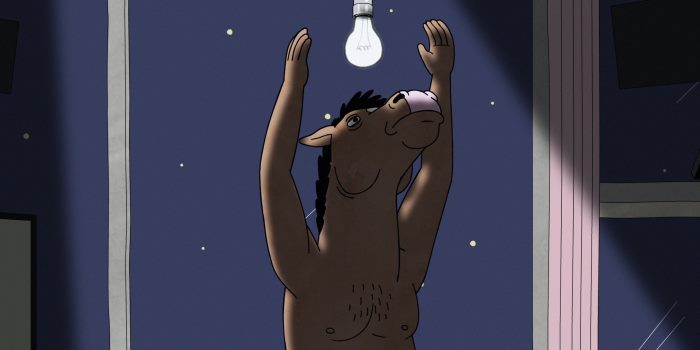
When BoJack Horseman returns to Netflix, fans will have to question how far they’re willing to follow his spiral of self-despair.
I hate to flog a dead horse, but BoJack Horseman is a bummer.
Yes, it’s an exceptionally silly, very funny, colourfully animated show about a version of the world half-inhabited by anthropomorphic animals, and follows a washed-up horse trying to make it in "Hollywoo". There are a lot of puns, a talking dog called Mr Peanutbutter, a talking cat called Princess Carolyn and a troupe of feral dentist-clowns.
And it’s so, so sad.
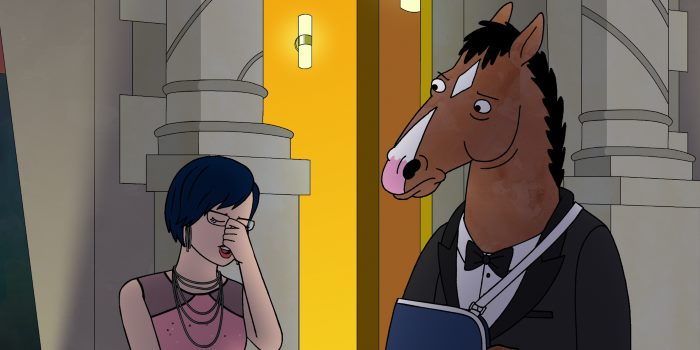
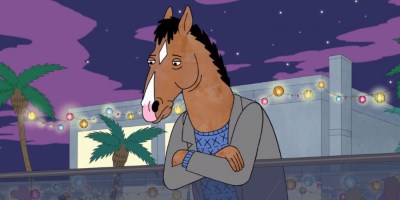
Over four seasons, we’ve watched BoJack (Will Arnett) go from disgraced former sitcom star to alcoholic movie star to depressed junkie to barely functional human—err, I mean, horse. In between, he’s reckoned with the cruelty of his upbringing and the lingering torment of his dementia-addled mother. He’s lost all his loves, and betrayed everyone who mattered most. Yet, with the fourth season finale, the program seemed to near a natural end, with BoJack’s surprise sister, Hollyhock (Aparna Nancherla), saying she indeed wanted him in her life, and the promise of professional redemption, thanks to a leading role in Princess Carolyn’s (Amy Sedaris) new series, the dark drama Philbert. The season ended, for the first-time, on an upbeat note. BoJack even smiled.
I hope you didn’t get used to it.
Anyone familiar with the ups-and-downs-and-loop-de-loops of a traditional BoJack Horseman season can probably predict BoJack’s newfound satisfaction won’t last long in Season 5. However, what’s really remarkable about the show’s excellent fifth season is how it pushes fans who have otherwise stuck with BoJack through thick and thin to follow him to his darkest point—and darkest act—to date.
Though it doesn’t become apparent immediately, the fifth season is ingeniously coiled around the sexual assault revelations that rocked actual Hollywood in 2017. It begins with an early issue-focused instalment, similar to its lauded and loaded "gun" and "abortion" eps. This time, it’s the #MeToo movement under the microscope, and particularly the film industry’s willingness to forgive abusive men, with BoJack happily adopting the mantle of "feminist" to score easy points with women. Unfortunately, the ladies in his life really know what’s up.
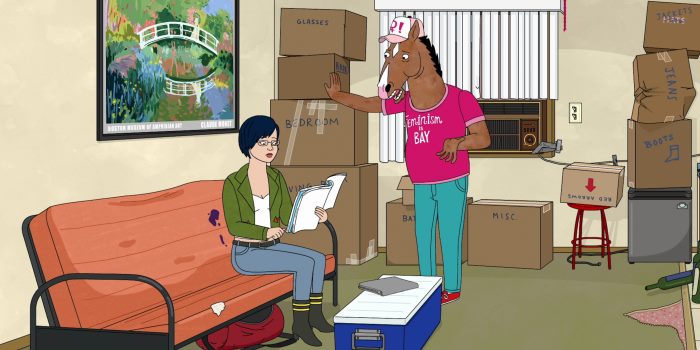
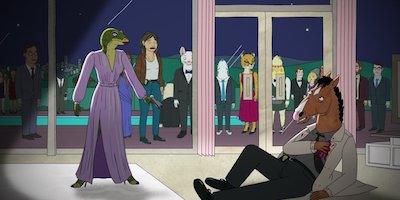
The episode is still hilarious, of course, but it also lets the show’s conscience, Diane (Alison Brie), voice the fury that underpins it. She talks about the injustice of women needing to defend their affiliation with questionable dudes (perhaps bringing to mind Brie’s brother-in-law, James Franco). Later, she’ll become a writer on BoJack’s gritty True Detective knock-off Philbert, and similarly wonders if her female writing credit is being used to let viewers off the hook for feeling sympathetic towards (or relating to) a misogynistic character. These threads come to a head in the shocking penultimate episode, in which BoJack’s actions will leave viewers wondering how culpable they’ve been in rooting for the funny horse cartoon to stay drunk, sick and terrible.
As disturbing as the season’s climactic moments are—they echo, and directly reference, BoJack’s despicable encounter with old friend Charlotte’s daughter from the second season finale—the show still finds plenty of other goofy paths to wander down. Every moment with Paul F. Tompkins’ Mr Peanutbutter is a dizzy delight, for instance. And the lovably dim, unspeakably lucky Todd (Aaron Paul) invents a particularly ridiculous contraption (even by his standards) that made me choke out a huge laugh every time it appeared. By the final episode, that machine’s true purpose in the context of the show was revealed, sealing its conception as nothing short of ridiculous genius. Sometimes BoJack Horseman is smartest at its dumbest. (And vice versa: a standalone episode of Diane struggling to connect with her Vietnamese heritage is a lacklustre response to the whitewashing criticisms lobbed at the show.)
There’s also a landmark episode for Arnett’s supreme vocal talents, where he gets to deliver an episode-long monologue in which he notes how there are no happy endings; life just keeps going, until it doesn’t. If that’s showrunner Raphael Bob-Waksberg’s justification for this fifth season—when BoJack could have ridden off semi-happily into the sunset last year—I’ll take it.
That said, If they’re bringing BoJack back for Season 6, it’ll be interesting to see how many fans follow him. Should he be written off? The show is trying to tell us it’s too early to say 'yea' or, ahem, neigh.
4/5
BoJack Horseman Season 5 debuts on Netflix 14 September 2018.
Header Image: Netflix
Topics
Ref: 8ff2b08f-5570-43df-b010-a93500548b22



Comments & Feedback
Share your opinion
Emoji cheatsheet Formatting Comment guidelines