Explained: How Preferential Voting Works in Australian Federal Elections

How your vote is really counted in these elections 🤔
On 3 May, Australians will gather for a celebratory democracy sausage, and more importantly cast their vote in the federal election.
Whether it’s your first time voting or you’ve done it before, it’s worth understanding how the voting system in Australia so you can make your voice heard on the things that are most important to you.
A breakdown of preferential voting.
Down under, we utilise a preferential voting system. Which means it’s compulsory for you (the voter) to mark a preference for every single candidate.
Some ballot papers require a certain number of preferences to be indicated, and others are optional.
In Australian federal elections, voters will be asked to:
- Mark a preference for every candidate on the green ballot paper (House of Representatives)
- Mark a preference for a designated number of preferences on the white ballot paper (Senate)
Here’s how your vote gets counted in both the House of Representatives and Senate.
View this post on Instagram
House of Representatives.
Voting for someone in the House of Reps in the federal election means voting on the smaller, vertical ballot.
In the House of Reps, you must number all the boxes on the ballot paper. You must number them from 1 until the last number (depending on how many candidates there are).
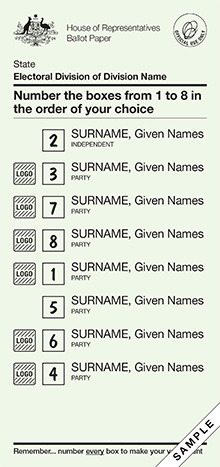 Source: Australian Electoral Commission.
If a candidate gets more than 50 per cent of the formal first preference votes (e.g. more than 50 per cent of people in that electorate have put the same candidate as their first preference) they are immediately elected.
However, all the other votes are still counted to show how the electorate voted.
If no candidate has the absolute majority, the candidate with the fewest ‘number 1’ votes is then excluded from the race because they don’t have enough votes to win.
But we now turn to the ‘number 2’ votes for this candidate on each ballot paper. The second preference on these ballot papers are now counted towards that candidate.
Take a look at this example ballot paper from our election above. In this hypothetical election Zendaya, Jacob Elordi, Sabrina Carpenter, Timothee Chalamet and Pedro Pascal are all up for election.
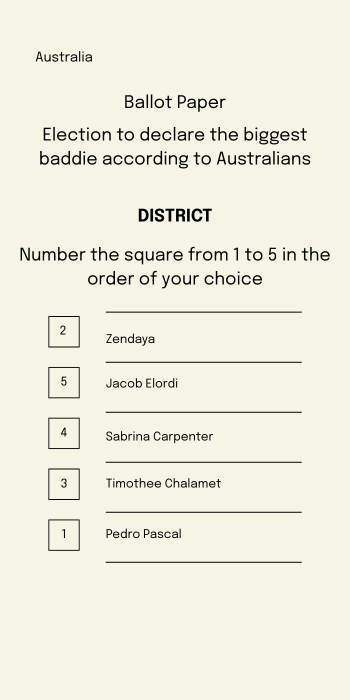
There was no 50 per cent majority and unfortunately Pedro Pascal received the least amount of votes (RIP). All of the ballot papers in which he received a first preference (like the one above), now need to be sorted through to see who received the second preference. Those votes are then allocated to those candidates.
In this example ballot paper’s case, the second preference was Zendaya. This vote is now transferred to her pile of votes.
This continues until one candidate has more than half the formal votes cast and is then declared elected.
You can also practise voting online for the House of Representatives here.
The Senate.
Voting for the Senate in the federal election means voting on the big, long ballot.
This ballot is split into two parts – above the line or below the line. The top half aka above the line is to vote for parties and groups. While below the line is to vote for an individual.
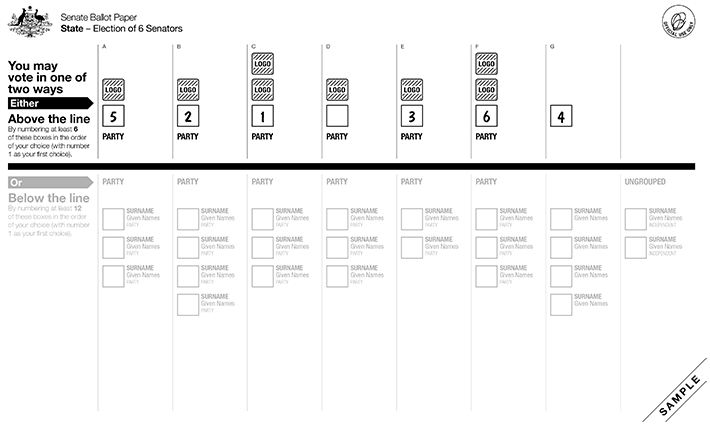 Source: Australian Electoral Commission.
In order for your vote to be counted as valid, you need to choose whether you vote above or below the line. You are not meant to do both, just choose one.
If you vote above the line, you’re choosing what parties you see in the Senate. If you vote below the line, you’re voting for the exact order of candidates you want to see in the Senate.
No matter which option you choose, there will be instructions asking you to number at least a certain number of boxes.
E.g. they might ask you to number at least six boxes if you are voting above the line. You can continue to keep numbering boxes, but you must have numbered at least six.
In the Senate instead of achieving a 50 per cent majority like the House of Representatives, to be elected a candidate needs to win a quota aka a proportion of the electorate’s votes.
The way preferential voting works here is that once a candidate gets all the votes they need to be elected, their ‘extra votes’ get passed on to the next preferred candidate based on who was ranked next on the ballot.
If after all this all the seats aren’t filled yet, the person with the fewest votes is knocked out, and their votes go to the next preferences too.
This repeats until all the spots are filled.
If you’re totally overwhelmed or unsure about how to vote for the Senate, good news is you can actually practice voting online here.
If you want more information on policies of the different parties, how they vote on them and which ones are the most impactful on young people – head to our Instagram or check out sources like theyvoteforyou.org.au or buildaballot.org.au.
Topics
Ref: a2300185-20c0-405d-8e30-b2c7008b0c85



Most Popular



Comments & Feedback
Share your opinion
Emoji cheatsheet Formatting Comment guidelines
Awesome, I learned something interesting from this article
We are so glad to hear this!