Movie Review: "The Irishman" Is One of Martin Scorsese’s Best Movies
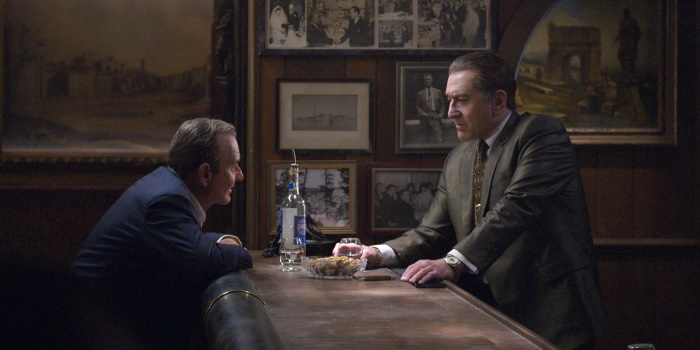
Marty’s long marriage to the (cinematic) mob comes to a devastating end.
Few films can justify a length longer than 90 minutes, but even at three-and-a-half hours, Martin Scorsese’s melancholy mob movie The Irishman still feels lean, and very mean.
Watching it, you’re reminded what it's like to see a movie by one of the best to ever make them. His craft is peerless, and his grasp of tone—as he see-saws back and forth between tragedy and outright gutbusting comedy—is a marvel. And his decades-long partnership with editor Thelma Schoonmaker is perhaps the finest in cinema history, in how they construct both scenes of shocking violence and nuanced conversational to-and-fros. (They make particularly choice cuts here during a celebratory dinner sequence that turns funereal, in which all the players assemble in one place to argue and give one another piercing looks.)
Even when the flick appears to go on and on (and on), labouring the point that its cast of mafia heavies have a habit of squabbling over perceived insults, it’s a delight, aided by Steven Zaillian’s witty script and a group of attentive actors. That may sound like faint praise, but getting 'attentive' performances from actors Robert De Niro or Al Pacino in 2019 is a rarity, and to get performances from them that are actively enthralling is basically unheard of.
De Niro plays Frank "The Irishman" Sheeran, a real-life mob enforcer who, late in life, confessed to a series of crimes, including the disappearing of union leader Jimmy Hoffa (portrayed by Pacino). Told from the perspective of Sheeran as an old man in a retirement home, direct to camera, you see how the ravages of time put everything that once seemed significant in a new perspective. It’s helped by a turn of uncommon vulnerability by De Niro (who, thanks to gobsmacking CGI, often portrays Sheeran in flashback as a young man out of his element). He’s left alone recalling his fatal friendship with Hoffa, and his conflicting allegiance to mob boss Russell Bufalino (an out of retirement Joe Pesci) convincing himself the feuds were worth a damn, despite everyone who once cared about them being dead.
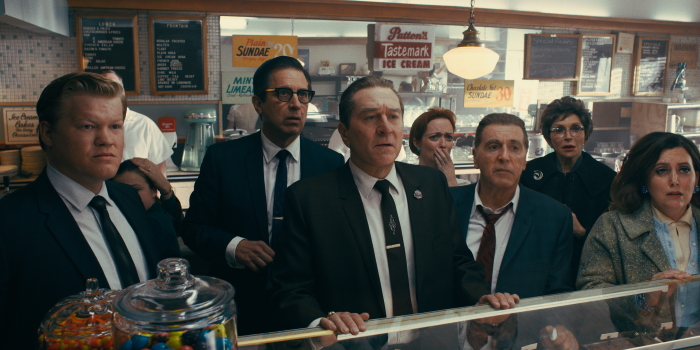
We see that the toll of their crimes and the pain they wrought was all a waste, as our antihero fails to accept his new insignificance as a civilian, or the fact he may have been insignificant all along. It’s a profound inversion of the endings to Goodfellas and The Wolf of Wall Street, which suggested there was no worse fate than to wind up a schnook living among the normies. Considering Scorsese's history of making gangster movies, the futility of it all feels especially poignant.
But I’m getting ahead of myself. There’s a long road to go until The Irishman meets its end, and for that we have Netflix to thank. They're the ones who gave Scorsese the budget to luxuriate for 209 minutes with this gifted assortment of actors. They let him keep his preferred title too. Though you’ll find it listed on the service under The Irishman, the picture itself is introduced with the more evocative card I Heard You Paint Houses, per the Charles Brandt biography about Sheeran on which the film is based (and remains refuted by some). Hey, whatever you say, Marty.
Netflix’s deep pockets also allow Scorsese to de-age De Niro, Pacino and Pesci, in a manner far more convincing than has been executed by any other blockbuster. Look closely, and sure, you’ll spot the CGI imperfections. But over time, you stop noticing, because the effects are in service of astute and considered physical performances.
Most iconic for his volatile hothead in Goodfellas, Pesci brings an inscrutable stillness here, as a man who's threatening for his unsaid insinuations, and the power we and he know he can wield. As Hoffa, Pacino has a frustrating stubbornness leavened by charisma, resulting in his most layered turn in years. De Niro, however, surprises most. It’s not always easy to buy him as a thirty-something (just as it was never easy to do when he was thirty-something), yet he’s coy and sympathetic in this, even as it emerges that this man may not have a conscience in the traditional sense. The film grows to center on his dual loyalties to both Russ and Jimmy, and his genuine crestfallen confusion over which side to take, and who to keep alive, building to a despairing climax in which he finally makes a call.
There are more actors and craftspeople to mention and appreciate, and that includes a near-silent Anna Paquin, as Frank’s suspicious daughter, who makes her single line of dialogue count. Robbie Robertson’s slow-grinding score—with circling cello, harmonica and guitar—is equally adept at ratcheting up dread. I'd go on, but I’d rather you watch The Irishman rather than have you read about it for three-and-a-half hours instead.
Because of its thematic resonance, it’s easy to think of The Irishman as a coda to Scorsese's career (or a longing throwback to his bad old days of crime movies). It ain’t that. Movies this alive and significant aren’t made by old men on the edge of irrelevance, playing games of "remember when". The Irishman is one of the best things ever achieved by everyone involved, precisely because it's doing something brand new.
5/5
The Irishman arrives in select Australian cinemas from 7 November, before becoming available globally on Netflix on 27 November.
Header Image: Netflix
Topics
Ref: cef840c3-84ca-46b4-ae75-aafb002e6cc1



Comments & Feedback
Share your opinion
Emoji cheatsheet Formatting Comment guidelines