The director of Anchorman and Step Brothers delivers the most damning portrait of America since, well, Anchorman and Step Brothers.
Whodathunk that one of the most sobering depictions of an American tragedy would come from Adam McKay, director of countless Will Ferrell comedies and former head writer for
Saturday Night Live?
And whodathunk that the man he once cast as lamp-loving, candle-eating Brick Tamland would be the emotional, irascible center of his first major dramatic flick?
If youdathunk both of those things, congrats: you had better foresight than the American institutions who were warned of a global financial crisis as early as 2005, but failed to heed the apocalyptic trumpets.
McKay’s engrossing
The Big Short, based on Michael Lewis’ non-fiction book of the same name, follows the analytical prodigies and intuitive investors who saw the worrying trends of America’s economy and did the trumpeting prior to 2008's GFC.
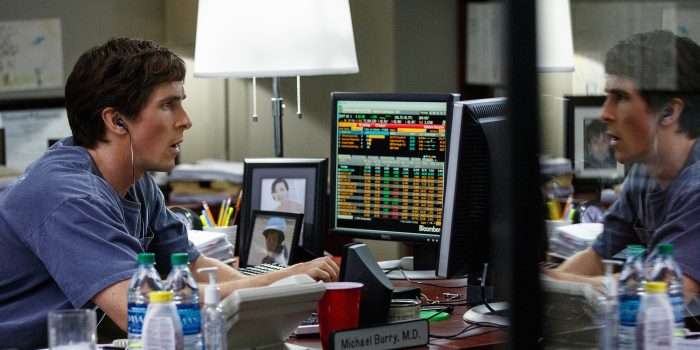
Christian Bale plays Michael Burry, a reclusive, heavy metal-loving hedge fund manager in California who digs into the statistics of unpaid mortgages and realises, with mathematical certainty, that the United States is headed for a giant financial collapse… a full three years before it actually occurs.
Having identified that America’s economy is propped up on subprime mortgages (basically, loans that are unlikely to ever be paid off), Burry takes the money of his many trusting investors and makes a billion-dollar wager on America’s downfall. If everyone’s about to lose their money, and no one wants to listen to his Chicken Little-ing, he might as well make a tidy profit.
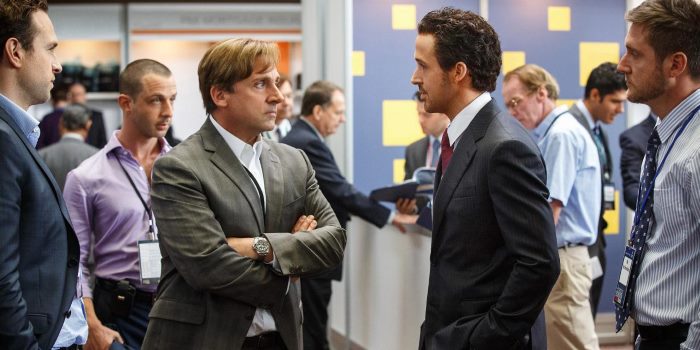
Meanwhile, in New York, the surly, rabble-rousing Mark Baum (Steve Carell) is clued into this potential scheme by ambitious Wall Street young gun Jared Vennett (Ryan Gosling). Though Baum - something of a Bernie Sanders type - would rather spare the working class from their inevitable ruin, he concedes that he’ll at least take great pleasure from betting against the banks and walking away with their fortune.
As Baum learns what those of us in the audience already know – that those institutions will ultimately be rescued by taxpayers (via government bailout) – the reality of where those riches are coming from start to sink in.
The picture’s other major thread follows two young investors from Boulder, Colorado (John Magaro, Finn Wittrock) who, under the mentorship of retired Wall Street shark and current paranoid hermit Ben Rickett (Brad Pitt), similarly bet hard and bet big against the American public. They delight in learning that their predictive algorithms are correct and that they’ll likely make-off with hundreds of millions of dollars when the GFC strikes. However, when news starts to drip in circa 2007 that banks are collapsing and pensions are being erased, their first reaction is not of joy: they call their parents.
I was initially worried that McKay, in an effort to depict the evil of American corporations and the greed that unraveled a planet’s economy, would turn Lewis’ book into an unfeeling PowerPoint presentation. Not so. The human toll of this catastrophe is deeply felt.
Turns out McKay is the best fit we've seen for Lewis, an author with an uncanny knack for making numbers and indecipherable data totally accessible. (Previous adaptions of his books include
Moneyball and
The Blind Side.) Alongside screenwriter Charles Randolph, McKay has done an impeccable job of maintaining Lewis’ voice, communicating the seemingly incommunicable, and producing a continuously entertaining and enthralling feature.
Its filmic style – courtesy of the handheld cinematography by Barry Ackroyd - is vastly different to what McKay’s attempted elsewhere, yet
The Big Short maintains that improvisational feel. It helps that his performers have great comic chops (and that many of them have been bestowed Ron Burgundy-level wigs).
Christian Bale is excellent in a subdued role as a lifetime pariah and Ryan Gosling, in the sweetest surprise, is a comic force as our anti-heroic tour guide.
He acts as the fourth wall-breaking narrator, explaining such head-scratching concepts as “collateralised debt obligations”, or turning the responsibility over to cameoing celebrities in a deliciously tongue-in-cheek manner. First off the block is
The Wolf of Wall Street’s Margot Robbie, explaining subprime loans from the comfort of a bubble bath.
Early on, Gosling’s Vennett interrupts himself to ask the audience if these big words make us feel stupid.
In
The Wolf of Wall Street, Leonardo DiCaprio’s Jordan Belfort did the same, assuming his viewers were ill-equipped to understand how exactly he swindled his millions on Wall Street.
Here’s the big difference between
The Big Short and Scorsese’s swaggering
Wolf of Wall Street (despite both containing larger-than-life investors, complex financial concepts and Margot Robbie in very little clothing): After Vennett asks if the Wall Street jargon makes us feel dumb, he adds the sympathetic kicker, “They’re supposed to.” It’s a perfect movie moment, and
The Big Short has plenty more where that came from.
McKay has produced so many near-iconic comedies in his time that his recent success in condensing and expressing
The Big Short in an informative and still thoroughly-electrifying manner affirms him as not only one of America’s great humourists, but an uncelebrated film genius too.
In a little over two hours, he documents the macro and micro repercussions of this chaotic event: from the betrayals by large organisations, to the very human, intimate, daily struggles of those trying to make ends meets.
The Big Short navigates that prickly terrain with great hilarity, fury, smarts and, above all, humanity. It's exceedingly watchable. At times, it's even shiver-inducing scary. I recently said to
“beware the picture with no sense of humour.” Strangely, it’s the funniest awards contender that has left me truly afraid.
4.5/5
In cinemas now. Rated M for coarse language and nudity.
Comments & Feedback
Share your opinion
Emoji cheatsheet Formatting Comment guidelines