Movie Review: "Ford v Ferrari" is the Cadillac of Generic Racing Biopics
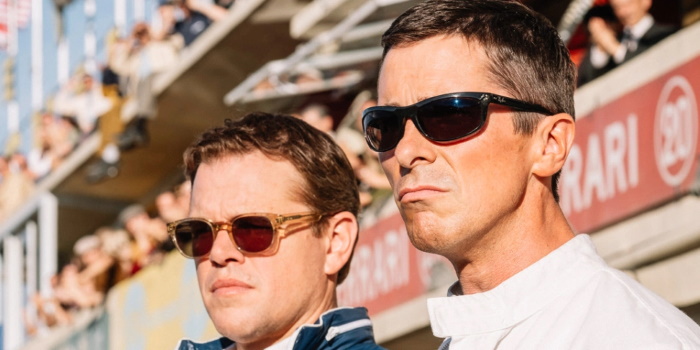
Stunning race sequences and a frisky Christian Bale compete against a lame and overlong script.
I hope you like listening to dudes describe the ecstasy of feeling a motor purr between their loins, because Ford v Ferrari is basically 152 minutes of that.
For what it’s worth, the purring is pretty impressive. Director James Mangold and his behind-the-scenes team can look forward to Oscar nominations for their scintillating sound design and editing.
But the movie they’ve installed the purrs into is lacking in oomph. Based on the true rivalry between car manufacturers Ford and Ferrari, it’s neither built for speed nor made to last, failing to explain the urgency or even the origin of this vehicular feud and taking way too long to get to the finish line as well.
Christian Bale stars as real-life legend Ken Miles, an extremely cocky/cockney race car driver who worries he’s missed his chance at glory. (His confrontational, sarcastic demeanour may have played a part in his blackballing by the industry.) He’s rescued from irrelevance by the nationally-beloved Carroll Shelby (Matt Damon), a retired racer who’s been recruited by Henry Ford II (Tracy Letts) to build an American car capable of toppling the fine European automobiles produced by Enzo Ferrari (Remo Girone). As Shelby explains to the many Ford executives who are suspicious of the enterprise, to win, they'll need a driver like Miles; one who has an almost symbiotic relationship to his car. Only Miles, Shelby argues, can feel exactly when his aerodynamic car is at its limit, and when it can be pushed further, to victory.
It’s at this point you start to wonder if we’re about to see these guys make love to the car.
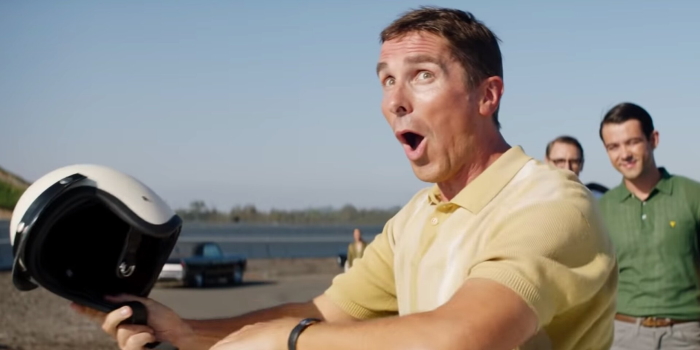
Thankfully, this is not David Cronenberg’s Crash, but a fairly conventional sports flick (down to Marco Beltrami’s Rocky-aping score), so Bale and Damon keep it purely platonic with their Ford.
The script—credited to Jason Keller and Jez & John-Henry Butterworth—races from 1963 to 1966 with nary a title card letting the audience know how quickly time is actually passing. It at once feels too tightly condensed and also languidly paced, dragging to its decisive 24-hour Le Mans endurance race and missing multiple off-ramps to what could have been timelier endings.
Bale makes it work, in the extremely rare performance to utilise his natural accent, which may explain why he seems so comfortable and affable as Miles. Damon’s similarly appealing as the American maverick Shelby, and never better than when he's sticking it to his stiff-shirted superiors.
Everyone else gets painted in far broader strokes, Team Ferrari especially. I’ve seen documentaries on Mussolini that showed Italians in a better light. Letts’ Henry Ford II wouldn't exactly be flattered by his depiction either, and you just know Josh Lucas’ snivelling executive is a bad guy because his hair has basically been gelled to engulf his scalp. In this film, a character’s virtue directly correlates with how wind-swept and motor oil-stained they look.
If you’ve come for the racing, you’re gonna see plenty. Mangold and cinematographer Phedon Papamichael (along with his additional units) shoot both the legendary Le Mans and Daytona showdowns in spectacular detail, establishing clear geographical markers to let viewers know where they're at (a not insignificant achievement, given the marathon format of the races). If only Mangold had stripped away the dead weight, or tuned into the cultural and emotional stakes of the title duel, he could have complemented his incredible racing sequences with a properly memorable movie too.
3/5
In Australian cinemas 14 November 2019. Rated M for coarse language.
Header Image: Twentieth Century Fox
Topics
Ref: 23512e16-36e3-4c9d-8964-ab0300815220




Comments & Feedback
Share your opinion
Emoji cheatsheet Formatting Comment guidelines