Movie Review: Split
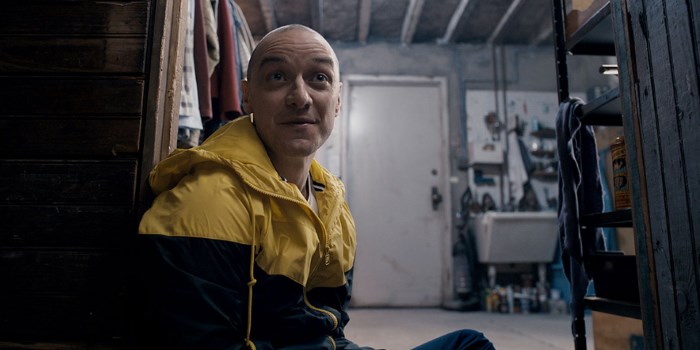
In Split, James McAvoy faces his greatest challenge yet: being directed by M. Night Shyamalan. (Oh, and playing two dozen distinct personalities. But mainly the first thing.)
The real terror that comes with each new M. Night Shyamalan picture? You never know which M. Night Shyamalan you’re going to get.
Will you get the thoughtful, spiritual, supernaturally-inclined auteur with the patience of saint? He’s the one behind The Sixth Sense, Unbreakable and Signs, but also The Village. (The wait in that was… not worth it.) Will you get the Hitchcockian provocateur who gifted us with Mark Wahlberg: Tree Whisperer, produced Devil and delivered 2015’s surprisingly decent The Visit? Or will you get the phoned-in paycheck collector behind tedious blockbusters After Earth and The Last Airbender?
The trouble is that none of these distinct directorial personalities is reliable, and if you had to pick which one made the worst feature, you’d be crippled by indecision.
The M. Night Shyamalan responsible for Split, an abduction thriller centred on a villain with dissociative identity disorder, is the provocateur; the one who most shamelessly treads on Alfred Hitchcock Presents with fresh, nasty, small-in-scope tales of horror. Split, like those others mentioned above, giddily leans into gore whereas his more patient thrillers left it to the imagination. It similarly lets him test that wicked, unhinged sense of humour of his that made The Visit a unique spin on an already-demented fairy-tale, and levelled The Happening with its misguided tone-shifting.
If your head is spinning, that indicates only that you are still sane. I’m here to confirm: this is the Shyamalan you want. Sure, he's high-risk, medium reward, but at least he’s not the guy who gave us After Earth. Meaning, you won’t be bored beyond all previous recorded benchmarks of boredom.
Anya Taylor-Joy, Haley Lu Richardson and Jessica Sula star in Split as a trio of teenage girls abducted by obsessive compulsive bruiser Dennis (James McAvoy). They’re dragged to a bunker of sorts, locked behind a door and left without explanation. Through the cracks in the wall they hear Dennis speaking to a woman, spying her high heels. The woman, Patricia, comes to introduce herself; however, when the door opens, the girls only see McAvoy, albeit with a new accent, heels and turtleneck.
Later, McAvoy returns to playfully toy with the girls as the childlike Hedwig. At the office of his therapist (Betty Buckley), we get some clarity: these are just three of the distinct personalities that belong to Kevin Crumb, a man beset with dissociative identity disorder, and host to twenty additional personas. He threatens a 24th—the “Beast”—is coming to claim the girls as food. Let’s just say Split won’t win any awards for sensitively depicting the struggle of mental illness.
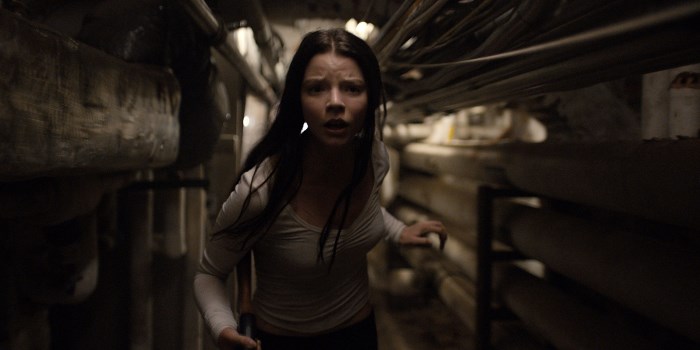
Split undeniably revels in the horror genre’s ugly side, finding a quick, barely defensible reason to get the girls into their underwear, and continues to demonise a community that has been misunderstood by cinema for decades. (It also apparently cut the adorable Sterling K. Brown’s entire role, which is quite simply cruelty in its purest form.)
And yet, it’s entirely compelling, even when it transcends the boundaries of common sense and good taste (in fact, maybe especially once it passes that point). Shyamalan’s name is a punch-line today, and not undeservingly. With Split he reminds us that he is skilled behind the camera. Cinematographer Mike Gioulakis (It Follows ) and composer West Dylan Thordson—both relative newcomers—seem to have reinvigorated him somewhat, or at least invigorated the film by proxy.
McAvoy too—who is becoming increasingly brazen with his choices, following Trance and Filth—gives Split his all. Still, his theatrical space-work and devotion to the individual identities can’t match Taylor-Joy’s subtler performance, as the most resourceful and emotionally-tortured of the three leads. With this and The Witch, she’s probably earned the title “Scream Queen”. When you’re this good in a movie that’s this silly, you deserve a coronation.
Split doesn’t end with a twist so much as it ends with a pitch. (No spoilers.) It’s a finale that will either justify the boundary-stretching that came in the preceding two hours—and perhaps make audiences appreciate it more—or will frustrate and alienate those who were off-board even further.
With deep shame over how easily I was tickled by the big reveal, I admit I’m in the former camp.
3/5
In cinemas January 26. Rated M for mature themes, violence and coarse language.
Photo: Universal
Topics
Ref: e79e54a1-fc7e-4a3a-8027-a7000077e79b

Most Popular


Comments & Feedback
Share your opinion
Emoji cheatsheet Formatting Comment guidelines
So... y'all can recognise that it's ableist and promotes harmful views of people with Dissociative Identity Disorder, but you still give it positive reviews???