Movie Review: Silence
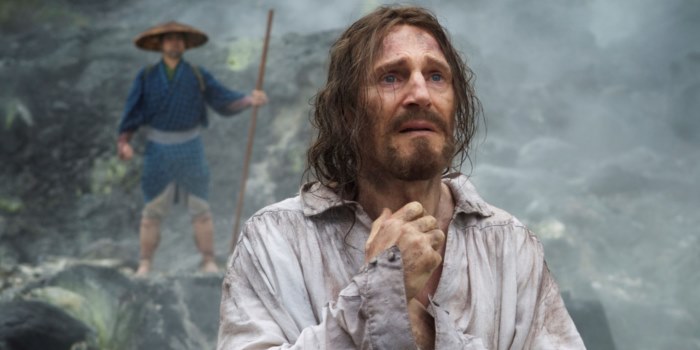
It took 28 years for Martin Scorsese to make his grisly passion project (or should that be ‘passion play’?) Silence. Patience is a virtue.
Martin Scorsese’s sobering, theologically anguished Silence feels like penance for the excesses of his last feature, The Wolf of Wall Street.
In the place of Leonardo DiCaprio’s slurring, pilled-up stockbroker Jordan Belfort, you have Andrew Garfield as the stubborn Jesuit priest Rodrigues, travelling from Portugal to preach the word of Christ in 17th century Japan.
Instead of Jonah Hill (junk in hand) as sidekick, you have Adam Driver as Garupe, an even more devout (and emaciated) padre than Rodrigues.
And whereas Wolf kicked off with Matthew McConaughey as Belfort’s first boss, thumping his chest and justifying complete moral corruption, we have Liam Neeson as the young priests’ mentor, Father Ferreira, now missing in Japan, after an opening scene in which he witnesses Christians being tortured by samurai.
Needless to say, Silence has no stand-in for Wolf’s ‘sex on a bed of cash’ montage.
Though the whiplash between projects is indeed extreme (both in content and execution), it’s not an unusual endeavour for Scorsese, whose films have been populated by faithful figures as frequently as they’ve featured wiseguys.
The religious hand-wringing merely comes to the foreground in Silence, based on Shūsaku Endō’s 1966 novel of the same name, which has been adapted, sparingly, by Scorsese and Jay Cocks. Yet, it still ranks among his most complicated and punishing watches; more gruelling than a Saw sequel and filled with just as many ingeniously cruel torture devices.
Self-flagellators will love it. Those in pricklier relationships with their God will wind up doing some soul-searching over its 161 minutes. Hey, if you wanted an easier time at the movies, you should have seen Hugo when you had the chance.
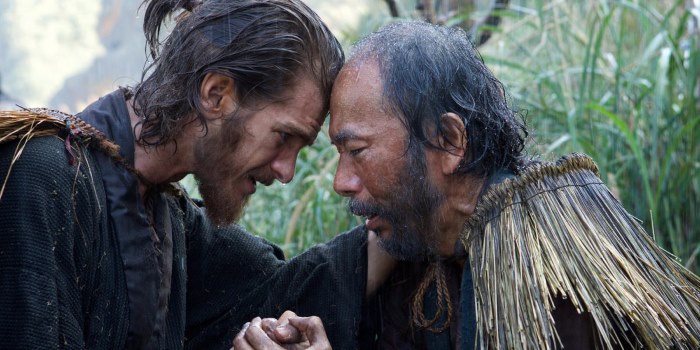
Rodrigues and Garupe begin as naïve men of the cloth, eager to find out what happened to Ferreira and return the word of God back to Japan in the 1600s. But upon arriving in a small, spiritual village, they immediately realise they’re in over their heads, wondering if their parishioners will keep their location quiet from the villainous “Inquisitor” (played flamboyantly by Issey Ogata). From Ferreira’s last reports, they know any discovered Christians will be forced to renounce their faith, or face mutilation, and worse. The priests do not need to wait long to see these methods in practice.
Garfield and Driver, distracting Spanish accents aside, do fine work. Driver, whose commitment and intensity is never up for debate, lets his body waste away for the sake of a higher power (Scorsese). Garfield—who anchors virtually every scene, often in isolation—draws out his creeping madness.
They’re joined by compelling Japanese actors, particularly Shinya Tsukamoto as Mokichi, an honourable martyr, and Yōsuke Kubozuka as the cowardly Kichijiro, whose constant need to confess sins that he’ll invariably repeat becomes Silence’s best, and most infuriating, running gag. The joke is that he keeps asking forgiveness for repeating the same act of betrayal. The laugh gets trapped in your throat when you realise his victim, Rodrigues, is the one he wants to be absolved by. Silence’s methods of torture are not always physical.
Rodrigues, Garupe and Ferreira are each asked to “apostatize” and walk away from their beliefs, or see innocent Japanese Christians executed. What’s the more commendable action? To stand their ground or to surrender? Is it more important to save someone else's life in this world, or your own soul for the next? And who started all this trouble anyway? As the priests are told by the samurai, pointing to their insistence on carrying the "one truth" and disregard for Buddhism and Shinto: “You teach, but you do not listen.”
Some will see Silence as a tale of hypocrisy and selfishness. Others will find it an inspiring tale of faithful resolve. Many will see similarities between the priests’ struggle in that era and more recent examples of religious persecution. Many will also question the colonial motives of the film’s protagonists.
Silence—like so many pictures about self-examination—is a mirror. You leave it with whatever feelings you brung, only accentuated and clarified by its cavernous quiet and ponderous contemplation. Rodrigo Prieto’s patient, Oscar-nominated cinematography lingers in the fog, and trains uncaringly on crucified men punished by crashing waves. The sound mix amplifies crickets and static, while your ear searches for calm. You are being tested too.
4/5
In cinemas February 16. Rated MA15+ for strong violence.
Topics
Ref: 0aac354b-4236-4a8a-be57-a7150077624c



Comments & Feedback
Share your opinion
Emoji cheatsheet Formatting Comment guidelines