Movie Review: Natalie Portman Becomes the Fame Monster in "Vox Lux"
This thing is a whole lotta movie.
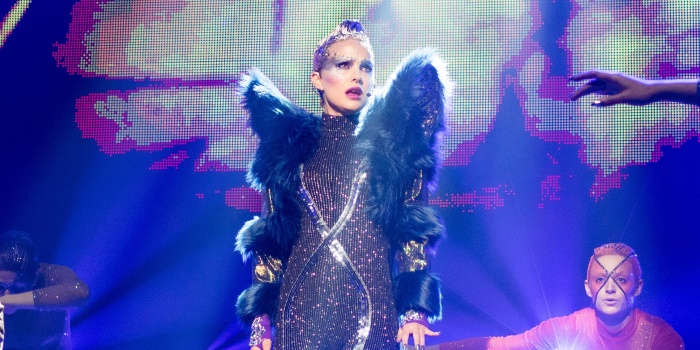
In Vox Lux, Natalie Portman plays a pop star (singing original songs by Sia!) reckoning with the decades of trauma she not only suffered—beginning with a school shooting—but also wrought, as a producer of disposable music, as an addled absent mother, and as an influencer of terrorist violence.
Wow, there’s a sentence for you that becomes significantly less fun as it goes along.
Writer-director Brady Corbet, who devised the story with his partner Mona Fastvold, isn’t making a confection with his second feature (despite the candy coloured visuals), opening with the deeply upsetting assault-gunning of a classroom in the year 1999.
One of the lone survivors is Celeste (played as a teen by Raffey Cassidy, and as an adult by Portman). Despite taking a bullet to the spine, she becomes a sensation when a song she wrote to process the pain—"Wrapped Up"—hits the charts. A greasy manager (Jude Law) and a doting sister (Stacy Martin) help usher her into the world of fame. Many, many compromising moments in her life follow.
By the climax, Celeste has evolved into a Lady Gaga-esque superstar, albeit with more sinister baggage, performing party songs to a strobe-lit stadium. The rest of us, however, are left rocked in our seats by all that we’ve grimly endured, wondering how the hell we got here exactly.
To be honest, I’m still not entirely sure. I only really understood Vox Lux by its final spoken words of dialogue—from sober narrator Willem Dafoe—which hint that this is simply a wild new take on old music-industry folklore. If that’s the intention, it was all worth it. Corbet is a skilled filmmaker and he has made an unforgettable work that leaves you with plenty to chew on, provided you have the stomach for a dread-inducing journey through modern spiritual corruption, and pop music.
If that's the intention.
Now, there's a lot going on in here, and to dissect, and that's before you even get to the Sia songs, so bear with me.
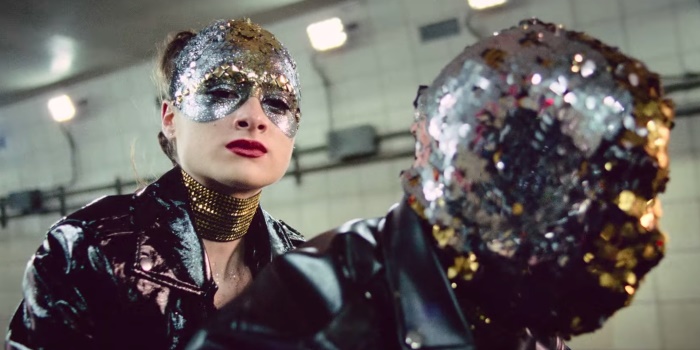
Vox Lux seems to suggest pop music—if not pop culture and celebrity, generally—is downright satanic. Or, it at least requires a satanic disposition. Older Celeste calls herself "the New Faith" at a press conference, after terrorists use her costumes to become famous themselves. Corbet conflates that with an entire industry suckling on pop’s teat, from music promoters to journalists to hangers-on. Earlier, young Celeste says she wants to make music people don’t need to think about; a comment on desensitisation in the years following Columbine (which inspired the pic's fictional school shooting) and 9/11 (mentioned only in passing, because there’s already enough tragedy for the characters to deal with). Like I said, Vox Lux is a lot.
It all looks beautiful. Though, given how often his flick echoes Elephant, My Own Private Idaho and Paranoid Park, I can’t quite tell if Corbet’s replication of Gus Van Sant’s aesthetic is a kind of social commentary too. Or, is it only dangerous to reproduce 'empty' pop culture unthinkingly? No, I’m seriously asking. I want to figure this film out.
It’s pretty humourless—concerningly so—until Portman turns up in the 2017-set sequence to inject some raucous energy into proceedings with her off-the-rails pop diva. Everyone else had previously appeared stunned into grave silence (the audience as well). Cassidy returns for those scenes to play Celeste’s own daughter, and her dual performance is an impressive feat in itself.
And then there are all the Sia tunes, and much like the music produced by Gaga’s character Ally in A Star Is Born, it’s not clear if we’re meant to find her out-the-box anthems transcendent or banal. I will say that, when listening back to the soundtrack, they blend into the current musical landscape in the best way. "Wrapped Up" and "Hologram (Smoke and Mirrors)" in particular could be real hits. Sometimes, they intermingle with Scott Walker’s bombastic, piercing score, chillingly.
I wish the movie better clarified Corbet’s feelings on music, culture, religion and fanaticism, instead of merely hurling grenades into the conversation. Its title—which translates to "Voice, Light"—implies there's something weightless about Celeste’s music. Seeing how Corbet was an anonymously handsome young actor who diverted to European art cinema, I get his negative feelings towards cultural disposability. Still, JFC Brady, some of us just want to listen to and enjoy "thank u, next" without thinking about its societal cost. Oh, wait, is that the inverted point he's trying to make?
It may be hard to discern from my review, but I’m actually recommending Vox Lux. At times, it was painful to watch, with seemingly conflicting ideals, and (perhaps) an anti-pop agenda I could never endorse. Yet I was sucked in. It seared my memory, and I’m not done wrestling with it. Like the work of any interesting artist, it demands to be wrestled with. If that’s your jam, Vox Lux might be for you too.
4/5
In Australian cinemas 21 February 2019. Rated MA15+ for strong themes and violence.
Header Image: Madman Entertainment
Topics
Ref: 823bfc51-1200-4688-86da-a9f9003f0e9b






Comments & Feedback
Share your opinion
Emoji cheatsheet Formatting Comment guidelines