Movie Review: Jackie
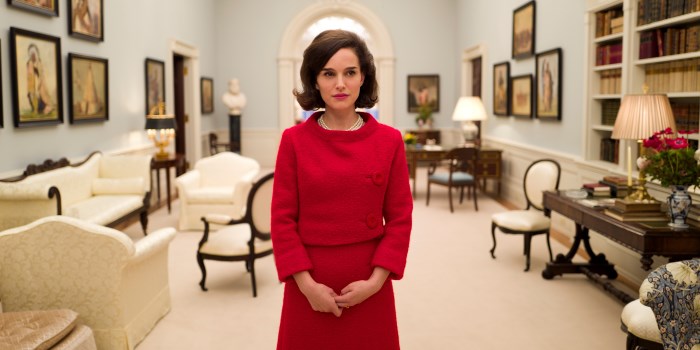
History comes to life and a former First Lady becomes a walking ghost in Pablo Larraín’s strange, disquieting biopic, Jackie.
Public figures often come to be defined by their big screen representations. Biopics seek to recreate history, and actors take on mannerisms, accents, and, where appropriate, prosthetics to make everything as accurate as possible. As if accuracy could ever truly be achieved, or was even an ideal goal. (Don’t believe the hype.)
Pablo Larraín, the disruptive Chilean director, knows that even the most “accurate” of biographical pictures is only going to be judged against the widely-held perceptions of their subjects (real or not).
What’s revolutionary about his Jackie, which details the mourning and mental anguish of President John F. Kennedy’s wife, Jackie Kennedy, in the days following his grisly assassination, is that it toys specifically with how one constructs a legacy—the kind that might result in a hagiographic film down the track—with the assistance of the media, technology and the public’s willingness to buy inspirational narratives. His star and co-conspirator, Natalie Portman, does the selling here, and it’s near impossible not to buy it. But this is no hagiography.
Their Jackie Kennedy is a victim of history yet also one of its architects. In the days after her husband’s execution in Dallas, she can do little except wander around the White House like an invisible spectre, as Lyndon B. Johnson (John Carroll Lynch) and Lady Bird (Beth Grant) prepare to move in, and aides begin removing Jackie’s carefully curated artworks.
Intercut between these sequences is Jackie seated, confidently, for an interview with journalist Theodore H. White (Billy Crudup), just one week later. She’s contrived a way to keep JFK’s name stitched into the cultural fabric, despite a lack of achievements in his three years as commander-in-chief. To White, she relays the invented idea of “Camelot”. He complies, and pushes the myth.
Portman and Larraín contribute to that heritage of legend-building more than they dispel it. Anyone who previously wrote off Jackie Kennedy as poised but inscrutable will here see her as brilliant and crafty as the Kennedy family she married into. If “Camelot” wasn’t real, why was it so easy to believe? Jackie explains.
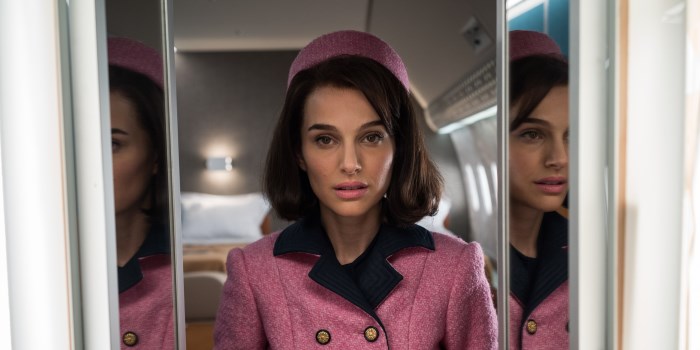
As the structure outlined above (courtesy of screenwriter Noah Oppenheim, though reportedly nudged in that direction by Larraín) has already revealed, Jackie is not your conventional biopic.
Stéphane Fontaine’s roaming cinematography evokes Grey Gardens (starring Jackie’s relatives, the Beales) more than, say, The Butler, with its invasive, documentarian’s gait.
Larraín, as he did on the masterful No, tinkers with grimy, almost-damaged video to recreate the infamous Zapruder footage of the era (as well as this 1962 tour of the White House we see Jackie conduct, interspersed with the original CBS clips).
Combined, the craftsmanship sidesteps ‘accuracy’ and instead strives for ‘immersion’. This is an American horror story; rather than it seeming like it occurs in our world, we are sucked into the screen, lost in the ‘60s alongside Jackie and her blood-stained dress.
Ultimately, though, it's about a person. Instead of conveying the global scale of the President’s death, Jackie focuses on the enormity of one woman’s grief. It’s an intimate movie, with a small cast (including Greta Gerwig as Jackie’s social secretary, and Peter Sarsgaard, as Bobby Kennedy). That puts additional pressure on Portman, who does not retreat from the role. Not ever.
Physically, the resemblance is close enough, yet still she deep-dives into the iconic, Mid-Atlantic accent. At first you even wonder if she’s torpedoing this Oscar bait-iest of parts with her gonzo take. Eventually, you accept that she—like Larraín—is working mightily to make us rethink Jackie Kennedy. The voice, the posture, the pillbox hat; they’re manicured and manufactured, like any Hollywood concoction. The woman, seen in her private moments, alternates between wraith-like and commanding; from menacing to shaken. The genius of Jackie is allowing Natalie Portman to go to the extremes of her character’s familiar persona, to remind that we’re all just putting on a show for cameras.
Like the movie around her, she’s mesmerising.
4.5/5
In cinemas January 12. CTC.
Photo: Fox Searchlight
Topics
Ref: 800582a6-269f-4e0b-94b8-a6d000283d3e




Comments & Feedback
Share your opinion
Emoji cheatsheet Formatting Comment guidelines