Movie Review: Inside Out
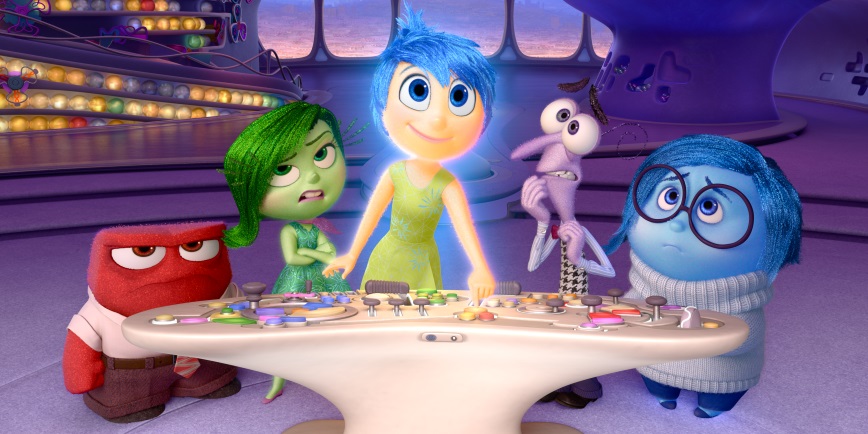
The tear-harvesters at Pixar team up with the effervescent Amy Poehler for Inside Out, their happy-sad heart-warmer and first great film in half a decade.
Don Draper describes nostalgia as "the pain from an old wound.”
There are no moviemakers better equipped at prying those old wounds open than the team at Pixar.
You likely shed a tear as elderly Carl Fredricksen recalled his married life at the start of Up, or when Andy handed over childhood pals Woody and Buzz at the end of Toy Story 3, or when food critic Anton Ego was propelled back through time after tasting Remy’s ratatouille, just like mama used to make.
Or, maybe your tear-duct rejuvenation surgery was botched and you're no longer able to moisten your eyes naturally. This is the only believable alternative.
Pixar’s latest, Inside Out, boasts a number of moments engineered to send pangs of bittersweetness through our vulnerable, too-human systems and remind us of the value in feeling blue.
This writer was certainly not impervious to its charms. It’s unwise to predict an audience’s response, so instead I’ll just offer fair warning: resistance is futile.
Don’t accuse director Pete Docter and his co-screenwriters Meg LeFauve and Josh Cooley of emotional blackmail though. By flavouring their simple, poetic story with a huge dollop of empathy, Inside Out communicates with startling clarity the complexity of being human. There are remarkable feats in cinema, and then there’s that. I personally walked out knowing myself more. Some therapists have achieved less.

Inside Out is the studio’s first release in two years and first on-form release since 2010’s Toy Story 3 (the harrowing climax of which inspired wails of sobbing in cinemas more usually suited to primal scream therapy). It’s also the rare production by the animation house to investigate the inner life of a female; quite literally, in this case.
Parks and Recreation heroine Amy Poehler voices Joy, the driving emotion within the mind of 11-year-old hockey player and goofball Riley (Kaitlyn Dias). Joy, an incandescent nymph with a Kris Jenner cut, works with Riley’s other emotions – Fear (Bill Hader), Disgust (Mindy Kaling) and Anger (Lewis Black) – to maintain a peaceful equilibrium in Riley’s brain.
Riley’s fifth major emotion, turtleneck-wearing teardrop Sadness (Phyllis Smith), is usually shunted aside and distracted with busy work. What good can Sadness bring to Riley’s charmed life otherwise? Bumming everyone out is kind-of her thing.
When Riley’s parents – voiced by Diane Lane and Kyle McLachlan – uproot Riley and move from Minnesota to San Francisco, the young prepubescent girl has to face the sacrifices and compromises of adulthood. Behind the scenes, Sadness is inexplicably compelled to turn Riley's favourite memories of left-behind friends and her innocent early days a melancholy blue. And Joy's not having it.
Following a brief skirmish, Joy and Sadness are accidentally ejected from Riley’s “control room” and dumped in the deep recesses of her long-term memory (depicted like a labyrinthine library), with no choice but to find a way back before an increasingly agitated and detached Riley forgets how to feel anything at all.
It’s in the outer limits that they run into abandoned invisible friend Bing Bong (cuddly mensch Richard Kind), wander through the studio where Riley’s dreams are produced like motion pictures, and take a shortcut through the “abstract thought” chamber, where the already-metaphorical characters are reduced to light and sound. The wonder this film’s imagination inspires…
Poehler is unsurprisingly enchanting as Joy. However, it's Phyllis Smith who helps craft the flick's most indelible creation in Sadness; her chalky monotone the perfect complement to that goth-kid fringe.
Adorable, endearing, inventive, sensitive and hugely funny, Inside Out is, above all, important. We usually reserve that word for movies about big ideas and pressing issues. Yet, I don’t know what could be more important for child viewers than to be told their sadness is valid, and isn’t to be hidden away like some defect; that all their joy, as it recedes with the past, will become a little bit sad, and that's fine too.
Inside Out should provide an important reminder for adults too. Catching feelings: it’s not just for kids.
5/5
In cinemas now. Rated PG for mild themes.
Topics
Ref: 938457dc-6cbf-4a2d-843f-a4c000626785




Comments & Feedback
Share your opinion
Emoji cheatsheet Formatting Comment guidelines