Movie Review: "In the Fade" Sends Diane Kruger On the Hunt for Nazis

Many movies are designed to make you feel empathy. In the Fade is a calculated hate machine.
Don’t be turned off: It is one hell of a hate machine.
Writer-director Fatih Akin stirs you to a boil with his German-language tale of a terroristic act that claims the life of a woman’s husband and son, and her struggle to identify and imprison the perpetrators.
The goal is seemingly to enrage viewers without radicalising them, criticising the cycle of violence that has sent Europe into a nationalistic tailspin. The film is playing with fire. Akin handles it with care, crafting his allegorical message into a compelling feature, anchored by a stellar leading performance.
Diane Kruger plays Katja Sekerci, the aforementioned wife and mother in mourning. When she learns of the fatal nail bomb attack against her Kurdish husband’s office in Hamburg, she immediately knows in her gut who’s responsible, telling the police, "Nazis". Her declaration is delivered so suddenly and strikingly you almost have to stifle a dark laugh, with memories of Inglourious Basterds springing to mind. Maybe it’s a laugh of relief. After all, if we’re being driven to the brink of seeking bloody vengeance on behalf of the heroine, it’s nice to have an uncomplicated, easy-to-despise antagonist like the Nazis to root against.
The picture is divided into three chapters, each interrupted by home videos of Katja and her late family. It’s wrenching stuff, intended to make you seethe, and encourage the darker impulses of the otherwise everyday woman at the film’s center. Akin’s script, in structure, is fairly conventional, progressing from crime flick, to courtroom drama, to revenge thriller. The nerve-jangling tone is what separates it. In the Fade riles us and Katja up, only narrowly avoiding irresponsibility by directing our loathing towards history’s easiest and most odious villains.
By the end, Akin is toying with our bloodlust, forcing us to wish one fate or another on the terrorists. Of course, the choice is out of our hands. After delivering a decisive and effective finale, Akin leaves us to resolve any lingering feelings somewhere outside the cinema. Hopefully you can personally pull back from the anger. Few ever do, which I suppose is the point being made.
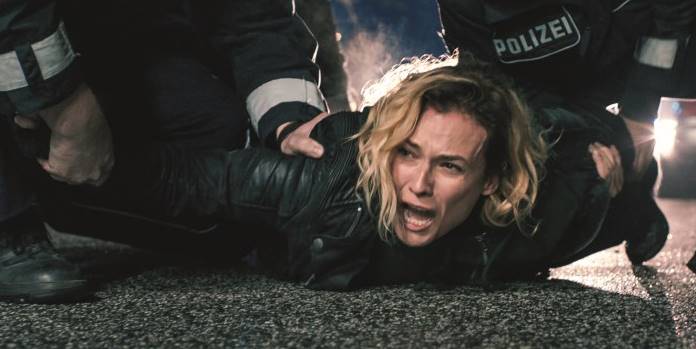
Despite being a hate machine, In the Fade isn’t inspired by the music of Trent Reznor's Nine Inch Nails, but Queens of the Stone Age, taking its title from their song of the same name. Its frontman, Josh Homme (whose other band, Eagles of Death Metal, was subjected to a real terrorist attack in France) provides a staccato, industrial, string-heavy score.
The rain-on-neon aesthetic of the poster (and the Gaspar Noé-evoking title) is a misdirect. In the Fade’s biggest chapter takes place in a sterile courtroom. That’s where a disoriented Katja faces her attackers, and the music drones to match her simmering frustration and confusion. Cinematographer Rainer Klausmann dolly-zooms in on Katja’s face and follows her from above as she wearily walks to the witness stand. It’s all nauseatingly symmetrical, even when the justice system itself feels askew.
The final third takes a more naturalistic approach, following Katja closely as she forges out on her own to seek real closure, and vindication. The camera follows her closely, rarely cutting, as she fumbles her amateur detective work or tries in vain to hide from those she's trailing. Kruger, as an actress, has no such luxury of hiding, and is laid bare throughout In the Fade, first in her early grieving scenes, and later in the stomach-knot-twisting conclusion. The Cannes jury awarded her Best Actress last year, and they’ll receive no complaints from me.
4/5
In Australian cinemas 8 March 2018. Rating CTC.
Photo: Madman
Topics
Ref: c6422cfc-837d-4865-aa0d-a89b00989dcd



Comments & Feedback
Share your opinion
Emoji cheatsheet Formatting Comment guidelines