Movie Review: Hidden Figures

Hidden Figures isn’t nearly as revolutionary or convention-busting as its subjects, but it illuminates an important story, and is given flight by three charismatic performers.
Movies based on real-events always want to tell us the tale we haven’t heard before.
Hidden Figures does one better, featuring characters who were seemingly scrubbed entirely from the historical record.
Of course, if we picked up a book—specifically, Margot Lee Shetterly’s Hidden Figures, though others about the space-race would suffice—we would learn of the significant contributions made by black women Katherine Johnson, Dorothy Vaughan and Mary Jackson to NASA in the ‘60s.
However, our memories often take their cues from the movies, and so when many recall America’s efforts to beat the Russians to the moon, only bespectacled white men in their pocket-protected short-sleeved shirts likely come to mind. For that, thank The Right Stuff, Apollo 13 and, sure, The Dish.
Ted Melfi’s Hidden Figures attempts a course correction, conveying the role played by Johnson, Vaughan, Jackson and many other under-represented women of colour at NASA. It’s not a fiery film—Melfi’s not a firebrand—but its conventionality and pleasing underdog story may be the more effective path to re-routing mainstream understanding of those responsible for this gargantuan achievement.
Taraji P. Henson—now there’s a firebrand—plays Katherine Johnson, a wunderkind mathematician working as a ‘computer’ under her Space Task Group director (Kevin Costner) in the early 1960s, while those new-fangled, just-delivered IBMs remain wrapped in plastic, still to be calibrated.
Until the machines are up and running, she’ll have to double check all the aeronautical calculations that will eventually help John Glenn (Glen Powell) become the first American to orbit the Earth—and keep him from incinerating on re-entry. Except, she won’t get her name on the daily reports. That honour will instead go to her white, male superior (Jim Parsons).
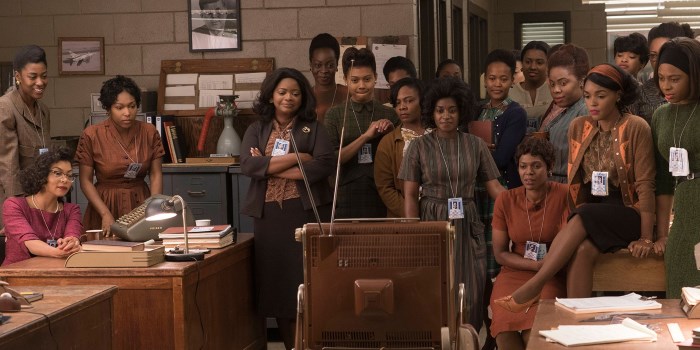
It’s a more muted turn from Henson than we’ve come to expect, especially following her instantly-iconic turn as Cookie on Empire. She does get one scorching speech about the lack of bathrooms available for black women at NASA’s HQ. It’s clichéd; she makes lemonade with it. (All Oscar-bait deserves a potential Oscar ceremony clip. You gotta build those in during the scripting!)
Janelle Monáe, instead, gets to be the spunky scene-stealer, as the feisty, stubborn Mary Jackson, another overlooked NASA employee eager to become an engineer. Octavia Spencer rounds out the star trio as the enterprising Dorothy Vaughan, NASA’s first black supervisor, and the woman with the foresight to educate herself and her staff on the technological devices that threaten to make them redundant. She’s reliably firm and, as always, armed with cocked-head and devastating side-eye.
(Mahershala Ali and Aldis Hodge also pop in to play love interests; there to provide support to Henson and Monáe, respectively, and do little else. You’re inclined to say they’re being wasted—notably Ali, following Moonlight—until you remember all the useless “supportive wife” roles bestowed upon more deserving actresses in cinema over the years, and suddenly you’re fine with it.)
As we see in the film, John Glenn phones the base before take-off to ensure Dorothy (“the girl”) checks the numbers before feeling comfortable enough to fly. You couldn’t have blamed screenwriters Melfi and Allison Schroeder for inventing such a satisfying climax, yet that particular moment was indeed torn from the truth.
Elsewhere, liberties have been taken, right down to the closeness of the three women. The characters played by Costner and Parsons are composites, too, though we can verify the existence of John Glenn. More significantly, the spirt of the film is as real as it gets; for too long, America tried to deny that its ‘exceptionalism’ extended to its black community. With all hands on deck, space travel was achieved. Hidden Figures adjusts the record, entertainingly enough.
3.5/5
In cinemas February 16, 2017. Rated PG for mild themes and coarse language.
Photo: Fox
Topics
Ref: 1f04f23d-5991-435b-b7e4-a708004ff5d8

Comments & Feedback
Share your opinion
Emoji cheatsheet Formatting Comment guidelines