Movie Review: Finding Dory
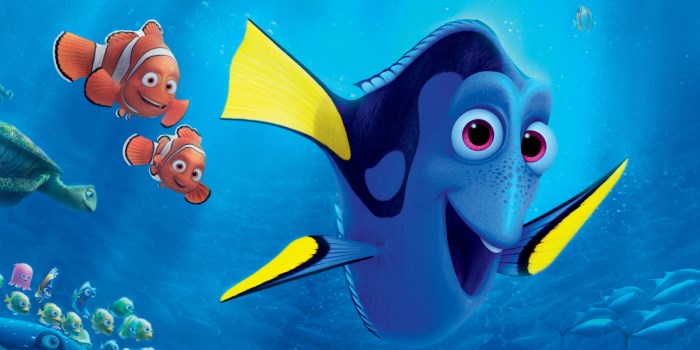
Pixar’s latest is yet another sequel that’s head and fin above most animated fare, but not accomplishing much more than the original already managed. (See also: Monsters University. Don’t see, ever: Cars 2.)
It’s cruel how Pixar so effortlessly extracts tears from audiences, doing so in record time with Andrew Stanton’s Finding Dory.
This writer’s eyes began to well up about 60 seconds into proceedings (and not simply because the familiar return to Finding Nemo’s underwater universe - complete with Thomas Newman’s pan-flutey score - only served as a reminder that the once indomitable studio’s best days are probably behind them).
At the opening, we see Ellen DeGeneres’ forgetful Pacific blue tang Dory as an adorable, giant-eyed baby fish, being fawned over by parents Charlie (Eugene Levy) and Jenny (Diane Keaton).
Fearful that their daughter might forget them (on account of her short-term memory loss), they hesitate to let her play with the other fish-kids. And yet, baby Dory still winds up separated from her parents. Cue a montage in which she roams the ocean asking for directions back home, even though she can’t remember where she came from, or to whom she belongs. If you’re not already crying, you may actually be dead.
Dory grows older, eventually bumps into Marlin (Albert Brooks), himself seeking lost son Nemo (Hayden Rolence, replacing Alexander Gould), and the rest is cinema history. Finding Dory picks up one year after the events of Finding Nemo, with the unconventional family summoned to action by the surprise spark of a parental memory in Dory. With only a vague clue to follow, the trio sets off to find her mum and dad, winding up at a Marine Life Institute in California. So, don’t expect any Aussie accents this time around.

Let’s get this requisite declaration out of the way: Finding Dory is a beautiful movie, in every way imaginable, and perhaps a few new ones too. Aesthetically, it’s more visually stunning than its predecessor, with the complex lighting and shadows of the sea proving Pixar’s bench of animators have an unequalled grasp on technological wizardry.
In spirit, it’s even lovelier, acting as a parable for a parent – and child’s – unconditional love, as well as a tribute to guardians of those with disability. (Charlie and Jenny don’t try to insulate Dory from the world, we learn, but work tirelessly, and happily, to make sense of it for her.) Dory also befriends some aquatic animals living with disability at the Institute, including the partially-sighted whale shark Destiny (Kaitlin Olson), the anxious beluga whale Bailey (Ty Burrell) and an octopus with PTSD named Hank (Ed O’Neill). Having these characters as part of our culture will mean so much to so many.
Narratively though, there’s some wheel-spinning going on. Finding Nemo already told this tale of unconditional love. That said, you’d have to be a serious Scrooge to lament a second film on the subject. All I’m saying is, do not turn to Finding Dory for the kind of innovative storytelling we saw in WALL-E, Ratatouille and last year’s impressionistic Inside Out. (These are the kinds of criticisms we have to fish out when reckoning with the usually-impeccable but no longer impervious Pixar: not innovative enough!)
Where narrative disappoints, the vocal talent satisfies. DeGeneres and Brooks, reprising beloved figures, do not get to repeat their iconic double act, given that they’re separated for much of the feature. (Send your letters of complaint to screenwriters Stanton and Victoria Strouse.) Nonetheless, they offer deeply affecting performances, as does MVP O’Neill, with Olson and Burrell on hand to provide goofy laughs.
Finding Dory is a delight, no question. Is it a necessary one? That’s the question we ask ourselves with each new Pixar movie. Should they spend their time on sequels that are easy wins (albeit with diminishing returns), or swing for the fences with ground-breaking originals? My heart would rather the latter. But in weeks where the world around us offers little in the way of joy or comfort, an easy win like Finding Dory will always be welcome. There’s no such thing as an unnecessary delight.
4/5
In cinemas June 16. Rated G. Some scenes may scare young children.
Topics
Ref: 8328acf8-4f84-4df5-9595-a625008f24ea

Most Popular



Comments & Feedback
Share your opinion
Emoji cheatsheet Formatting Comment guidelines
can't wait to see finding dory.